RamerDouglasPeuker not great for closed paths #376


-
|
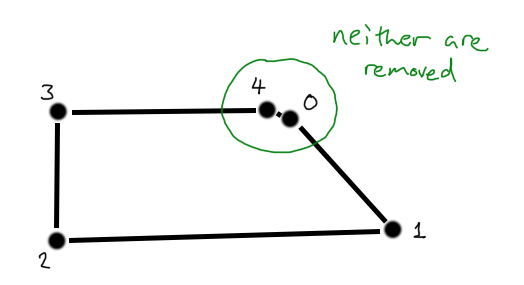
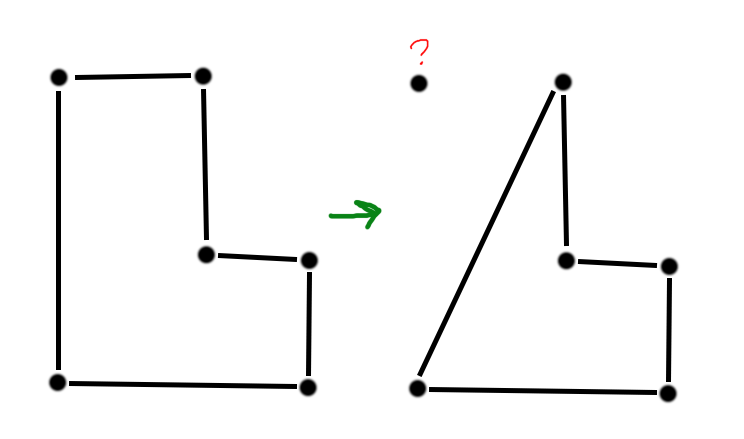
I'm trying out the function When the points that need to be removed lie at the beginning or end of the path, the algorithm fails to identify them. Example: I attempted to resolve this by explicitly looping the path, like so: template<typename T>
inline Paths<T> closedRamerDouglasPeucker(const Paths<T> &paths, double epsilon) {
Paths<T> result;
result.reserve(paths.size());
for (const Path<T>& path : paths) {
Path<T> looped_path = path; // copy
looped_path.push_back(path.front()); // make the path loop back
result.push_back(RamerDouglasPeucker<T>(looped_path, epsilon));
}
return result;
}Unfortunately, while this appears to successfully clean up some polygons, it destroys important vertices in others.
It looks like RDP is intended for open paths, but the documentation recommends running this after offset operations. |
Beta Was this translation helpful? Give feedback.
Replies: 2 comments
-
|
I've found a solution that works for me, but it's certainly not ideal in terms of memory allocation. template<typename T>
inline Paths<T> closedRamerDouglasPeucker(const Paths<T> &paths, double epsilon) {
Paths<T> result;
result.reserve(paths.size());
for (const Path<T>& path : paths) {
if (path.size() <= 4) {
result.push_back(path);
continue;
}
// Perform the algorithm on the path twice, once rotated by half
Path<T> new_path = RamerDouglasPeucker<T>(path, epsilon);
if (new_path.size() <= 4) {
result.push_back(new_path);
continue;
}
Path<T> rotated;
rotated.reserve(new_path.size());
auto middle = new_path.begin() + new_path.size() / 2;
std::copy(middle, new_path.end(), std::back_inserter(rotated));
std::copy(new_path.begin(), middle, std::back_inserter(rotated));
new_path = RamerDouglasPeucker<T>(rotated, epsilon);
result.push_back(new_path);
}
return result;
} |
Beta Was this translation helpful? Give feedback.
-
|
Resolved by 1aae9b4 |
Beta Was this translation helpful? Give feedback.

Resolved by 1aae9b4