Given a binary tree root. Split the binary tree into two subtrees by removing 1 edge such that the product of the sums of the subtrees are maximized.
Since the answer may be too large, return it modulo 10^9 + 7.
Example 1:
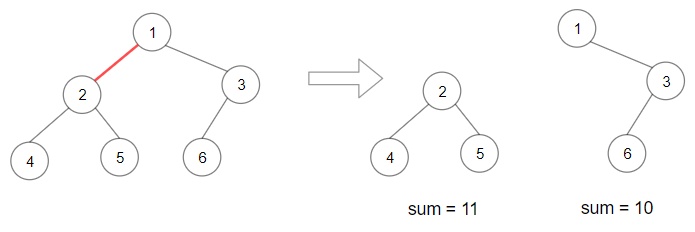
Input: root = [1,2,3,4,5,6]
Output: 110
Explanation: Remove the red edge and get 2 binary trees with sum 11 and 10. Their product is 110 (11*10)
Example 2:
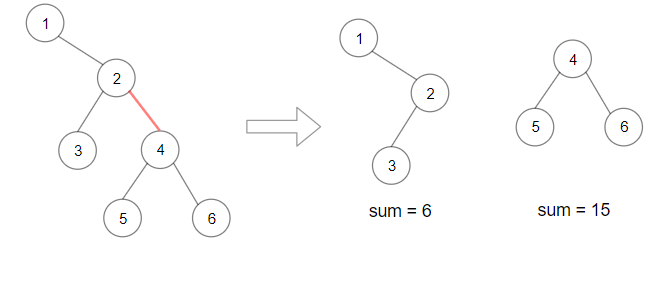
Input: root = [1,null,2,3,4,null,null,5,6]
Output: 90
Explanation:  Remove the red edge and get 2 binary trees with sum 15 and 6.Their product is 90 (15*6)
Example 3:
Input: root = [2,3,9,10,7,8,6,5,4,11,1]
Output: 1025
Example 4:
Input: root = [1,1]
Output: 1
Constraints:
- Each tree has at most
50000nodes and at least2nodes. - Each node's value is between
[1, 10000].
Related Topics:
Dynamic Programming, Tree
// OJ: https://leetcode.com/problems/maximum-product-of-splitted-binary-tree/
// Author: github.com/lzl124631x
// Time: O(N)
// Space: O(H)
class Solution {
    long long s = 0, mod = 1e9 + 7, ans = 0;
    int postorder(TreeNode *root) {
        if (!root) return 0;
        int sum = root->val + postorder(root->left) + postorder(root->right);
        if (s) ans = max(ans, sum * (s - sum));
        return sum;
    }
public:
    int maxProduct(TreeNode* root) {
        s = postorder(root);
        postorder(root);
        return ans % mod;
    }
};