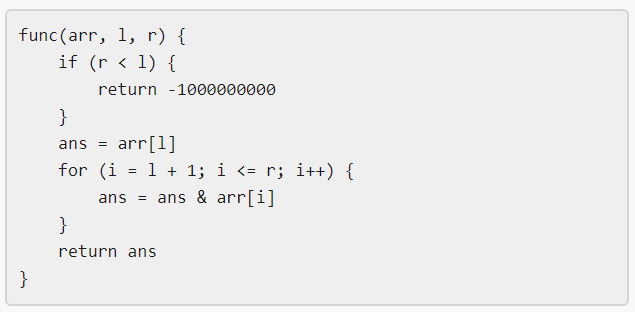
Winston was given the above mysterious function func. He has an integer array arr and an integer target and he wants to find the values l and r that make the value |func(arr, l, r) - target| minimum possible.
Return the minimum possible value of |func(arr, l, r) - target|.
Notice that func should be called with the values l and r where 0 <= l, r < arr.length.
Example 1:
Input: arr = [9,12,3,7,15], target = 5
Output: 2
Explanation: Calling func with all the pairs of [l,r] = [[0,0],[1,1],[2,2],[3,3],[4,4],[0,1],[1,2],[2,3],[3,4],[0,2],[1,3],[2,4],[0,3],[1,4],[0,4]], Winston got the following results [9,12,3,7,15,8,0,3,7,0,0,3,0,0,0]. The value closest to 5 is 7 and 3, thus the minimum difference is 2.
Example 2:
Input: arr = [1000000,1000000,1000000], target = 1
Output: 999999
Explanation: Winston called the func with all possible values of [l,r] and he always got 1000000, thus the min difference is 999999.
Example 3:
Input: arr = [1,2,4,8,16], target = 0
Output: 0
Constraints:
1 <= arr.length <= 10^51 <= arr[i] <= 10^60 <= target <= 10^7
Related Topics:
Binary Search, Bit Manipulation, Segment Tree
The func funciton is calculating the result of applying bitwise and operation on all the elements between arr[l] and arr[r] inclusive.
Note that when we apply bitwise and operation from left to right, the result value is monotonically decreasing since whenever a bit 0 is met, that bit will no longer be set back to 1.
So we can have two insights:
- Once the result is
0, we don't need to continue calculating more elements. - We only need to keep calculating if the
andresult is greater than or equal totargetbecause:- If the result is greater than or equal to
target, we can keep calculating the result since decreased result will get closer totarget. - If the result is less than
target, we don't need to continue calculating because the difference between it and thetargetwill only increase.
- If the result is greater than or equal to
// OJ: https://leetcode.com/problems/find-a-value-of-a-mysterious-function-closest-to-target/
// Author: github.com/lzl124631x
// Time: O(N^2)
// Space: O(1)
class Solution {
public:
    int closestToTarget(vector<int>& A, int target) {
        int N = A.size(), ans = INT_MAX;
        for (int i = 0; i < N; ++i) {
            if (i > 0 && A[i] == A[i - 1]) continue;
            int func = A[i];
            ans = min(ans, abs(func - target));
            for (int j = i + 1; j < N && func && func >= target; ++j) {
                func &= A[j];
                ans = min(ans, abs(func - target));
            }
            if (ans == 0) return 0;
        }
        return ans;
    }
};
Or
// OJ: https://leetcode.com/problems/find-a-value-of-a-mysterious-function-closest-to-target/
// Author: github.com/lzl124631x
// Time: O(N^2)
// Space: O(1)
class Solution {
public:
    int closestToTarget(vector<int>& A, int target) {
        int N = A.size(), ans = INT_MAX;
        for (int i = 0; i < N; ++i) {
            if (i > 0 && A[i] == A[i - 1]) continue;
            int func = A[i];
            for (int j = i; j < N; ++j) {
                func &= A[j];
                ans = min(ans, abs(func - target));
                if (func <= target) break;
            }
            if (func >= target) break; // if the result is greater than or equal to `target`, the best result we can get in the next loop must be greater than the current result, so the difference can only increase, we can break here.
        }
        return ans;
    }
};Note that using set is more performant than unordered_set here. It's because unordered_set initialization has greater overhead.
// OJ: https://leetcode.com/problems/find-a-value-of-a-mysterious-function-closest-to-target/
// Author: github.com/lzl124631x
// Time: O(N(logM)^2) where M is the maximum element in A
// Space: O(logM)
// Ref: https://leetcode.com/problems/find-a-value-of-a-mysterious-function-closest-to-target/discuss/743381/Python-6-lines-O(nlogm)-solution
class Solution {
public:
    int closestToTarget(vector<int>& A, int target) {
        set<int> s;
        int ans = INT_MAX;
        for (int n : A) {
            set<int> next{n};
            for (int m : s) {
                if ((m & n) < target) continue;
                next.insert(m & n);
            }
            for (int val : next) ans = min(ans, abs(val - target));
            if (ans == 0) return 0;
            swap(s, next);
        }
        return ans;
    }
};
Since there are only log(M) elements in the set, we can even use vector<int> to store the values.
// OJ: https://leetcode.com/problems/find-a-value-of-a-mysterious-function-closest-to-target/
// Author: github.com/lzl124631x
// Time: O(N * logM * loglogM)
// Space: O(logM)
class Solution {
public:
    int closestToTarget(vector<int>& A, int target) {
        vector<int> s;
        int ans = INT_MAX;
        for (int n : A) {
            vector<int> next{ n };
            for (int m : s) {
                if ((m & n) < target) continue;
                next.push_back(m & n);
            }
            sort(begin(next), end(next));
            next.resize(unique(begin(next), end(next)) - begin(next));
            swap(s, next);
            ans = min(ans, abs(s.front() - target));
        }
        return ans;
    }
};