In a directed graph, we start at some node and every turn, walk along a directed edge of the graph. If we reach a node that is terminal (that is, it has no outgoing directed edges), we stop.
Now, say our starting node is eventually safe if and only if we must eventually walk to a terminal node. More specifically, there exists a natural number K so that for any choice of where to walk, we must have stopped at a terminal node in less than K steps.
Which nodes are eventually safe? Return them as an array in sorted order.
The directed graph has N nodes with labels 0, 1, ..., N-1, where N is the length of graph. The graph is given in the following form: graph[i] is a list of labels j such that (i, j) is a directed edge of the graph.
Example:
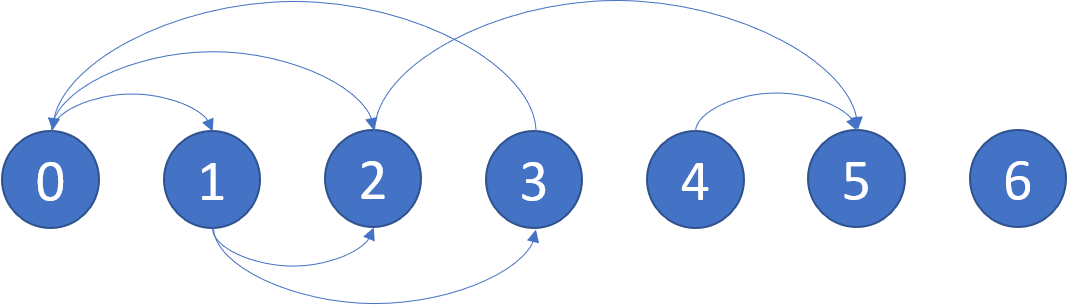
Input: graph = [[1,2],[2,3],[5],[0],[5],[],[]]
Output: [2,4,5,6]
Here is a diagram of the above graph.
Note:
graphwill have length at most10000.- The number of edges in the graph will not exceed
32000. - Each
graph[i]will be a sorted list of different integers, chosen within the range[0, graph.length - 1].
Related Topics:
Depth-first Search, Graph
Similar to the DFS version of Topological Sort.
// OJ: https://leetcode.com/problems/find-eventual-safe-states/
// Author: github.com/lzl124631x
// Time: O(N)
// Space: O(N)
class Solution {
    vector<int> state; // -1 unvisited, 0 visiting, 1 safe, 2 unsafe
    int dfs(vector<vector<int>> &G, int u) {
        if (state[u] == 0) return state[u] = 2; // circle detected, unsafe
        if (state[u] == 1 || state[u] == 2) return state[u];
        state[u] = 0;
        for (int v : G[u]) {
            if (dfs(G, v) == 2) return state[u] = 2; // upstream of unsafe node is unsafe
        }
        return state[u] = 1;
    }
public:
    vector<int> eventualSafeNodes(vector<vector<int>>& G) {
        state.assign(G.size(), -1);
        vector<int> ans;
        for (int i = 0; i < G.size(); ++i) {
            dfs(G, i);
            if (state[i] == 1) ans.push_back(i);
        }
        return ans;
    }
};// OJ: https://leetcode.com/problems/find-eventual-safe-states/
// Author: github.com/lzl124631x
// Time: O(V + E)
// Space: O(V + E)
class Solution {
public:
vector<int> eventualSafeNodes(vector<vector<int>>& G) {
int N = G.size();
vector<vector<int>> R(N); // reversed graph
vector<int> indegree(N), safe(N), ans;
for (int i = 0; i < N; ++i) {
for (int j : G[i]) {
R[j].push_back(i);
indegree[i]++;
}
}
queue<int> q;
for (int i = 0; i < N; ++i) {
if (indegree[i] == 0) q.push(i);
}
while (q.size()) {
int u = q.front();
q.pop();
safe[u] = 1;
for (int v : R[u]) {
if (--indegree[v] == 0) q.push(v);
}
}
for (int i = 0; i < N; ++i) {
if (safe[i]) ans.push_back(i);
}
return ans;
}
};