Design
Bitquery widgets are a set of user interface components for building rich analytical interfaces. They are specialized to used with the blockchain data, and intended to use with the GraphQL interface to bitquery.io analytical backend.
The whole system is combined from independent components:
- backend data storage. It stores the data, extracted from blockchains in tables;
- GraphQL interface for queries. This allows to specify which data is required, and it will decide how to query backend tables to deliver the data required;
- Bitquery widgets, displaying data from GraphQL queries to the web interface
- A web page or application, embedding widgets to build ultimate user interface for users
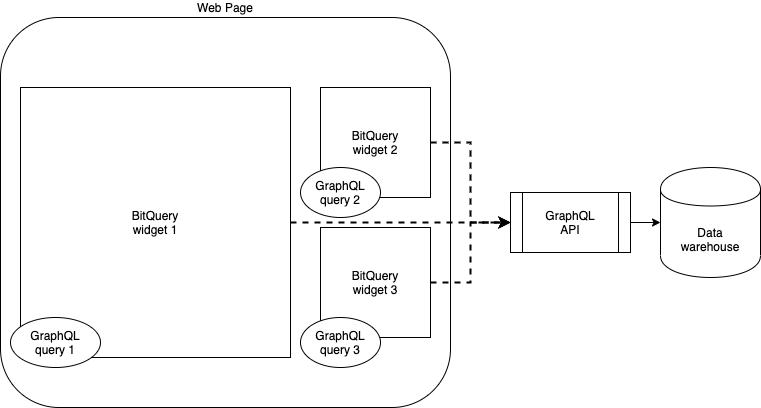
The whole request/response process works as:
-
User navigate to a web page. It can be as example, the page for some blockchain address, e.g. https://explorer.bitquery.io/binance/address/bnb1qu59r9degdxqtzvhsqupcrnnwtr6qdv3n3usgg;
-
The page loads the widgets placed on it and invokes them using Javascript, supplying GraphQL query with parameters. In our example the parameters may be the address ( bnb1qu59r9degdxqtzvhsqupcrnnwtr6qdv3n3usgg ) and optionally the data range. Set of allowed parameters is specific for a GraphQL query used;
-
Widget composes the request to GraphQL API using parameters. It fetches the data from data warehouse and responds with the data in JSON format. What is good about the GraphQL is that the response data is ensured to exactly match the schema, specified in the request;
-
Widgets displays data using javascript, canvas and other capabilities depending on the type of the widgets.