
Replies: 1 comment

-
|
Q: how many lives would have been saved by purifying the water supply.
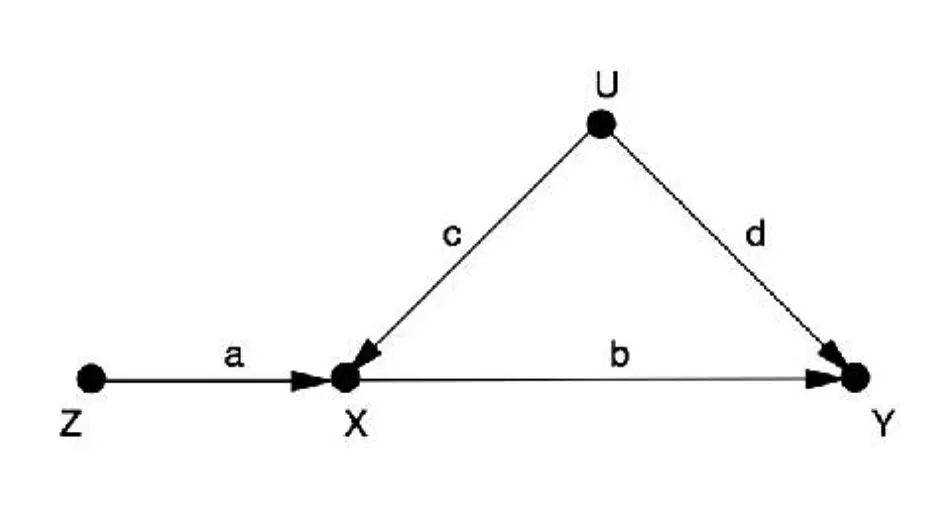
FIGURE 7.9. General setup for instrumental variables.
If we divide the first equation by the second, we get the causal effect of X on Y:
|
Beta Was this translation helpful? Give feedback.
0 replies
Sign up for free
to join this conversation on GitHub.
Already have an account?
Sign in to comment

Uh oh!
There was an error while loading. Please reload this page.
-
“THE CURIOUS CASE(S) OF DR. SNOW
In 1853 and 1854, England was in the grips of a cholera epidemic. ”
The theory of Miasma 瘴气理论
“The prevailing wisdom held that a “miasma” of unhealthy air caused cholera, a theory seemingly supported by the fact that the epidemic hit harder in the poorer sections of London, where sanitation was worse.”
“Dr. John Snow, a physician who had taken care of cholera victims for more than twenty years, was always skeptical of the miasma theory. ”
“The John Snow story has two chapters, one much more famous than the other.
Hollywood version
In what we could call the “Hollywood” version, he painstakingly goes from house to house, recording where victims of cholera died, and notices a cluster of dozens of victims near a pump in Broad Street. Talking with people who live in the area, he discovers that almost all the victims had drawn their water from that particular pump. He even learns of a fatal case that occurred far away, in Hampstead, to a woman who liked the taste of the water from the Broad Street pump. She and her niece drank the water from Broad Street and died, while no one else in her area even got sick. Putting all this evidence together, Snow asks the local authorities to remove the pump handle, and on September 8 they agree. As Snow’s biographer wrote, “The pump-handle was removed, and the plague was stayed.”
“All of this makes a wonderful story. Nowadays a John Snow Society even reenacts the removal of the famous pump handle every year. Yet, in truth, the removal of the pump handle hardly made a dent in the citywide cholera epidemic, which went on to claim nearly 3,000 lives.”
The non-Hollywood chapter of the story,
we again see Dr. Snow walking the streets of London, but this time his real object is to find out where Londoners get their water.
There were two main water companies at the time: the Southwark and Vauxhall Company and the Lambeth Company. The key difference between the two, as Snow knew, was that the former drew its water from the area of the London Bridge, which was downstream from London’s sewers. The latter had moved its water intake several years earlier so that it would be upstream of the sewers. Thus, Southwark customers were getting water tainted by the excrement of cholera victims. Lambeth customers, on the other hand, were getting uncontaminated water. (None of this has anything to do with the contaminated Broad Street water, which came from a well.)
“The death statistics bore out Snow’s grim hypothesis. Districts supplied by the Southwark and Vauxhall Company were especially hard-hit by cholera and had a death rate eight times higher. Even so, the evidence was merely circumstantial. A proponent of the miasma theory could argue that the miasma was strongest in those districts, and there would be no way to disprove it. In terms of a causal diagram, we have the situation diagrammed in Figure 7.7. We have no way to observe the confounder Miasma (or other confounders like Poverty), so we can’t control for it using back-door adjustment.”
“Here Snow had his most brilliant idea. He noticed that in those districts served by both companies, the death rate was still much higher in the households that received Southwark water. Yet these households did not differ in terms of miasma or poverty.”
“Each company supplies both rich and poor, both large houses and small; there is no difference either in the condition or occupation of the persons receiving the water of the different Companies.” Even though the notion of an RCT was still in the future, it was very much as if the water companies had conducted a randomized experiment on Londoners. ”
“Snow’s painstaking detective work had showed important things:
FIGURE 7.8. Diagram for cholera after the introduction of an instrumental variable.
“A variable that satisfies these three properties is today called an instrumental variable.
Clearly Snow thought of this variable as similar to a coin flip, which simulates a variable with no incoming arrows.
Because there are no confounders of the relation between Water Company and Cholera, any observed association must be causal.
Likewise, since the effect of Water Company on Cholera must go through Water Purity, we conclude (as did Snow) that the observed association between Water Purity and Cholera must also be causal. Snow stated his conclusion in no uncertain terms: if the Southwark and Vauxhall Company had moved its intake point upstream, more than 1,000 lives would have been saved.”
摘录来自: Judea Pearl. The Book of Why
Beta Was this translation helpful? Give feedback.
All reactions