There is no getting around the fact that an integral aspect of our everyday lives is the presence of networked solutions. The Internet, as well as local networks and VPNs, are in widespread use in almost every field, including educational institutions. Many schools and universities use their centralized networks to perform a number of security and management functions. These range from the storage of confidential student information, including submitting assignments and taking examinations, to automated control of environmental and security systems. An entire school system can benefit from the implementation of effective LAN and WAN solutions. Connecting thousands of computers and devices spread throughout remote classrooms, offices, lecture halls, etc. into a single network opens up many opportunities to increase the institution’s efficiency.
Modern universities are extensive educational systems that have their own infrastructure and interactive environment. Their educational resources include electronic libraries, internal archives, laboratories and research facilities, as well as administrative information systems. The IT specialists at the university attempt to connect all of the diverse components, including lab equipment, database servers, workstations, etc., forming a network to reliably transmit their data. The goal is to create a network where any user, group of users, or remote computer can share and access any network connected USB or serial port device. The development of a robust network can be a formidable task. Providing USB and serial network connections calls for the virtualization of hardware ports as well as sharing them over the Internet or LAN. Software that provides dedicated port redirection technology can be essential in implementing a successful network.
###The way to develop Wireless Campus LAN
Eltima Port Virtualization Technology (EPVT) is an advanced software application that can easily be incorporated into any university network. Using EPVT will enable you to connect all of your COM and USB-based devices to a single Ethernet network. Once connected to the network, you will be able to interact with these devices no matter where they are physically located. Virtualization allows you to create and access an unlimited number of virtual ports.
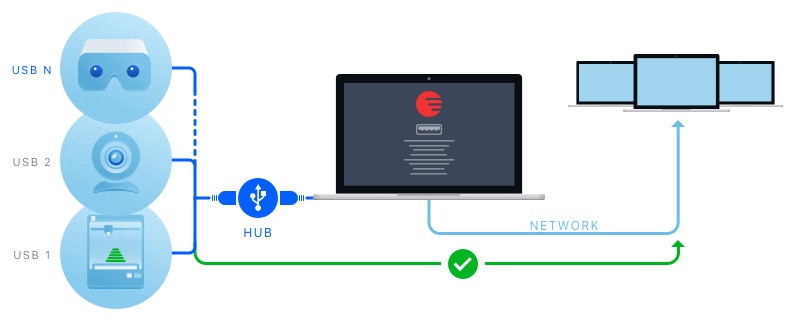
Eltima Port Virtualization Technology converts the USB and serial signals, turning them into network data packets. These packets are then forwarded to client machines over the network. The client machines use virtual interfaces that were created with EPVT to connect to the remote equipment.
Now, thanks to EPVT, working with remote equipment across any educational institution can be a more streamlined process. The integration of EPVT into your educational network gives you these benefits:
- The ability to remotely interact and manage devices over totally secure channels. EPVT can be integrated into the university’s computer network’s operating system or its network server.
- Overall improvements in the efficiency of work and the complete education process. For example, working with the university database or sharing laboratory research results becomes a simple matter.
- The education network gives its users the opportunity to connect to and use an unlimited number of remote devices.