Object-oriented programming is a philosophy with a focus on classes and their instantiated objects. To make class data structures more efficient, developers can define relationships between classes. This allows for commonly used behavior to be shared between classes.
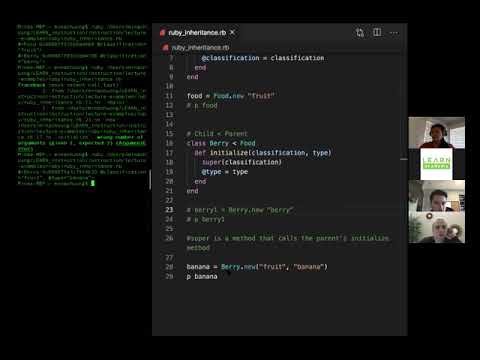
- can define the syntax to create an inheritance relationships between two classes
- can explain the purpose of the super method
- can describe how to access parent class methods from within a child class instance
- can articulate that instance variables are not inherited from parent classes
- four pillars of object-oriented programming
- superclass
- subclass
- inheritance
- super
cdinto theruby-challengesrepository- Create a new branch:
inheritance-initials1-initials2(ex. inheritance-aw-sp) toucha file with no spaces and.rbextension:inheritance-student1-student2.rb(ex. inheritance-austin-sarah.rb)- Open the folder in a text editor
- Code!
The philosophy of object-oriented programming (OOP) is a human-constructed model that allows us to organize large code structures. OOP puts the primary focus on data and data structures. The tenets of the OOP philosophy are more thoroughly explained by the four pillars of object-oriented programming: Abstraction, Encapsulation, Polymorphism, and Inheritance.
Briefly, abstraction is keeping complex logic wrapped up inside the class and only exposing what is necessary to use the logic. An analogy of abstraction is that most of us wouldn't be able to build a television from scratch yet we can still use it to watch a show. We don't need to understand all the mechanical complexities since we are given access to what is needed to operate the TV.
Encapsulation is ensuring that all the content needed to perform logic is inside the scope of that data structure. In the television analogy, the inner workings of the TV stay contained. The only inputs have been predefined for the user by the buttons on the television and remote control.
Polymorphism is the ability for data to take many shapes. Many object can be instantiated from the same class. Each object will have the instance variables defined in the class yet each object can have different values. Many televisions can be made using the same inner mechanisms yet have different sizes, brands, or colors.
The last pillar of OOP is inheritance. Inheritance allows classes to have relationships with each other. With inheritance, classes can share behaviors making code more efficient.
There are often situations where multiple classes have a need for very similar attributes. In this situation we can extract those common attributes so they can be shared among other classes. Putting common behaviors into a shared class is creating a superclass.
A superclass can then pass information down to a subclass that will be able to access the data from the superclass. A superclass can have many subclasses. This relationship of passing data is called inheritance. Inheritance is defined with the syntax <.
We can create a superclass called Dog that will hold information shared between many kinds of dogs. The Dog class will have a name value defined on initialization.
class Dog
  def initialize(name)
    @name = name
  end
endNow we will create a subclass called Pointer that will have an relationship with the superclass Dog. Pointer will inherit from Dog. This allows the Pointer class to have more specific information while still having access to the content from Dog.
The Pointer class will have its own data created on initialization. It will also note which data it will collect from the Dog class. The data we want from the Dog class will be passed into the initialize method as well as a method called super. The super method calls the initialize method in the superclass.
class Pointer < Dog
  def initialize(name, breed)
    super(name)
    @breed = breed
  end

  def get_info
    "#{@name} is a #{@breed}."
  end
end

my_dog = Pointer.new('Jax', 'German Shorthaired Pointer')
p my_dog.get_info
# output: 'Jax is a German Shorthaired Pointer.'The initialize method invokes super with an argument called name. As soon as the super method is invoked, Ruby sends a message to the Dog class looking for a method called initialize. Now, Pointer is essentially borrowing Dog's initialize method to assign an instance variable of @name to Pointer. The argument/s you pass to the new instance of your subclass will be the exact same arguments passed to super.
Because of the way this code behaves, you may be tempted to say that the instance variables are also inherited. But that is not how Ruby works. In the above code, Pointer defines an initialize method that chains to the initialize method of its superclass. The chained method assigns values to the variable @name which makes those variables come into existence for a particular instance of Pointer.
The super method is used in the subclass. After invoking super the subclass will have access to the instance variables within that method. Instance variables are not inherited since instance variables are local to a specific instance of a class. Via super, you are allowed to borrow instance variables from the parent.
The superclass Dog can pass information to as many subclasses as needed. Each subclass can create unique instance variables. We can use the attr_accessor helper method to create getter and setter methods for the instance variables that the class Dachshund has access to.
class Dachshund < Dog
  attr_accessor :tricks, :name
  def initialize(name, tricks)
    super(name)
    @tricks = tricks
  end
end

baby = Dachshund.new('Baby', 'playing fetch')
p baby.tricks
# output: 'playing fetch'

baby.name = 'Baby Dog'
p baby.name
# output: 'Baby Dog'Read all stories before starting the challenge.
- As a developer, I can make a generic Animal class.
- As a developer, upon initialization, I can give my Animal a status of
alive, which will be set to true. - As a developer, I can give my Animal an
ageof 0 upon initialization. - As a developer, I can age my Animal up one year at a time.
- As a developer, I can return my Animal's
age, as well as if they'realive.- Hint: Use
attr_accessoras well as aninitializemethod.
- Hint: Use
- As a developer, I can create a Fish that inherits from Animal.
- As a developer, I can initialize all of my fish to be
cold_blooded. (Yes, there is one fish who is technically fully warm-blooded but we aren't going to talk about that.) - As a developer, I can create a Salmon that inherits from Fish.
- As a developer, I can initialize my Salmon to be a specific species (Atlantic, Sockeye, etc).
- As a developer, I can see that my Salmon is cold-blooded.
- As a developer, I can age my Salmon up.
- As a developer, I can see a message that tells me all of my Salmon's information.
- As a developer, if my Salmon reaches the ripe old age of 4, I can make it die peacefully after a full and happy life.
- Hint: You will need a method that changes the status of
alivein the initialize method of Animal.
- Hint: You will need a method that changes the status of
- As a developer, I can create a Mammal that inherits from Animal.
- As a developer, I can initialize all of my Mammals to be
warm_blooded. - As a developer, I can create a Bear that inherits from Mammal.
- As a developer, I can age my Bear up.
- As a developer, I can see a message that tells me all of my Bear's information.
- As a developer, if my Bear turns 20 years old, I can make it die peacefully after a full and happy life.
- Hint: You will need a method that changes the status of
alivein the initialize method of Animal.
- Hint: You will need a method that changes the status of
- As a developer, I can create a Mammal of my choice.
- As a developer, I can interact with the new Mammal via various methods.
- As a developer, I can see a message that tells me all of my new Mammal's information.
- As a developer, I can keep a collection of two of each Animal.
- Hint: You'll want to add your Animals into an array.
- As a developer, I can sort my collection of Animals based on age.
- Hint: Find out how the spaceship operator can help you with an array.
- As a developer, I can utilize a Ruby
moduleto help DRY up my code. I can create aswimmethod inside of mymodulethat will apply to Animals who can swim. This method should return "I can swim!"- Hint: Look into module
mix ins. Since not all animals can swim, only certain Animals will have access to this module.
- Hint: Look into module