Design: Flow testing
This is a work in progress.
Node-RED project already provides the tools for testing:
- Runtime
- Node
- Editor (under development)
This design note focuses on realizing flow testing.
Basic requirements of this tool are as follows.
- Node-RED user can test flows without programming.
- Node-RED uesr can see the test results on the editor.
- The original flow should be tested. If the testing target is a copied flow, sync problem will happen.
- Node-RED user does regression testing for the existing flows when updating Node-RED or services that connect with Node-RED.
- Node-RED automatically runs a test on Travis CI when pull request was posted.
There are two new nodes called test-in node and test-out node. Test-in node sends a mock message on behalf of the actual input node such as http-in node, and test-out node receives a message on behalf of the actual output node such as http-response node. One test case consists of exactly one test-in node and one test-out node.
The requirements of test node are as follows.
- Do nothing when it is NOT in a testing mode.
- Appear only in a testing mode.
- Substitute input node and output node in a testing mode. (named as
shadowing)
Test-in node specifies one or more test patterns so that one test-in node can run multiple test cases.
Test-out node verifies whether the received message is exactly the expected value or not.
User can do the following actions on test sidebar.
- Choose test cases to run.
- Click
Runbutton to start testing. - See the result of each test case.
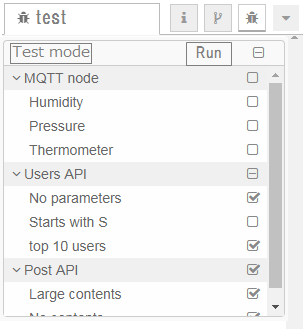
Need to consider how to store the information of test nodes. There are two options. #1 is to store into flow.json. #2 is to create a new file test.json.
- flow.json
- Easy to share flow data including test data.
- Data will get larger even if a user does not need to run a test.
- test.json
- Can divide production code and test code.
- Affect to storage API to load a new file.