 Quarto

Replies: 3 comments 3 replies

-
|
The issue here is that the standard LaTeX font does not have support for text-mode unicode characters like that. You'll need to select fonts that do have that support. This is unfortunately not something that we can solve in general in Quarto itself because different fonts have access to different subsets of the Unicode code points. It is unfortunate that greek characters are commonplace in Julia code, and that they're not available in (eg) Computer Modern and Computer Modern Sans Serif. We should document that better, but this is not a quarto bug. |
Beta Was this translation helpful? Give feedback.

-
|
Thank you. Yes, given that the .tex file seemed okay, I thought it would be an issue with processing of the .tex. I'll see what I can do with changing font. (Not a big fan of computer modern in any case...!) |
Beta Was this translation helpful? Give feedback.

-
|
Ideally, xelatex would warn that some glyphs are not available, but evidently it does not. In the meantime, I think the syntax is: You will, of course, need to have those fonts installed in your system. |
Beta Was this translation helpful? Give feedback.
-
|
making some progress. in the .tex file shows the alpha and beta, and now warns about a missing character (for 'in'): thanks for your help, I'll keep digging. |
Beta Was this translation helpful? Give feedback.

-
|
ok, made some progress.
Input fileOutput
thanks for your help, I think this is good enough for me to move forward. |
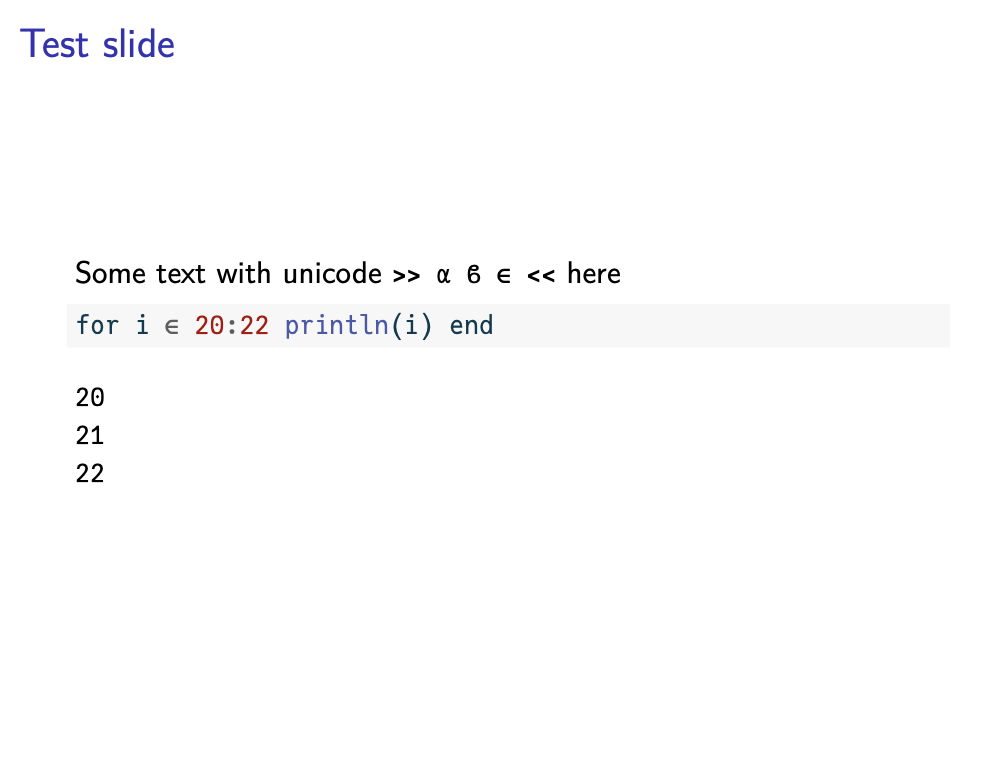
Beta Was this translation helpful? Give feedback.
-
|
p.s. https://github.com/cormullion/juliamono is the github repo and tagging @cormullion just for info. |
Beta Was this translation helpful? Give feedback.


Uh oh!
There was an error while loading. Please reload this page.
Uh oh!
There was an error while loading. Please reload this page.
-
Hi,
I've got a small test document that I'm converting to pdf using
quarto render temp.qmd
where the unicode characters for alpha and beta are found in the test.tex file, but not rendered in the pdf.
it seems to be using xelatex for the compilation -- what am I missing to get the unicode in the pdf?
thanks, Stephen
p.s. given how Julia uses unicode, I'd like to get this working on Julia code snippets, but have reduced it to this simpler example first. It didn't work when I was using the unicode operator \in ∈
Test file
page 2 of temp.pdf
Beta Was this translation helpful? Give feedback.
All reactions