Documentation: "Adding Decoherence Noise" Example Needs Changes to Work #1402

Description

Pre-Report Checklist
- I am running the latest versions of pyQuil and the Forest SDK
- I checked to make sure that this bug has not already been reported
Issue Description
The example at:
requires two changes to work correctly.
How to Reproduce
The code snippet below contains the changes needed to make the example work.
The changes are:
 ####CORRECTION1 - Replace following commented line with the following line
        #noisy = add_decoherence_noise(prog, T1=t1).inst([
        noisy = add_decoherence_noise(prog, T1=t1, T2=2*t1).inst([
            Declare("ro", "BIT", 2),
            MEASURE(0, ("ro", 0)),
            MEASURE(1, ("ro", 1)),
        ])
and
  ####CORRECTION2 - Add "noisy.wrap_in_numshots_loop(1000)"
        noisy.wrap_in_numshots_loop(1000)
If CORRECTION1 is not made errors will result.
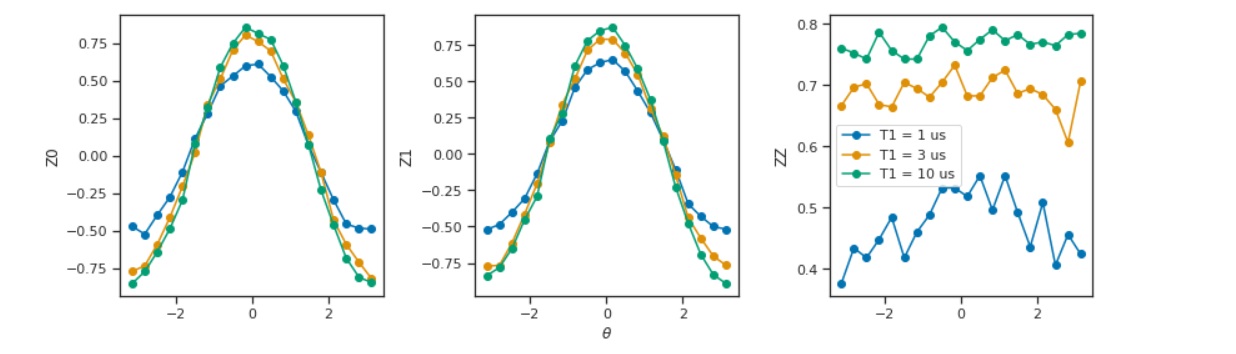
If CORRECTION2 is not made the output will be incorrect.
Code Snippet
# general imports
import matplotlib.pyplot as plt
%matplotlib inline
import string
import time
import numpy as np
import random as rd

import json
import os
from numpy import pi

from pyquil import Program, get_qc
from pyquil.api import QVM
from pyquil.gates import RX, MEASURE, H, S, CNOT, S, RZ, RY, CZ, Declare
from pyquil.quil import Pragma
from pyquil.noise import add_decoherence_noise

def get_compiled_prog(theta):
    return Program([
        RZ(-pi/2, 0),
        RX(-pi/2, 0),
        RZ(-pi/2, 1),
        RX( pi/2, 1),
        CZ(1, 0),
        RZ(-pi/2, 1),
        RX(-pi/2, 1),
        RZ(theta, 1),
        RX( pi/2, 1),
        CZ(1, 0),
        RX( pi/2, 0),
        RZ( pi/2, 0),
        RZ(-pi/2, 1),
        RX( pi/2, 1),
        RZ(-pi/2, 1),
    ])

import numpy as np
from pyquil import get_qc
qc = get_qc("2q-qvm")

t1s = np.logspace(-6, -5, num=3)
thetas = np.linspace(-pi, pi, num=20)
t1s * 1e6 # us

from pyquil.noise import add_decoherence_noise
records = []
for theta in thetas:
    for t1 in t1s:
        prog = get_compiled_prog(theta)
        ####CORRECTION1 - Replace following commented line with the following line
        #noisy = add_decoherence_noise(prog, T1=t1).inst([
        noisy = add_decoherence_noise(prog, T1=t1, T2=2*t1).inst([
            Declare("ro", "BIT", 2),
            MEASURE(0, ("ro", 0)),
            MEASURE(1, ("ro", 1)),
        ])
        ####CORRECTION2 - Add "noisy.wrap_in_numshots_loop(1000)"
        noisy.wrap_in_numshots_loop(1000)
        bitstrings = qc.run(noisy).readout_data.get("ro")

        # Expectation of Z0 and Z1
        z0, z1 = 1 - 2*np.mean(bitstrings, axis=0)

        # Expectation of ZZ by computing the parity of each pair
        zz = 1 - (np.sum(bitstrings, axis=1) % 2).mean() * 2

        record = {
            'z0': z0,
            'z1': z1,
            'zz': zz,
            'theta': theta,
            't1': t1,
        }
        records += [record]

%matplotlib inline
from matplotlib import pyplot as plt
import seaborn as sns
sns.set(style='ticks', palette='colorblind')

import pandas as pd
df_all = pd.DataFrame(records)
fig, (ax1, ax2, ax3) = plt.subplots(1, 3, figsize=(12,4))

for t1 in t1s:
    df = df_all.query('t1 == @t1')

    ax1.plot(df['theta'], df['z0'], 'o-')
    ax2.plot(df['theta'], df['z1'], 'o-')
    ax3.plot(df['theta'], df['zz'], 'o-', label='T1 = {:.0f} us'.format(t1*1e6))

ax3.legend(loc='best')

ax1.set_ylabel('Z0')
ax2.set_ylabel('Z1')
ax3.set_ylabel('ZZ')
ax2.set_xlabel(r'$\theta$')
fig.tight_layout()
Error Output
First error seen if CORRECTION1 is not made:
---------------------------------------------------------------------------
ValueError                                Traceback (most recent call last)
<ipython-input-28-8002bb82ebb6> in <module>
      6        ####CORRECTION1 - UNCOMMENT TO FIX
      7        #noisy = add_decoherence_noise(prog, T1=t1, T2=2*t1).inst([
----> 8        noisy = add_decoherence_noise(prog, T1=t1).inst([
      9            Declare("ro", "BIT", 2),
     10            MEASURE(0, ("ro", 0)),

/opt/conda/lib/python3.8/site-packages/pyquil/noise.py in add_decoherence_noise(prog, T1, T2, gate_time_1q, gate_time_2q, ro_fidelity)
    626     """
    627     gates = _get_program_gates(prog)
--> 628     noise_model = _decoherence_noise_model(
    629         gates,
    630         T1=T1,

/opt/conda/lib/python3.8/site-packages/pyquil/noise.py in _decoherence_noise_model(gates, T1, T2, gate_time_1q, gate_time_2q, ro_fidelity)
    461         ro_fidelity = {q: ro_fidelity for q in all_qubits}
    462
--> 463     noisy_identities_1q = {
    464         q: damping_after_dephasing(T1.get(q, INFINITY), T2.get(q, INFINITY), gate_time_1q) for q in all_qubits
    465     }

/opt/conda/lib/python3.8/site-packages/pyquil/noise.py in <dictcomp>(.0)
    462
    463     noisy_identities_1q = {
--> 464         q: damping_after_dephasing(T1.get(q, INFINITY), T2.get(q, INFINITY), gate_time_1q) for q in all_qubits
    465     }
    466     noisy_identities_2q = {

/opt/conda/lib/python3.8/site-packages/pyquil/noise.py in damping_after_dephasing(T1, T2, gate_time)
    344         if T1 != INFINITY:
    345             if T2 > 2 * T1:
--> 346                 raise ValueError("T2 is upper bounded by 2 * T1")
    347             gamma_phi -= float(gate_time) / float(2 * T1)
    348

ValueError: T2 is upper bounded by 2 * T1
Environment Context
Operating System:
Python Version (python -V):
Quilc Version (quilc --version):
QVM Version (qvm --version):
Python Environment Details (pip freeze or conda list):
Copy and paste the output of `pip freeze` or `conda list` here.
Example of correct output: