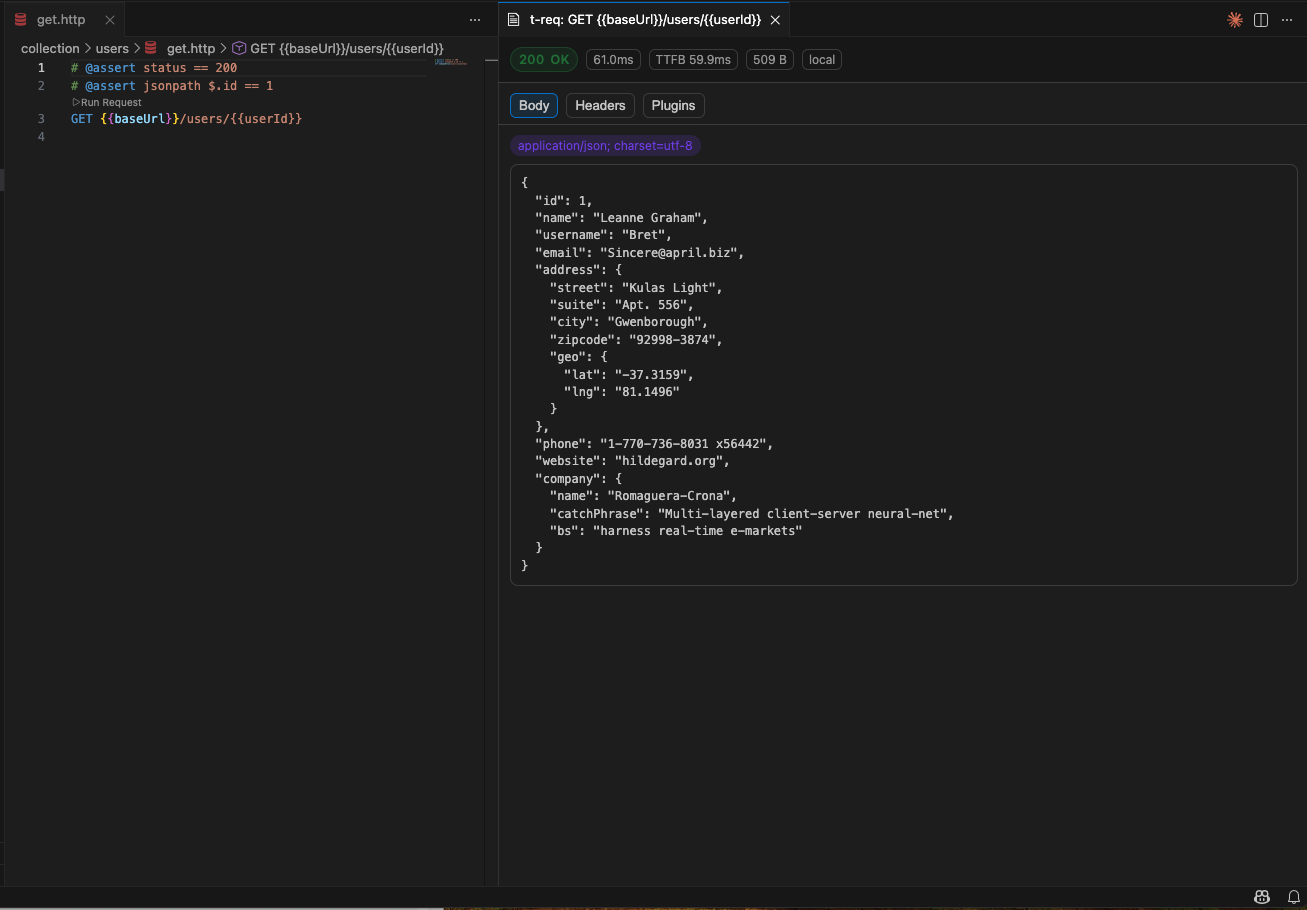
A lightweight HTTP/REST client for testing APIs directly from .http files. Write requests in plain text with full syntax highlighting, run them with a click, and view formatted responses — all without leaving your editor. A file-based alternative to Postman, Thunder Client, Insomnia, and Bruno.



- File-based workflow: Write requests in
.httpfiles with full syntax highlighting - One-click execution: Run individual requests or all requests in a file
- Response viewer: View status, headers, and body with JSON/XML/HTML formatting
- Variables: Use dynamic values with
$variablesyntax for environment switching
- Environment profiles: Switch between dev, staging, and production configurations
- Sequential execution: Run entire test suites from a single file
- Plugin system: Extensible with assert directives, custom resolvers, and hooks
- Diagnostics: Inline warnings and errors from static analysis
- Local mode: Bundled engine runs entirely within the extension (no CLI install)
- Server mode: Connect to remote t-req servers (powered by @t-req/app) for shared environments
- Secure token storage: Server authentication via editor SecretStorage (never in settings files)
While the extension works standalone, installing the t-req CLI (@t-req/app) unlocks the full potential of the ecosystem:
- TUI & Web Dashboard: Interactive terminal and browser-based exploration.
- CI/CD Integration: Execute
.httpfiles headlessly in automated pipelines. - Advanced Scripting: Write TypeScript/Bun tests that report results back to the UI with "Observer Mode".
- WebSocket Testing: Dedicated tools for testing real-time APIs.
# Install via npm
npm install -g @t-req/app

# Or via curl
curl -fsSL https://t-req.io/install | bashAll commands are available via the Command Palette (Ctrl+Shift+P / Cmd+Shift+P):
| Command | Description |
|---|---|
t-req: Run Request |
Execute the request under the cursor |
t-req: Run All Requests |
Execute all requests in the current file |
t-req: Select Profile |
Choose the active environment profile |
t-req: Cancel Request |
Cancel a running request |
t-req: Set Server Token |
Store a bearer token for server mode (saved in SecretStorage) |
t-req: Clear Server Token |
Remove the stored server token |
Configure via Settings > Extensions > t-req or in settings.json:
| Setting | Type | Default | Description |
|---|---|---|---|
t-req.executionMode |
"local" | "server" |
"local" |
Execution mode — local uses the bundled engine, server proxies to a remote t-req server |
t-req.serverUrl |
string |
"" |
Base URL for the t-req server (server mode only) |
t-req.defaultProfile |
string |
"" |
Default profile for request execution |
t-req.timeout |
number |
30000 |
Request timeout in milliseconds (min: 100) |
t-req.enableDiagnostics |
boolean |
true |
Enable inline diagnostics for .http files |
t-req.maxBodyBytes |
number |
1048576 |
Maximum response body size to render (min: 1024) |
When using server mode, authenticate with a bearer token:
- Run
t-req: Set Server Tokenfrom the Command Palette - Enter your token — it is stored securely in the editor's SecretStorage (never in settings files)
- To remove it, run
t-req: Clear Server Token
- VS Code ^1.96.0 or compatible editors (Cursor, VSCodium, etc.)
- No external CLI install needed — the t-req core engine is bundled in the extension
- Recommended: Install @t-req/app for Server Mode, TUI, and CI/CD features