What density function does "HAR1" as prior on coefficients correspond to? #4


-
|
Hello, First of all, thank you for the dynsurv package. I am not having any trouble using the code, which is wonderful! However, I would like to know what the prior density on the coefficients is that corresponds to the "HAR1" selection (as exemplified in the code below from the dynsurv documentation). That is, I don't know right now what "HAR1" corresponds to in terms of a known density function. My current best guess from reading Wang et al. BMC Medical Research Methodology (2016) is that the prior in this case is a Gaussian with mean 0 and variance given by a scaled (by a variable named "ao" in that paper) inverse gamma with the specified shape and scale parameters. Is that right? If so, is "a0" specified/hard-coded somewhere, or does it also have a prior? Fit dynamic coefficient model with dynamic hazards (in log scales)fit3 <- bayesCox(myformula, mydata, model = "Dynamic", Many thanks, |
Beta Was this translation helpful? Give feedback.
Replies: 1 comment 4 replies
-
|
I found in the comments of the bayesCox function that a0 defaults to 100: ##' \item{a0:}{Multiplier for initial variance in time-varying or dynamic So the only thing that remains from my initial question is whether the prior on the coefficients is a Gaussian with mean 0 and variance given a0 times an inverse gamma with the specified shape and scale parameters. Thanks again, |
Beta Was this translation helpful? Give feedback.

-
|
Hi Eric,
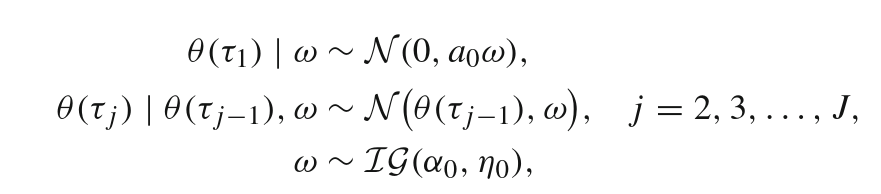
The prior specifications for the dynamic model are given as follows:
where
|
Beta Was this translation helpful? Give feedback.

-
|
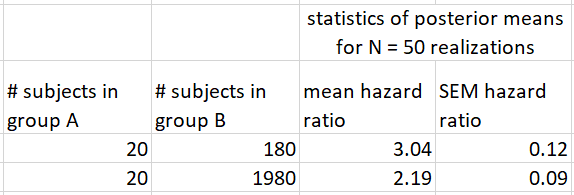
Thank you for the answer Wenjie. I have another question if you would be so kind: I am doing simulations using in which I generate data with right-censoring for 2 groups of subjects with hazard rate of 0.03 in group A (reference level of factor) vs. 0.01 group B and then estimate the hazard function using dynsurv::bayesCox. I am finding that, for a fixed sample size of group A, that the estimated hazard ratio decreases from the simulated value of 3 as I increase the sample size of group B. This phenomenon is surprising to me, as I was expecting the estimated hazard ratio to, if anything, become closer to ground truth as I increased the sample size of either group. Here are some simulation results for N = 50 realizations of data per condition:
This is the call I used: Can you provide any insight? Many thanks again, |
Beta Was this translation helpful? Give feedback.
-
|
The dynamic model is intended for interval-censored data, some of which can be right-censored [t, |
Beta Was this translation helpful? Give feedback.
-
|
Ok, thank you very much for both answers Wenjie! Best, |
Beta Was this translation helpful? Give feedback.


Hi Eric,
The prior specifications for the dynamic model are given as follows:
where${\tau_j}$ 's are jump points, $J$ is the number of jumps, and $a_0$ is a hyperparameter. See Section 3 of Wang et al., (2013) for details.