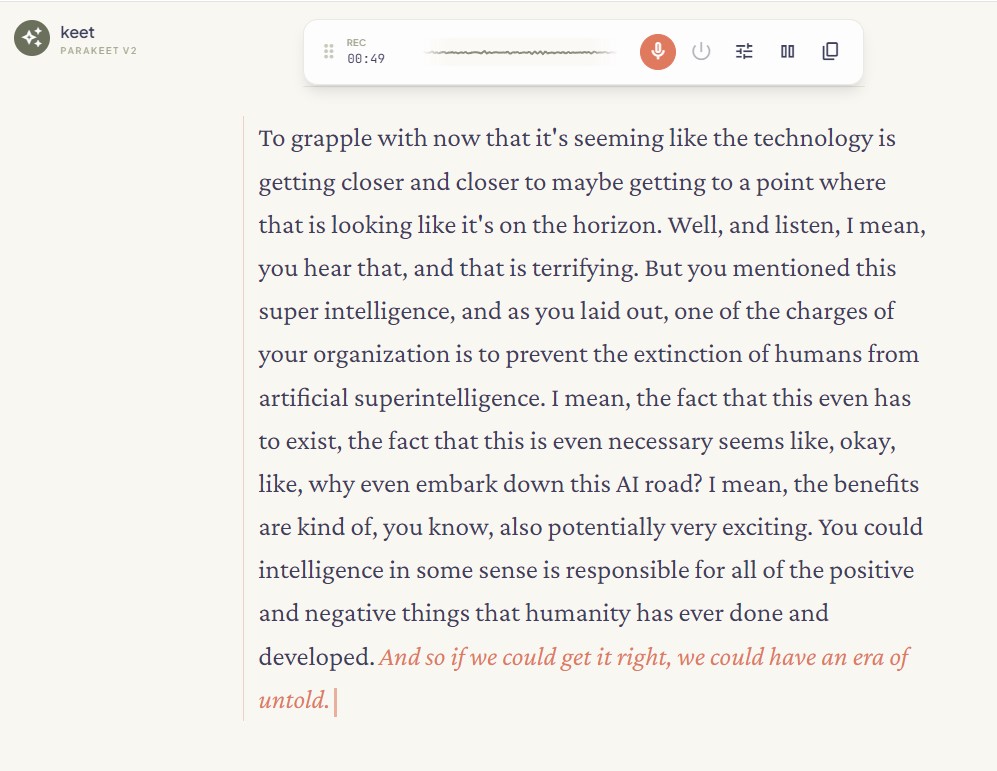
Browser-based speech-to-text using NVIDIA Parakeet models. Runs entirely client-side on WebGPU or WASM via ONNX Runtime Web.
Key features:
- Pure JavaScript mel spectrogram preprocessor with incremental caching for real-time streaming
- Parallel preprocessing support via worker threads and
precomputedFeaturesdirect-feed path - Stateful chunked inference with cached decoder state for low-latency applications
- Decoder state caching and reuse: Incremental decoder cache stores LSTM state at the prefix boundary (keyed by
cacheKey); the next call with the same key restores state and skips decoding the overlapping prefix (~80% decoder time savings for typical overlap). Chunk-to-chunk streaming usespreviousDecoderState/returnDecoderStatewith snapshot/restore so decoding continues without redoing the past.StatefulStreamingTranscriberuses this flow internally. - Mel and feature caching:
IncrementalMelProcessorcaches raw mel frames. WithprefixSamplesonly new frames are computed; the rest are reused (~60-70% preprocessing savings for overlapping streaming). Metrics can reportmel_cache: { cached_frames, new_frames }. - Decoding speedups: Zero-copy
subarray()instead ofslice()for token and duration logits in the hot path; systematic tensor disposal to avoid WASM/GPU growth; pre-allocated tensors for target, length, and encoder frame. - Preprocessor in a separate worker: The library accepts precomputed mel features via
precomputedFeatures. When your app runs mel in its own worker and passes that in,transcribe()skips built-in preprocessing (0 ms preprocessing in the main thread) and you get pipeline parallelism: mel in one worker, inference in another.
v1.2.0 | Parakeet-TDT v2 (English) and v3 (Multilingual, 13 languages)
- Tensor Disposal: Systematic
dispose()calls for all per-call ORT tensors (input, encoder output, joiner logits, decoder state) to prevent WASM/GPU memory leaks on repeated calls. - Array Slicing Optimization: Replaced
slice()withsubarray()in the decoding loop -- zero-copy view into the joiner output buffer (~22x faster for logit extraction in microbenchmarks). - LRU Cache Eviction: Added
maxIncrementalCacheSize(default 50) to cap the incremental decoder cache and prevent unbounded memory growth during long sessions. - Tokenizer Pre-computation: Sanitized tokens are pre-computed in the constructor, removing per-decode regex work.
- Incremental Mel Optimization: Faster incremental mel frame calculation path in
IncrementalMelProcessor. - Conditional Performance Logging:
console.log/console.tablein the decode path is now gated behindenableProfiling, reducing overhead when profiling is off.
- The library's incremental decoder cache (
incremental: { cacheKey, prefixSeconds }) andprecomputedFeaturespath were validated in a production real-time app (keet) with measurable results:
| Stage | Before | After |
|---|---|---|
| Preprocess | 181 ms | 0 ms (mel worker + precomputedFeatures) |
| Decode | 133 ms | 19-99 ms (incremental cache skips overlap prefix) |
| Total | 787 ms | 187-265 ms |
| Real-time factor | 6.3x | 19-27x |
- The sliding-window pattern: a dedicated mel Web Worker continuously produces raw log-mel frames; when inference triggers, normalized features for the window are ready instantly. The encoder runs on WebGPU, and the decoder reuses its LSTM state from the previous window's overlap boundary via
cacheKey/prefixSeconds, skipping ~80% of decoder frames for typical overlap ratios. precomputedFeatures(v1.1.1) removes preprocessing from the inference thread entirely.subarray()(v1.2.0) and tensor disposal (v1.2.0) keep the hot loop fast and memory-stable across hundreds of consecutive calls.
- Static Import Refactoring: Switched to static top-level imports in
src/index.jsfor better bundler compatibility and IDE support. - Subpath Exports: Import only what you need (e.g.,
parakeet.js/parakeet,parakeet.js/hub) for smaller bundle footprints. - Enhanced Demo: Version display for both the library and ORT-web, plus real-time profiling toggles.
- Dynamic ORT Versioning: Automatically derives the CDN URL for WASM binaries from the active runtime version.
enableProfilingdefaults totrue:result.metricsis populated by default, matching v1.1.x behavior. SetenableProfiling: falseto disable metric collection and getmetrics: null.
- Pure JavaScript mel spectrogram is now the default (
preprocessorBackend: 'js'). Eliminates ONNX Runtime overhead and skips the ~5MB ONNX preprocessor model download. - Matches NeMo's pipeline exactly (pre-emphasis, STFT, Slaney mel filterbank, log, normalization). Cross-validated against ONNX reference with max error < 4e-4.
- Switch back to ONNX with
preprocessorBackend: 'onnx'in config.
IncrementalMelProcessorcaches raw mel frames across overlapping streaming windows.- Integrated into
transcribe()viaprefixSamplesoption. For typical 70% overlap: ~60-70% preprocessing savings. - Exact numerical match with full computation.
- Call
model.resetMelCache()when starting a new recording session.
- Runtime preprocessor switching:
model.setPreprocessorBackend('js' | 'onnx')andmodel.getPreprocessorBackend(). - Preprocessor warm-up: Runs automatically during
fromUrls()model loading. - Known issue: Some ONNX preprocessor model artifacts in external repos may use older preprocessing logic. The default JS preprocessor implements the corrected version.
First stable release with NeMo-aligned accuracy and multilingual support.
- 100% Parity with NVIDIA NeMo: Aligned the JavaScript TDT decoding loop with the original Python reference implementation.
- Fixed "Missing Words" Bug: Resolved an issue where multi-token emissions from a single frame were being skipped due to incorrect frame advancement.
- Conditional State Updates: Decoder state now correctly updates only upon non-blank token emission, matching the official transducer algorithm.
- Dynamic Vocabulary Mapping: Replaced hardcoded blank IDs with dynamic lookup from the model's vocabulary.
- Added support for Parakeet TDT 0.6B v3 with 13 languages: English, French, German, Spanish, Italian, Portuguese, Dutch, Polish, Russian, Ukrainian, Japanese, Korean, Chinese.
- Both v2 (English-only) and v3 (Multilingual) models now work out of the box.
- New Model Configuration API for programmatic access to model metadata and language support.
- Model Configuration API: Query supported languages and model metadata programmatically.
- Improved Demo UI: Modern design with automatic dark mode support.
- Speech Dataset Testing: Integration with HuggingFace datasets for quick validation.
- Audio Playback: Listen to loaded test samples directly in the demo.
- Incremental transcription capabilities for real-time applications.
- Optimized state snapshots for low-latency prefix caching.
- Stable core API.
# npm
npm i parakeet.js

# yarn
yarn add parakeet.js
onnxruntime-web is bundled as a dependency and supplies the runtime back-ends (WebGPU, WASM).
We host ready-to-use ONNX exports on the HuggingFace Hub:
| Model | Languages | Repo ID |
|---|---|---|
| Parakeet TDT 0.6B v2 | English | istupakov/parakeet-tdt-0.6b-v2-onnx |
| Parakeet TDT 0.6B v3 | 13 languages | istupakov/parakeet-tdt-0.6b-v3-onnx |
The helper getParakeetModel() downloads all required files and caches them in IndexedDB:
import { getParakeetModel, MODELS } from 'parakeet.js';

// Option 1: Use model key (recommended)
const { urls, filenames, modelConfig } = await getParakeetModel('parakeet-tdt-0.6b-v3', {
  backend: 'webgpu',
  progress: ({file,loaded,total}) => console.log(file, loaded/total)
});

// Option 2: Use repo ID directly
const { urls, filenames } = await getParakeetModel('istupakov/parakeet-tdt-0.6b-v2-onnx', {
  backend: 'webgpu',
  encoderQuant: 'fp32',
  decoderQuant: 'int8',
  preprocessor: 'onnx-preprocessor',
});
Returned structure:
{
  urls: {
    encoderUrl: string,
    decoderUrl: string,
    encoderDataUrl?: string | null,
    decoderDataUrl?: string | null,
    tokenizerUrl: string,
    preprocessorUrl: string
  },
  filenames: { encoder: string; decoder: string }
}import { ParakeetModel } from 'parakeet.js';
const model = await ParakeetModel.fromUrls({
...urls, // spread the URLs returned above
filenames, // needed for external .data mapping
backend: 'webgpu', // 'webgpu' or 'wasm'
cpuThreads: 6, // For WASM backend
verbose: false, // ORT verbose logging
});If you want smaller startup in non-bundled ESM environments, import only what you need via subpath exports:
import { ParakeetModel } from 'parakeet.js/parakeet';
// or: import { fromHub } from 'parakeet.js/hub';import { fromHub } from 'parakeet.js';
// Load English-only model
const model = await fromHub('parakeet-tdt-0.6b-v2', {
backend: 'webgpu',
progress: ({ file, loaded, total }) => {
console.log(`${file}: ${Math.round(loaded/total*100)}%`);
}
});
// Transcribe audio
const result = await model.transcribe(pcmFloat32, 16000);
console.log(result.utterance_text);import { fromHub } from 'parakeet.js';
// Load multilingual model (supports 13 languages)
const model = await fromHub('parakeet-tdt-0.6b-v3', {
backend: 'webgpu'
});
// Works with any supported language automatically
const frenchResult = await model.transcribe(frenchAudio, 16000);
const germanResult = await model.transcribe(germanAudio, 16000);The library supports two primary backends: webgpu and wasm.
-
webgpu(Default): This is the fastest option for modern desktop browsers. It runs in a hybrid configuration:- The heavy encoder model runs on the GPU (WebGPU) for maximum throughput.
- The decoder model runs on the CPU (WASM). The decoder's architecture contains operations not fully supported by the ONNX Runtime WebGPU backend, causing it to fall back to WASM anyway. This configuration makes the behavior explicit and stable, avoiding performance issues and warnings.
- In this mode, the encoder must be
fp32, but you can choosefp32orint8for the decoder.
-
wasm: Both encoder and decoder run on the CPU. This is best for compatibility with older devices or environments without WebGPU support. Both models can befp32orint8.
// 16-kHz mono PCM Float32Array
await model.transcribe(pcmFloat32, 16_000, {
  returnTimestamps: true,
  returnConfidences: true,
  frameStride: 2,      // 1 (default) = highest accuracy / 2-4 faster
});
Extra options:
| Option | Default | Description |
|---|---|---|
temperature |
1.0 | Softmax temperature for decoding (1.0 = greedy, >1.0 = sampling) |
frameStride |
1 | Advance decoder by n encoder frames per step |
enableProfiling |
true | Collect timing metrics and populate result.metrics. Set to false to disable. |
returnLogProbs |
false | Return per-token log probabilities |
timeOffset |
0 | Time offset (seconds) to add to all timestamps |
prefixSamples |
0 | Number of overlapping prefix samples for incremental mel caching |
precomputedFeatures |
null | Pre-computed mel features (see Streaming with Pre-computed Features) |
incremental |
null | Incremental decoder cache config (see Incremental Decoder Cache) |
For streaming applications that compute mel spectrograms in a separate worker, you can bypass the built-in preprocessor entirely:
const result = await model.transcribe(null, 16000, {
  precomputedFeatures: {
    features: melFloat32Array,  // [T * melBins] row-major Float32Array
    T: 500,                     // number of time frames
    melBins: 128                // number of mel bands
  }
});
When precomputedFeatures is provided:
- The audio parameter can be
null(audio is not needed) - The built-in preprocessor (JS or ONNX) is completely skipped
- Features must be normalized (zero mean, unit variance per feature)
- This enables pipeline parallelism: compute mel in one worker, run inference in another
For overlapping streaming windows, the decoder can cache its state to avoid re-decoding the overlapping prefix:
const result = await model.transcribe(audio, 16000, {
  incremental: {
    cacheKey: 'stream-1',     // unique key for this stream
    prefixSeconds: 3.5        // seconds of overlap to cache
  },
  timeOffset: windowStartTime  // adjust timestamps for the window position
});
The cache stores decoder state at the prefix boundary. On the next call with the same cacheKey, frames up to prefixSeconds are skipped, reducing decoder time by ~80% for typical overlap ratios.
You can tune the cache size with maxIncrementalCacheSize (default 50) when constructing the model. Increase it for many concurrent streams to avoid LRU evictions; in debug mode, evictions are logged to help with tuning.
Call model.clearIncrementalCache() when starting a new recording session.
{
  utterance_text: string,
  words: Array<{text,start_time,end_time,confidence}>,
  tokens: Array<{token,start_time,end_time,confidence}>,
  confidence_scores: { overall_log_prob, word_avg, token_avg },
  metrics: {               // null when enableProfiling: false
    rtf: number,
    total_ms: number,
    preprocess_ms: number,
    encode_ms: number,
    decode_ms: number,
    tokenize_ms: number
  } | null,
  is_final: boolean
}The first time you run inference after loading a model, the underlying runtime needs to compile the execution graph. This makes the first run significantly slower. To ensure a smooth user experience, it's best practice to perform a "warm-up" run with a dummy or known audio sample immediately after model creation.
Our React demo does this and also verifies the output to ensure the model loaded correctly.
// In your app, after `ParakeetModel.fromUrls()` succeeds:
setStatus('Warming up & verifying…');

const audioRes = await fetch('/assets/known_audio.wav');
const pcm = await decodeAudio(audioRes); // Your audio decoding logic
const { utterance_text } = await model.transcribe(pcm, 16000);

const expected = 'the known transcript for your audio';
if (utterance_text.toLowerCase().includes(expected)) {
  setStatus('Model ready ✔');
} else {
  setStatus('Model verification failed!');
}| Property | Where | Effect |
|---|---|---|
cpuThreads |
fromUrls() |
Sets ort.env.wasm.numThreads; pick cores-2 for best balance |
encoderQuant |
getParakeetModel() |
Selects fp32 or int8 model for the encoder |
decoderQuant |
getParakeetModel() |
Selects fp32 or int8 model for the decoder |
preprocessorBackend |
getParakeetModel() / fromUrls() |
'js' (default) uses pure JS mel; 'onnx' uses the ONNX preprocessor path |
frameStride |
transcribe() |
Trade-off latency vs accuracy |
precomputedFeatures |
transcribe() |
Bypass preprocessor with external mel features |
enableProfiling |
transcribe() |
Populates result.metrics with timing data (default true). Set false to skip metric collection. |
enableProfiling |
fromUrls() |
Enables ORT session profiler (JSON written to /tmp/profile_*.json; default false) |
Query model metadata programmatically:
import { MODELS, LANGUAGE_NAMES, getModelConfig, supportsLanguage } from 'parakeet.js';

// List all available models
console.log(Object.keys(MODELS));
// ['parakeet-tdt-0.6b-v2', 'parakeet-tdt-0.6b-v3']

// Get model config
const config = getModelConfig('parakeet-tdt-0.6b-v3');
console.log(config.languages); // ['en', 'fr', 'de', 'es', ...]
console.log(config.displayName); // 'Parakeet TDT 0.6B v3 (Multilingual)'

// Check language support
supportsLanguage('parakeet-tdt-0.6b-v3', 'fr'); // true
supportsLanguage('parakeet-tdt-0.6b-v2', 'fr'); // false

// Get language display names
console.log(LANGUAGE_NAMES['fr']); // 'French'The library includes a unified demo application:
examples/demo/ # React demo with switchable source
cd examples/demo
npm install

# Test with local source files (for library development)
npm run dev:local

# Test with npm package (simulates end-user experience)
npm run dev
The demo runs at http://localhost:3000/ with CORS headers enabled for SharedArrayBuffer support.
# Deploy to HuggingFace Spaces
npm run deploy-to-hf

# Trigger GitHub Pages deploy manually (optional)
gh workflow run deploy-gh-pages.yml
GitHub Pages is normally auto-deployed by the deploy-gh-pages.yml workflow when examples/demo/** or src/** changes on master. The workflow uses build:local, so the live page reflects the latest repository source rather than waiting for an npm release.
All demos share the same modern UI with:
- Model Selector: Switch between v2 (English) and v3 (Multilingual)
- Language Selector: Context-aware dropdown showing only supported languages
- Quick Test: Load random samples from HuggingFace speech datasets
- Reference Text: Compare transcription against ground truth
- Dark Mode: Automatic theme toggle
- Version Display: Shows the active
parakeet.jsversion/source and the loadedonnxruntime-webruntime version
The demo includes reusable utilities for testing with HuggingFace datasets:
// Located in: examples/react-demo-dev/src/utils/speechDatasets.js
import { fetchRandomSample, hasTestSamples, SPEECH_DATASETS } from './utils/speechDatasets';

// Check if test samples are available for a language
if (hasTestSamples('fr')) {
  // Fetch a random French audio sample with transcription
  const sample = await fetchRandomSample('fr', {
    targetSampleRate: 16000,
    onProgress: ({ message }) => console.log(message),
  });

  console.log(sample.transcription); // Ground truth text
  console.log(sample.pcm);           // Float32Array audio
  console.log(sample.duration);      // Duration in seconds
}
Supported languages for testing: English (People's Speech), French, German, Spanish, Italian, Portuguese, Dutch, Polish (Multilingual LibriSpeech)
| File | Purpose |
|---|---|
App.jsx |
Complete end-to-end reference UI with model/language selection, performance metrics, and transcription history |
utils/speechDatasets.js |
Reusable utilities for fetching test samples from HuggingFace datasets |
Copy-paste the loadModel() and transcribeFile() functions into your app, adjust UI bindings, and you are ready to go.
The library includes a Vitest test suite (82 tests across 7 suites):
npm test          # Run all tests once
npm run test:watch # Watch mode| Suite | Tests | Description |
|---|---|---|
mel.test.mjs |
39 | Mel constants, filterbank, FFT, JsPreprocessor, IncrementalMelProcessor, ONNX cross-validation |
preprocessor-selection.test.mjs |
16 | Hub file selection logic, fromUrls preprocessor creation, default config |
precomputed-features.test.mjs |
15 | Feature format, audioDur computation, edge cases, integration |
transcribe_perf.test.mjs |
5 | Profiling/metrics behavior, tensor disposal verification |
incremental_cache_fix.test.mjs |
2 | LRU incremental decoder cache, cache clearing |
stateful-streaming.test.mjs |
3 | StatefulStreamingTranscriber state handoff, finalize/reset, and explicit non-dedupe behavior |
index.test.mjs |
2 | Top-level fromUrls and fromHub exports |
| Symptom | Cause | Fix |
|---|---|---|
Some nodes were not assigned... warning |
When using the webgpu backend, ORT assigns minor operations (Shape, Gather, etc.) in the encoder to the CPU for efficiency. |
This is expected and harmless. The heavy-lifting is still on the GPU. |
| GPU memory still ~2.4 GB with INT8 selected | In WebGPU mode, the encoder must be fp32. The int8 option only applies to the WASM backend or the decoder in hybrid mode. |
This is the expected behavior for the webgpu backend. |
Graph capture feature not available error |
Mixed EPs (CPU/GPU) or unsupported ops prevent GPU graph capture. | The library automatically retries without capture; safe to ignore. |
- Tensor Disposal: Systematic
dispose()calls for all per-call ORT tensors to prevent WASM/GPU memory leaks. subarray()Optimization: Zero-copy view replacesslice()in the decode hot loop (~22x faster logit extraction).- LRU Cache Eviction:
maxIncrementalCacheSize(default 50) caps the incremental decoder cache. - Tokenizer Pre-computation: Sanitized tokens built once in constructor.
- Incremental Mel Optimization: Faster frame calculation in
IncrementalMelProcessor. - Conditional Perf Logging:
console.log/console.tablegated behindenableProfiling. enableProfilingbackward compat: Defaults totruesoresult.metricsis populated by default (matching v1.1.x). Setfalseto disable.- Static Import Refactor:
src/index.jsuses static top-level imports for better bundler compatibility. - Subpath Exports: Import specific modules (e.g.,
parakeet.js/parakeet) for smaller bundles. - Dynamic ORT Versioning: WASM CDN paths derived automatically from the active runtime.
- Streaming demo validated: Sliding-window transcription with mel worker +
precomputedFeatures+ incremental decoder cache demonstrated 19-27x real-time in keet.
precomputedFeaturesoption:transcribe()accepts pre-computed mel spectrograms, bypassing the built-in preprocessor.- Conditional ONNX loading:
fromUrls()andgetParakeetModel()skip the ONNX preprocessor model whenpreprocessorBackend: 'js'(~5MB saved). timeOffsetbugfix: FixedeffectiveTimeOffsetin incremental decoder cache path.- Vitest test suite: Automated tests for mel accuracy, preprocessor selection, and feature format.
- New exports:
hzToMel,melToHzfrommel.js.
First stable release
- Accuracy Alignment: Critical fix for TDT decoding loop to match NVIDIA NeMo parity.
- Multi-token Fix: Resolved bug skipping tokens emitted from the same encoder frame.
- Space Normalization: Improved SentencePiece decoding regex for better punctuation spacing.
- Dynamic Blank ID: Automatic detection of blank token index from model vocabulary.
- Multilingual Support: Added Parakeet TDT 0.6B v3 with 13 languages.
- Model Config API: New
MODELS,LANGUAGE_NAMES,getModelConfig(),supportsLanguage()exports. - Demo Enhancements: Modern UI with dark mode, model/language selectors, HuggingFace dataset testing.
- Streaming Support: Incremental transcription capabilities for real-time applications.
- Accuracy improvements and multilingual foundation
- Initial multilingual experiments
- Initial WebGPU/WASM hybrid backend
- IndexedDB model caching
- Performance instrumentation (RTF, timing metrics)
This project builds upon the excellent work of:
- istupakov - For providing the ONNX-ASR repository, which served as the foundation and starting point for this JavaScript implementation
The Python-based ONNX-ASR project provided crucial insights into model handling, preprocessing pipelines, and served as a reference implementation during the development of this browser-compatible version.
Happy hacking!