Examples
These are some circuit examples provided by several users. You're free to reproduce and expand them. Please consider adding more examples if you've built your own advanced circuits.
Author: CoderCow, AC Version: 1.2
Not much to say about it, just a simple circuit for an automated door. Note that the door will also be automatically closed when it has been opened by the player directly.


Author: CoderCow, AC Version: 1.2
A simple circuit of two automated doors utilizing only a single timer. Note that the doors will also be automatically closed when they have been opened by the player directly.


Author: CoderCow, AC Version: 1.2
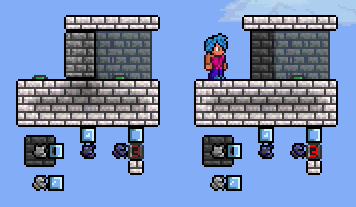
A simple automated door made of solid blocks and a block activator. Don't forget that the wall behind the block activator must equal the wall behind the blocks which should be modified.


In some cases, you might want to avoid placing a wall behind specific blocks for design purposes. In order to change both blocks, those with a wall and those without, you may just use a second Block Activator in your circuit.

Author: CoderCow, AC Version: 1.2
An automated solid door which may be locked from the inside using a lever. The red and green torches above indicate the current locked / unlocked status.


Author: CoderCow, AC Version: 1.2
This automated solid door must be opened by two players at the same time. As one of those levers beneath the floor is toggled, the blocks between them above will become active, so that the player who just toggled the lever can not move over to the other. The second lever must be toggled one second right after the first, if not, the other lever will simply reset and the blocks inbetween will disappear again. If both levers were eventually toggled within the same second, then the door will open for a few seconds so that both players can progress forward. Once one of them made it behind the door, they can easily re-open it from the inside again.
There's one really tricky thing to notice about this circuit. If you look clearly, you will notice that there are some useless spikes in the lower parts of the circuit. They act like a kind of resistor, their purpose is to slow down the signal in order to let other components of the circuit to be signaled first. Technically, it doesn't matter what port defining components are used to delay a signal transmission, as long as you add more components to one wire branch than the other branch has, you'll ensure that the signal of this branch will always be processed after the signal of the other branch.


Author: CoderCow, AC Version: 1.2
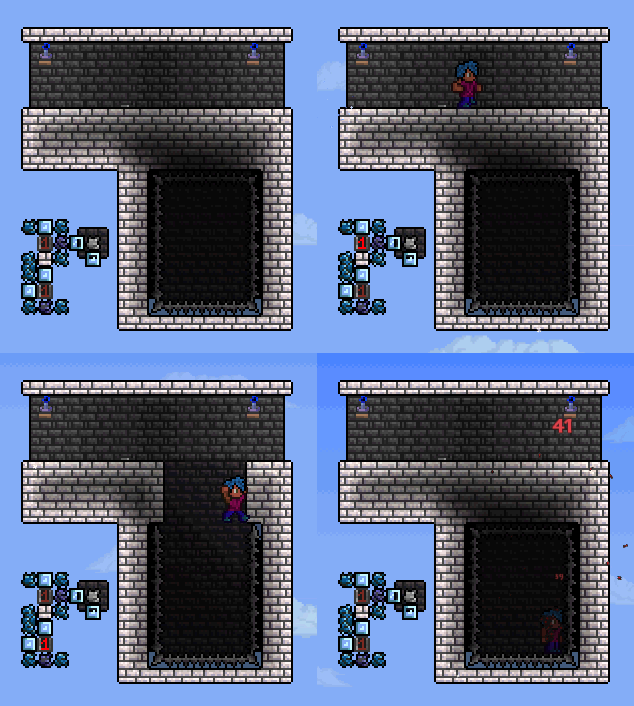
The careless person running over the Pressure Plate will eventually loose ground and fall into a locked room filled with deadly spikes. Lag can yield this trap useless though, it's recommend to enlarge the hole to have a higher chance of catching the prey.

Author: CoderCow, AC Version: 1.2
Using doors to send signals can be utilized for many kinds traps. Here's a simple lava trap.


Author: CoderCow, AC Version: 1.2
This trap makes use of a cycling timer, once activated it fires four times in a 1.5 seconds interval before it deactivates again.


Author: Terion, AC Version: 1.2
This smart jukebox simply starts playing a random song with each sunset and sunrise.


Author: Terion, AC Version: 1.1.1 (outdated)
A deluxe hellevator. Once the switch is toggled, a bunny companion is spawned and the ground vanishes, causing the player to fall down - the bunny escort the user of course, so they don't have to feel so alone on their way down to hell.


Author: SantaRLJ, AC Version: 1.2
Life can be a chill with a modern Advanced Circuits powered house. No need to open doors by hand, just walking towards them is sufficient. Also, the lights and the music is automatically turned on and off accordingly with the time of day.

