React Native network inspector – intercept and inspect HTTP/XHR requests. This package exports only the core API and hooks; you build your own UI.
yarn add react-native-network-inspectorPeer dependencies: react, react-native.
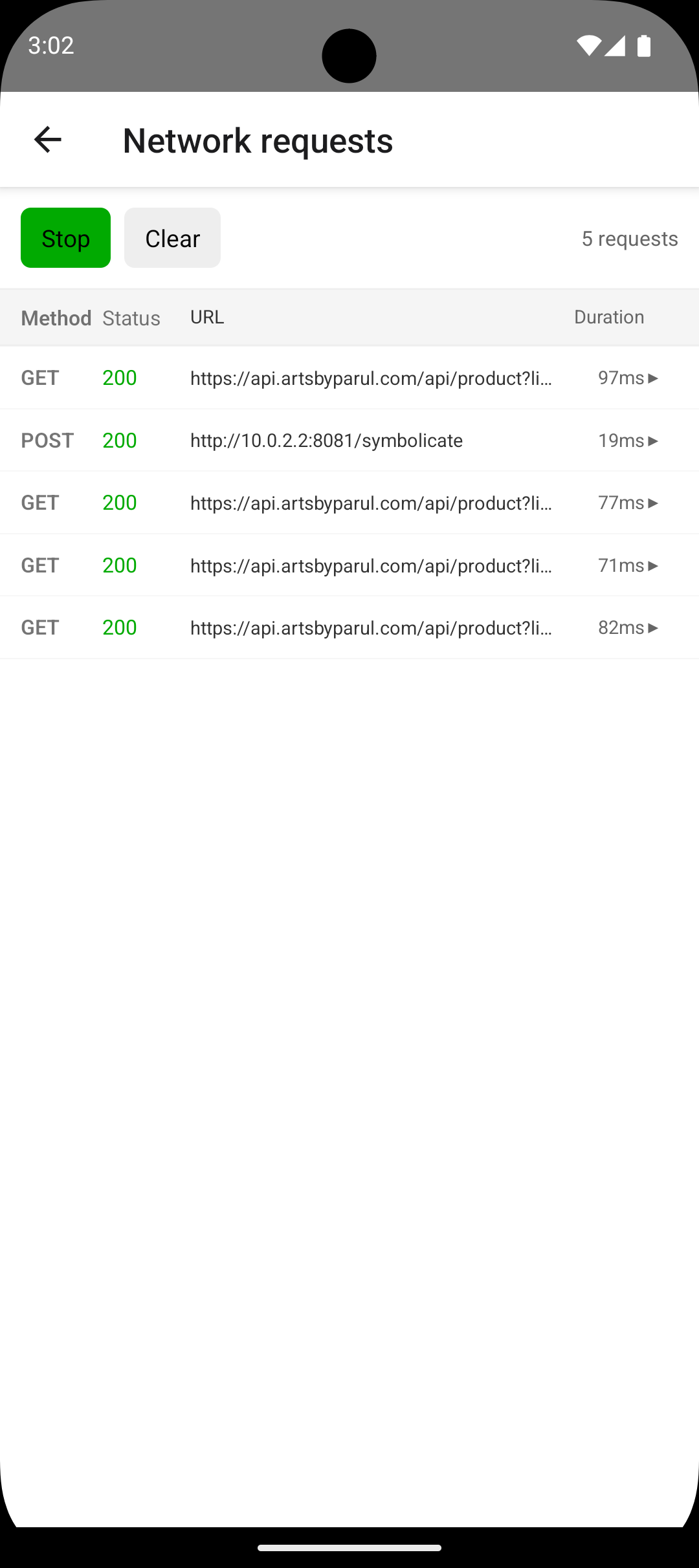
This is how captured requests can be viewed in your own UI.
1. Base code (default options) — intercept and display all requests:
const { requests, isActive, start, stop } = useNetworkRequests();
// Render your list with requests; start() / stop() to begin or end capture.
2. With options — e.g. ignore a host so it does not appear in the list:
const { requests, isActive, start, stop } = useNetworkRequests({
  ignoredHosts: ["10.0.2.2"],
});
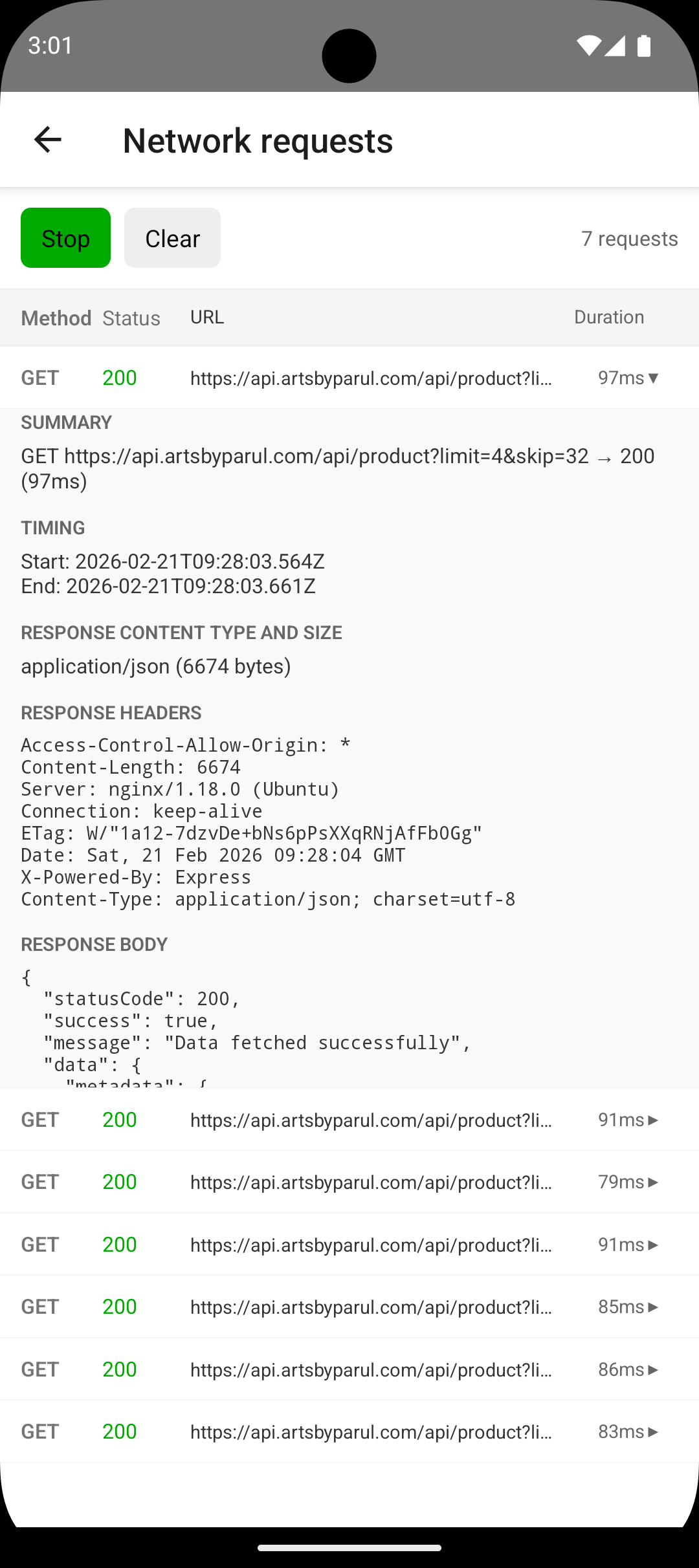
import { getNetworkInspector } from "react-native-network-inspector";

const inspector = getNetworkInspector();

// Start intercepting (optional filter options)
inspector.start({
  maxRequests: 500,
  refreshRate: 50,
  ignoredHosts: ["analytics.example.com"],
  ignoredUrls: ["https://example.com/ignore"],
  ignoredPatterns: [/^GET https:\/\/api\.example\.com\/health/],
  onRequestsChange: (requests) => {
    console.log(requests.length);
  },
});

// Read current requests
const requests = inspector.getRequests();

// Stop intercepting
inspector.stop();

// Clear the in-memory list (logging can stay active)
inspector.clear();Use the hook to drive your own UI (list, detail, filters).
import { useNetworkRequests } from "react-native-network-inspector";

function MyNetworkScreen() {
  const { requests, isActive, start, stop, clear } = useNetworkRequests({
    ignoredHosts: ["analytics.example.com"],
  });

  return (
    <View>
      <Button
        title={isActive ? "Stop" : "Start"}
        onPress={isActive ? stop : start}
      />
      <Button title="Clear" onPress={clear} />
      <FlatList
        data={requests}
        keyExtractor={(r) => r.id}
        renderItem={({ item }) => (
          <Text>
            {item.method} {item.url} {item.status}
          </Text>
        )}
      />
    </View>
  );
}| Option | Type | Description |
|---|---|---|
maxRequests |
number |
Max requests to keep (default 500) |
refreshRate |
number |
Notify interval in ms (default 50) |
ignoredHosts |
string[] |
Blocklist by host, e.g. ['api.analytics.com'] |
ignoredUrls |
string[] |
Blocklist by full URL |
ignoredPatterns |
RegExp[] |
Blocklist by pattern; match target is `${method} ${url}` |
forceEnable |
boolean |
Force start even if another interceptor is active |
onRequestsChange |
(requests) => void |
Callback when requests update (e.g. for non-React usage) |
Everything you need to build your UI is below. Requests are plain objects/class instances with the listed properties and methods.
Returns the singleton network inspector. Use it for the imperative API (no React).
import { getNetworkInspector } from "react-native-network-inspector";
const inspector = getNetworkInspector();| Method / property | Signature | Description |
|---|---|---|
start |
(options?: NetworkInspectorOptions) => void |
Start intercepting. No-op if already active. |
stop |
() => void |
Stop intercepting and clear internal XHR mapping. |
getRequests |
() => NetworkRequest[] |
Current list of requests (newest first). Returns a copy. |
clear |
() => void |
Clear the in-memory request list. Interception can stay active. |
subscribe |
(listener: (requests: NetworkRequest[]) => void) => () => void |
Subscribe to request updates. Returns an unsubscribe function. |
enabled |
boolean |
Whether interception is currently active. |
React hook to drive your UI. Options are the same as NetworkInspectorOptions (filters, maxRequests, refreshRate, etc.).
Returns:
| Property / method | Type | Description |
|---|---|---|
requests |
NetworkRequest[] |
Current list of requests (newest first). |
isActive |
boolean |
Whether interception is active. |
start |
() => void |
Start intercepting (uses options passed to the hook). |
stop |
() => void |
Stop intercepting. |
clear |
() => void |
Clear the request list. |
Each item in requests (from getRequests() or the hook) is a NetworkRequest with these members. Use them to render list rows, detail screens, copy-as-curl, etc.
Properties (read-only unless noted):
| Property | Type | Description |
|---|---|---|
id |
string |
Unique id for the request. |
type |
string |
e.g. 'XMLHttpRequest'. |
url |
string |
Request URL. |
method |
RequestMethod |
'GET' | 'POST' | 'PUT' | 'PATCH' | 'DELETE'. |
status |
number |
HTTP status (e.g. 200). -1 until response. |
dataSent |
string |
Raw request body as sent. |
responseContentType |
string |
Response Content-Type header value. |
responseSize |
number |
Response size (when available). |
requestHeaders |
Headers |
Request headers { [name: string]: string }. |
responseHeaders |
Headers |
Response headers { [name: string]: string }. |
response |
string |
Raw response (or blob reference). Prefer getResponseBody() for body text. |
responseURL |
string |
Final response URL (after redirects). |
responseType |
string |
e.g. 'text', 'blob'. |
timeout |
number |
Timeout value. |
startTime |
number |
Timestamp when request started. |
endTime |
number |
Timestamp when request finished. |
updatedAt |
number |
Last update timestamp. |
duration |
number (getter) |
Math.max(0, endTime - startTime) in ms. |
curlRequest |
string (getter) |
Approximate curl command for the request. |
Methods:
| Method | Signature | Description |
|---|---|---|
getRequestBody |
(replaceEscaped?: boolean) => string |
Request body. If replaceEscaped === true, unescapes \\n and \\" for display. |
getResponseBody |
() => Promise<string> |
Response body as text. For blob responses, reads the blob and resolves with text. Rejects on read error. |
update |
(values: Partial<NetworkRequest>) => void |
Update mutable fields (internal use; you typically only read). |
NetworkInspectorOptions— Options forinspector.start(options)anduseNetworkRequests(options). See Filter options table.UseNetworkRequestsResult— Return type ofuseNetworkRequests():{ requests, isActive, start, stop, clear }.NetworkRequestShape— Interface describing a request (same shape asNetworkRequestinstances).Headers—{ [header: string]: string }.RequestMethod—'GET' | 'POST' | 'PUT' | 'PATCH' | 'DELETE'.
- Functions:
getNetworkInspector() - Classes:
NetworkInspector,NetworkRequest - Hook:
useNetworkRequests(options?) - Types:
NetworkRequest,NetworkInspectorOptions,NetworkRequestShape,UseNetworkRequestsResult,Headers,RequestMethod
From the package root:
yarn install
yarn build- React: 16.8+
- React Native: The package resolves
XHRInterceptorandBlobFileReaderInterceptorvia fallbacks:- 0.79+: uses private API paths (
react-native/src/private/...). - 0.72 and earlier: uses public path (
react-native/Libraries/Network/XHRInterceptor,Libraries/Blob/...).
- 0.79+: uses private API paths (
If a future React Native version moves or changes these internal APIs, compatibility may need a patch.
MIT