Packet listening
In this page, you will learn how to listen for incoming and outgoing packets using AbstractPacketListeners.
At first we need to understand how data flows between client, server and proxy.
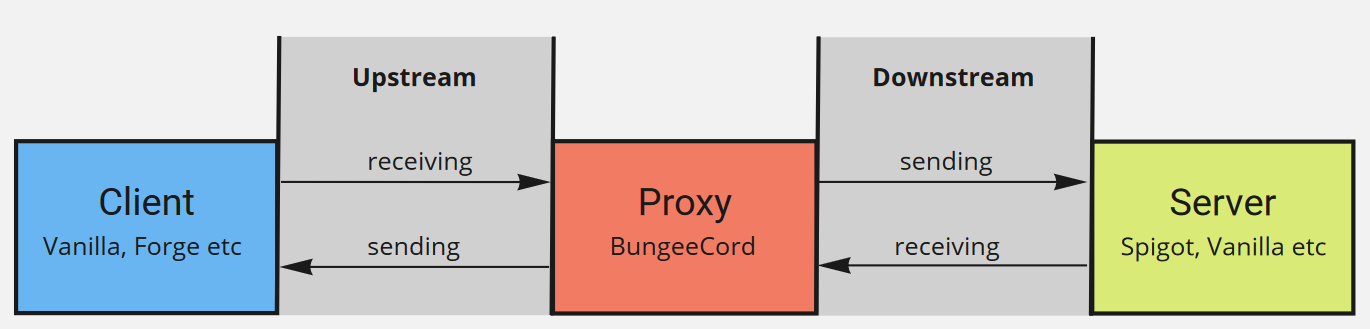
NOTICE: This example is written for the BungeeCord platform and uses the BungeeCord Chat packet. On velocity, the packet name may differ.
In this example I will show you how to intercept chat message packets. First we need to create a new AbstractPacketListener for that packet type.
MyPacketListener.java:
public class MyPacketListener extends AbstractPacketListener<Chat> {
  public MyPacketListener() {
    super(Chat.class, Direction.UPSTREAM, 0);
  }
}
The super constructor needs three parameters. The type of packet to listen for, the direction and the listener priority (default is 0). Now we are able to implement the two methods packetReceive and packetSend.
@Override
public void packetReceive(PacketReceiveEvent<Chat> event) {
  // Receive on UPSTREAM means receiving a packet from a player
  // Receive on DOWNSTREAM means receiving a packet from a server a player is connected to
}

@Override
public void packetSend(PacketSendEvent<Chat> event) {
  // Sending on UPSTREAM means sending a packet to a player
  // Sending on DOWNSTREAM means sending a packet to a server a player is connected with
}
For example if we want all actionbar messages printing in the chat instead we can use the following logic on Direction.DOWNSTREAM:
public class MyPacketListener extends AbstractPacketListener<Chat> {

  public MyPacketListener() {
    super(Chat.class, Direction.DOWNSTREAM, 0);
  }

  @Override
  public void packetReceive(PacketReceiveEvent<Chat> event) {
    Chat packet = event.packet();
    if(packet.getPosition() == 2) { // Position 2 means actionbar
      packet.setPosition((byte) 0); // Set to normal chat
      event.markForRewrite(); // We need to mark the packet for rewriting after we changed fields in the packet class. This is only necessary when receiving packets on BungeeCord.
    }
  }
}
One thing left to do. Let's register our created AbstractPacketListener:
Protocolize.listenerProvider().registerListener(new MyPacketAdapter());