Docker images for Umbrel app store integration.
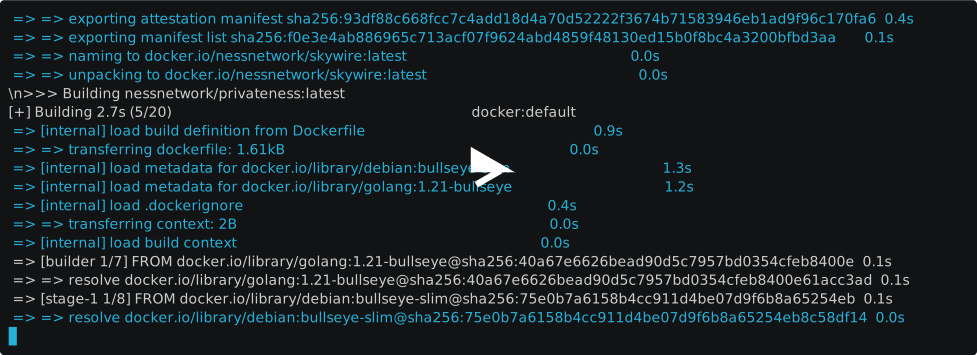


To record or update short terminal walkthroughs, this repository currently uses asciinema.
pip install --user asciinemaFor other installation options and platforms, please refer to the upstream asciinema documentation.
From the project root:
asciinema rec 1ness-menu.castRun through the menu or workflow you want to capture, then exit the recording as prompted.
asciinema upload 1ness-menu.castThe upload command returns a URL such as https://asciinema.org/a/<CAST_ID>. To embed that cast in Markdown (as used at the top of this file), you can add:
[](https://asciinema.org/a/<CAST_ID>)Replace <CAST_ID> with the identifier from your uploaded recording.
This stack includes an experimental configuration where some cryptographic operations block if the system believes entropy may be insufficient. The intent is to favour perceived cryptographic safety over availability on hosts that opt into this profile.
On correctly configured Linux hosts, the pyuheprng service feeds /dev/random directly with a mix of:
- RC4OK from Emercoin Core (blockchain-derived randomness)
- Original hardware bits (direct hardware entropy)
- pyuheprng / UHEPRNG (Python integration of Steve Gibson's ultra-high-entropy UHEPRNG engine)
For this profile, GRUB is configured to avoid trusting /dev/urandom for cryptographic material and to rely on /dev/random instead. This is a conservative choice specific to this project and not a general statement about /dev/urandom on Linux.
See CRYPTOGRAPHIC-SECURITY.md and the external references in SOURCES.md for details and background.
This project treats binary equivalence as an important design goal for decentralised deployments: every node should be able to verify that it is running the same code as its peers.
Without reproducible builds and a way to compare hashes, it becomes harder to:
- Verify node integrity
- Detect compromised or modified nodes
- Build confidence in the behaviour of the network
See REPRODUCIBLE-BUILDS.md for the reference build profiles and verification ideas.
At the lowest layer, this stack is designed so that breaking its public authentication requires either new physics or a catastrophic failure of Emercoin consensus:
- Cryptographic floor – We assume the existence of one-way functions, which in the classical PPT model is equivalent to the existence of EUF-CMA signatures (Rompel, STOC 1990). All public authentication (wallets, PAX, EmerSSH-style auth, Identity Switch, PoX manifests) reduces to signature verification. There is no weaker primitive that still gives public verification.
- Directory assumption – We assume Emercoin's hybrid PoS + BTC AuxPoW consensus provides an append-only key–value directory (EmerNVS) with a costed attack model. Identity, node descriptors, binary manifests, migration hashes, incentive markers and DNS policy all live as WORM JSON values inside NVS.
Everything else (overlay routing, containers, UX, PoX implementation details) is layered above these two assumptions. In particular:
- Bedrock WORM schemas (e.g.
bedrock.account,bedrock.node,bedrock.pkg*,bedrock.pox_attestation,bedrock.benji_reward) give structure to NVS values and are enforced by MCP servers before any write occurs. - 3FA incentives – Before hostile nodes are rewarded, three independent "truth sources" must agree:
- Emercoin Bedrock – Identity, node WORMs and package manifests must match what is on chain.
- Skycoin inventory – Skycoin chain state defines which addresses are eligible as Skyminers (entitled to higher reward tiers).
- Execution & overlay – PoX attestations (
pox:*) and network metrics must show that the node is actually running the expected binaries and carrying traffic.
If any factor fails, the node can still run whatever it wants, but higher-level automation (e.g. Benji rewards) will not trust it or pay it. This keeps the mathematical bedrock (OWF/signatures + Emercoin directory) as the only place where long-term assumptions live; everything else is replaceable infrastructure on top.
- SERVICES.md - Complete service list, dependencies, ports, use cases
- DEPLOY.md - Docker Hub deployment instructions (nessnetwork)
- PORTAINER.md - Portainer deployment guide, stack management
- CRYPTOGRAPHIC-SECURITY.md - Entropy architecture, pyuheprng, GRUB configuration
- REPRODUCIBLE-BUILDS.md - Binary equivalence, deterministic builds, verification
- INCENTIVE-SECURITY.md - Trustless payment to hostile nodes, game theory
- NETWORK-ARCHITECTURE.md - Protocol hopping, MPLS routing, untraceability
- ARCHITECTURE.md - Multi-architecture build details
- ipfs/README.md - IPFS daemon, Emercoin integration
- pyuheprng/README.md - Entropy service documentation
- amneziawg/README.md - Stealth VPN configuration
- skywire-amneziawg/README.md - Access layer integration
- CONCEPT.md - Perception/Reality architecture notes
- EmerDNS + EmerNVS (
dpo:PrivateNESS.Network,ness:dns-reverse-proxy-config) are the only sources of truth for identities, bootstrap info, DNS policy, and service URLs. Anything not reachable from those records is treated as untrusted by default. - DNS enforcement happens through
dns-reverse-proxyon127.0.0.1:53/udp, which uses EmerDNS (127.0.0.1:5335) for owned TLDs and optionally forwards other TLDs only through trusted upstreams. - Clearnet existence toggle reverses or restores access to non-Emer TLDs; OFF means unknown names are NXDOMAIN/blackholed and the node only perceives EmerDNS, ON adds controlled clearnet forwarders.
- Transport graph: WG-in → Skywire → Yggdrasil → (optional i2pd Ygg-only) → WG/XRAY-out → clearnet. All visor-to-visor traffic stays on Ygg; optional i2p runs strictly inside Ygg-only mode.
- Identity-to-config pipeline: an external orchestrator reads Emercoin entries, derives
wg.conf,xray config.json, Skywire/Ygg config, DNS policy, and writes them into each container, which never contacts untrusted infrastructure directly. - Amnezia exits are the only clearnet-visible surfaces. The new
amnezia-exitimage buildsamnezia-xray-core, installsamneziawg-tools, and expectswg.conf+config.jsonfrom these EmerDNS identities.
Emercoin blockchain node
docker build -t nessnetwork/emercoin-core ./emercoin-core
docker run -v emercoin-data:/data -p 6661:6661 nessnetwork/emercoin-core
Privateness native blockchain (github.com/ness-network/ness)
docker build -t nessnetwork/ness-blockchain ./ness-blockchain
docker run -v ness-data:/data/ness -p 6006:6006 -p 6660:6660 nessnetwork/ness-blockchain
Dual-chain architecture with Emercoin for enhanced security.
Privateness network core
docker build -t ness-network/privateness ./privateness
docker run -p 6006:6006 -p 6660:6660 ness-network/privateness
Skycoin Skywire mesh network
docker build -t ness-network/skywire ./skywire
docker run -p 8000:8000 ness-network/skywire
Cryptographic Entropy Service - Feeds /dev/random with RC4OK + Hardware + UHEP
docker build -t ness-network/pyuheprng ./pyuheprng
docker run --privileged --device /dev/random -v /dev:/dev \
  -p 5000:5000 \
  -e EMERCOIN_HOST=emercoin-core \
  -e EMERCOIN_PORT=6662 \
  ness-network/pyuheprng
CRITICAL: Requires privileged mode to feed /dev/random directly. This service eliminates entropy deprivation and ensures all cryptographic operations use secure randomness.
Private number generation service
docker build -t ness-network/privatenumer ./privatenumer
docker run -p 3000:3000 ness-network/privatenumer
Privateness network tools
docker build -t ness-network/privatenesstools ./privatenesstools
docker run -p 8888:8888 ness-network/privatenesstools
Yggdrasil mesh network
docker build -t ness-network/yggdrasil ./yggdrasil
docker run -p 9001:9001 ness-network/yggdrasil
I2P routing through Yggdrasil mesh network (IPv6)
docker build -t ness-network/i2p-yggdrasil ./i2p-yggdrasil
docker run --cap-add=NET_ADMIN --device /dev/net/tun \
  -p 7657:7657 -p 4444:4444 -p 6668:6668 -p 9001:9001 -p 9002:9002 \
  ness-network/i2p-yggdrasil
DNS reverse proxy
docker build -t ness-network/dns-reverse-proxy ./dns-reverse-proxy
docker run -p 53:53/udp -p 53:53/tcp -p 8053:8053 ness-network/dns-reverse-proxy
IPFS Daemon - Decentralized content-addressed storage
docker build -t nessnetwork/ipfs ./ipfs
docker run -d \
  -v ipfs-data:/data/ipfs \
  -p 4001:4001 -p 5001:5001 -p 8082:8080 -p 8081:8081 \
  nessnetwork/ipfs
Integrates with Emercoin for decentralized naming (IPFS hashes stored in blockchain).
AmneziaWG (stealth WireGuard with obfuscation)
docker build -t nessnetwork/amneziawg ./amneziawg
docker run --cap-add=NET_ADMIN --cap-add=SYS_MODULE --device /dev/net/tun \
  -p 51820:51820/udp -v awg-config:/etc/amneziawg \
  nessnetwork/amneziawg
Access Layer: AmneziaWG stealth VPN → Skywire mesh routing
docker build -t ness-network/skywire-amneziawg ./skywire-amneziawg
docker run --cap-add=NET_ADMIN --cap-add=SYS_MODULE --device /dev/net/tun \
  -p 8001:8000 -p 51821:51820/udp \
  ness-network/skywire-amneziawg
Clients connect via AmneziaWG, traffic routes through Skywire mesh.
All services combined in one container
docker build -t ness-network/ness-unified ./ness-unified
docker run -v ness-data:/data \
  -p 6661:6661 -p 6662:6662 -p 8775:8775 \
  -p 6006:6006 -p 6660:6660 \
  -p 9001:9001 -p 7657:7657 -p 4444:4444 -p 6668:6668 \
  -p 8000:8000 -p 53:53/udp -p 53:53/tcp -p 8053:8053 \
  -p 5000:5000 -p 3000:3000 -p 8888:8888 \
  ness-network/ness-unified
# Deploy via Portainer UI
# Stacks → Add Stack → Upload portainer-stack.yml
See PORTAINER.md for complete guide.
Minimal production-ready stack (recommended for Pi4 and resource-constrained devices):
./deploy-ness.sh
This deploys:
- Emercoin Core: Blockchain + RC4OK entropy source
- pyuheprng + privatenesstools: Combined entropy + tools (saves resources)
- DNS Reverse Proxy: Decentralized DNS
- Privateness: Core application
Or manually:
docker-compose -f docker-compose.ness.yml up -d
docker-compose up -d
docker-compose -f docker-compose.minimal.yml up -d
- emercoin-core (starts first, healthcheck required)
- yggdrasil (waits for emercoin)
- dns-reverse-proxy (waits for emercoin + yggdrasil)
- skywire (waits for emercoin)
- pyuheprng (waits for emercoin)
- ipfs (independent, can start anytime)
- i2p-yggdrasil (waits for yggdrasil)
- privatenumer (waits for pyuheprng)
- privateness (waits for emercoin + yggdrasil + dns)
- privatenesstools (waits for privateness + emercoin)
See NETWORK-ARCHITECTURE.md for a detailed description. At a high level, traffic can flow as:
AmneziaWG (obfuscated) → Skywire (MPLS-style mesh) → Yggdrasil (IPv6) → I2P (garlic) → Blockchain DNS
Some design aspects:
- Reduced IP visibility in core: Skywire uses label-based forwarding in the mesh core instead of ordinary IP routing.
- Multiple encryption layers: Each protocol adds its own encryption.
- Dynamic path selection: Routes can change per packet.
The goal is to increase the effort required for large-scale traffic analysis and simple blocking, not to claim mathematically proven untraceability.
All images support:
- linux/amd64 (x86_64)
- linux/arm64 (aarch64)
- linux/arm/v7 (armhf)
./build-multiarch.sh
docker login
./build-all.sh
./push-all.sh
docker login
./build-multiarch.sh
For the external specifications and documentation that underpin this stack (Linux RNG behavior, UHEPRNG, Emercoin RC4OK/EmerDNS/EmerNVS, Yggdrasil, I2P, WireGuard/AmneziaWG, IPFS, Windows NRPT, reproducible builds), see:
doc/SOURCES.mdin this repository – consolidated reference list