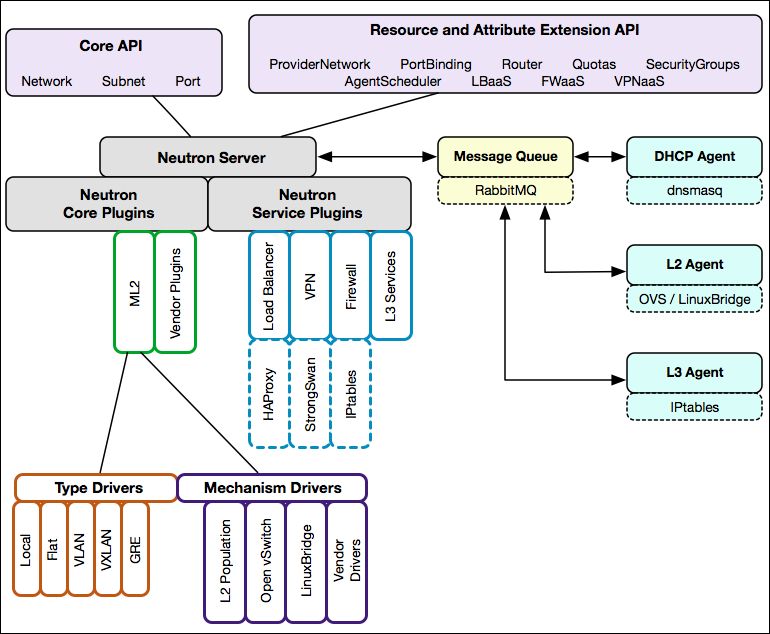
openstack neutron
Software Defined Network
Virtual switch: support Linux Bridge and Open vSwitch.
Based on the Linux Bridge and OVS, Neutron supports VLAN. Besides,
Tunneling overlay network like VxLan and GRE are supported.
Virtual router: leverages IP forwarding and iptables to do routing and NAT.
- Local: Instance can only access to the instances on the same node.
- Flat: no VLAN tagging. Instance could access to the instances in the same network, regardless the node.
- VLAN: Instances with the same VLAN tag can access to each other no matter they are on the same nodes or not. Otherwise, a router is needed.
- VxLan: overlay network based on tunneling. Each VxLan network has unique
Segmentation ID(aka VNI). In VxLan packets are transmitted by packaging into UDP packets via VNI. The packets orignal in L2 is enpacked into L3, it breaks the limitation of VLAN. - GRE: like VxLan. The main difference is that it uses IP packets instead UDP.
Any two Networks here are isolated from the view of L2.
Each Network should belong to one Project/Tenant. But one Project/Tenant could have more
than one Network.
Each two Subnet in one Network cannot have the same CIDR.
But two Subnet in two Network could.
If two instances in two Network have the same IP. The Neutron router can
take care of it. How? Use Linux Network Namespace. The routers in different
Linux network namespace have isolated route tables.
Like the ports of the virtual switch. The virtual interface (VIF) of instances can
be bound to several Ports.
Project 1 : n Network 1 : n Subnet 1 : n Port 1 : 1 VIF n : 1 Instance
Entry of Neutron request.
Linux bridge or Open vSwitch
Plugin, Agent, Network provider are a set.
For example, if the network provider is Linux bridge, then the plugin
and the agent should be the one for Linux bridge.
There are Core Plugin and Service Plugin. Core Plugin is used to
manage the Network, Subnet and Port. While Service Plugin is for routing,
firewall, load balance.
Control:
- neutron server (including Core Plugin and Service Plugin inside),
- neutron-plugin-agent
- neutron-dhcp-agent
- neutron-metadata-agent
- neutron-l3-agent
- neutron-lbaas-agent
Compute:
- neutron-plugin-agent
Control:
- neutron server (including Core Plugin and Service Plugin inside),
Network:
- neutron-plugin-agent
- neutron-dhcp-agent
- neutron-metadata-agent
- neutron-l3-agent
- neutron-lbaas-agent
Compute:
- neutron-plugin-agent
Modular Layer 2 is a core plugin. Before ML2, only one core plugin can be used. So it limits that every node would be configured to use the same core plugin agent, like Linux bridge or Open vSwitch.
ML2 is used to support the hybrid agent. When using ML2 core plugin, the node could use any agent.