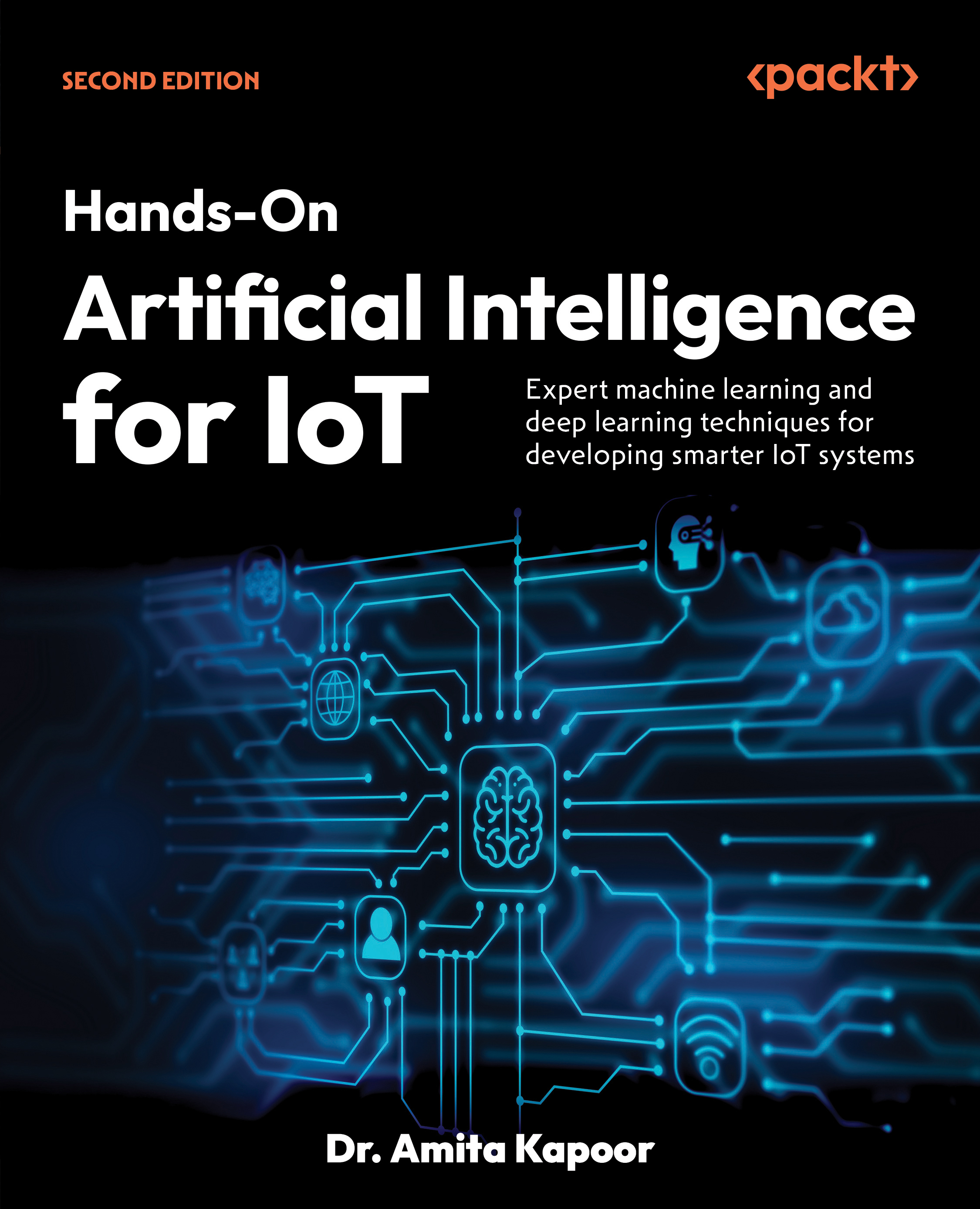
This is the code repository for Hands-On Artificial Intelligence for IoT , Second Edition, published by Packt.
Expert machine learning and deep learning techniques for developing smarter IoT systems
Transform IoT systems with the power of artificial intelligence using this hands-on guide. Dive into practical techniques and expert insights to innovate and optimize your IoT devices, making them smarter and more efficient.
This book covers the following exciting features:
- Integrate AI and IoT for enhanced device intelligence
- Understand how to build scalable and efficient IoT systems
- Master both supervised and unsupervised machine learning techniques for processing IoT data
- Explore the full potential of deep learning in IoT applications
- Discover AI-driven strategies to optimize IoT system efficiency
- Implement real-world IoT projects that leverage AI capabilities
- Improve device performance and decision-making using AI algorithms
If you feel this book is for you, get your copy today!

All of the codes are organized into folders. For example, Chapter01.
The code will look like the following:
future = model.make_future_dataframe(periods=365)

future['PT08.S1(CO)'] = df['PT08.S1(CO)'].mean()
future['NMHC(GT)'] = df['NMHC(GT)'].mean()
future['NOx(GT)'] = df['NOx(GT)'].mean()
forecast = model.predict(future)
Following is what you need for this book: This book is for IoT developers, engineers, and tech enthusiasts, particularly those with a background in Python, looking to integrate artificial intelligence and machine learning into IoT systems. Python developers eager to apply their knowledge in new, innovative ways will find it useful. It’s also an invaluable guide for anyone with a foundational understanding of IoT concepts ready to take their skills to the next level and shape the future of intelligent devices.
With the following software and hardware list you can run all code files present in the book (Chapter 1-15).
Before you begin, a working knowledge of Python is essential, as the book focuses on applying AI techniques through hands-on coding. All code examples are provided in Python and can be run easily on Google Colab, requiring minimal setup. Familiarity with basic machine learning concepts will be helpful but is not mandatory. Step-by-step instructions are included to guide you through practical implementation.
| Chapter | Software required | OS required |
|---|---|---|
| 1-15 | Keras 3 | Windows, macOS, or Linux |
| 1-15 | pandas | Windows, macOS, or Linux |
| 1-15 | NumPy | Windows, macOS, or Linux |
| 1-15 | scikit-learn | Windows, macOS, or Linux |
| 1-15 | Matplotlib | Windows, macOS, or Linux |
| 1-15 | Seaborn | Windows, macOS, or Linux |
Besides the dependencies and hardware/software requirements listed, some chapters may require additional libraries specific to the use case being discussed. These dependencies are mentioned clearly at the beginning of each relevant chapter, along with step-by-step installation instructions.
Amita Kapoor, a seasoned expert in Artificial Intelligence, serves as the Chief Artificial Intelligence Officer at Retured, bringing over 25 years of experience in AI, data science, and neuroscience. Her consultancy, NePeur, stands testament to her leadership in applying AI across diverse industries, enhancing operational efficiency and business intelligence. Amita is also a devoted board member of Neuromatch Academy, where she plays a crucial role in making neuroscience and deep learning education accessible to all. Holding a PhD from the University of Delhi, she has dedicated her career to education, authoring numerous articles and papers, and creating impactful online classes. Her significant contributions extend to pioneering projects in intelligent vehicle fleet management, surveillance through AI-powered face detection, and robust data anonymization solutions. Connect with Amita on LinkedIn.