TypeScript SDK for building encrypted Solana apps with Arcium: derive Arcium PDAs, encrypt user inputs, encode encrypted instructions, add compute/priority-fee helpers, and verify SignedComputationOutputs. Focused on crypto + transport helpers you can drop into any frontend.
Compatible with @arcium-hq/client v0.8.x (Arcium protocol v0.8.0).
- PDAs: mxe, mempool, executing pool, computation, cluster, comp_def.
deriveCompDefAccounts— async helper that fetcheslutOffsetSlotand returns the Address Lookup Table address required forinitCompDefinstructions (v0.7.0+).- Encryption helpers (X25519 + RescueCipher), nonce/computation offset generation.
- Encrypted instruction builder + compute-budget helpers (
cu_price_micro,cuLimit). - Output verification helpers for
SignedComputationOutputs(verify_output). - Environment-driven config: cluster offset/program ID provided by the consumer.
Scaffold a new terminal-styled Arcium app with built-in Solana wallet support:
npx crucible init <project-name>
# or
crucible init <project-name>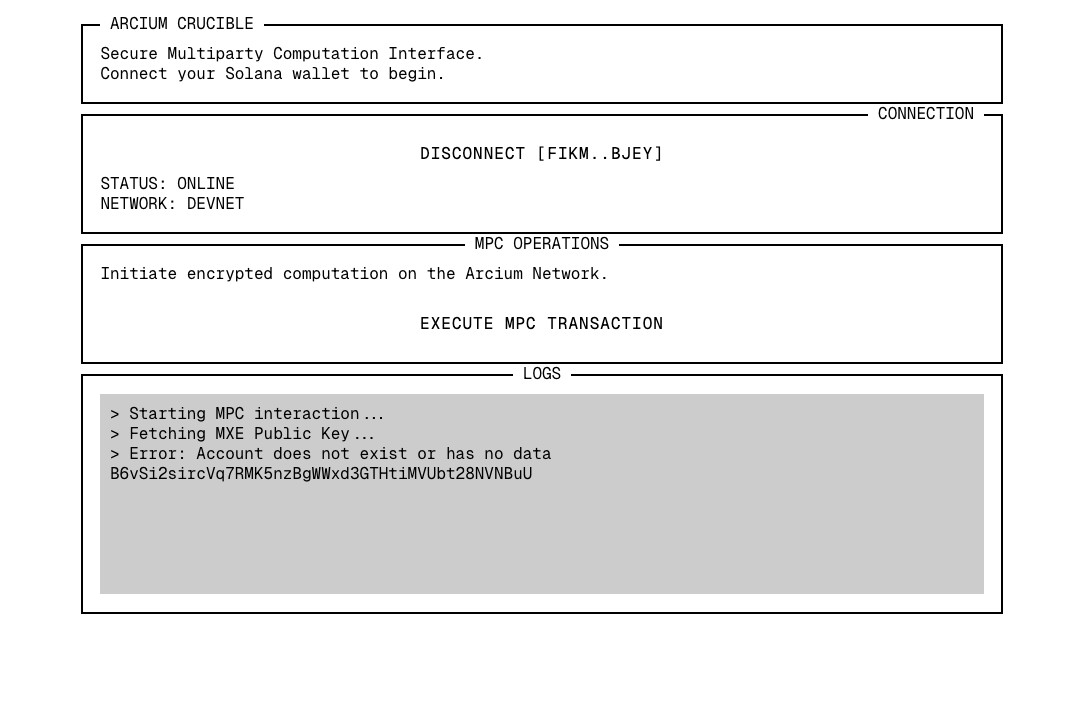
Published package (with required peers):
npm install arcium-frontend-sdk @coral-xyz/anchor @solana/web3.js @arcium-hq/clientLocal workspace build (current repo):
cd arcium-sdk
npm install
npm run build
Requires Node 20.18+.
ARCIUM_CLUSTER_OFFSET— required; keep per environment (dev/stage/prod) in.env.NEXT_PUBLIC_RPC_URL/RPC_URL— optional RPC (defaults to devnet).NEXT_PUBLIC_MXE_PROGRAM_ID— your program ID; the SDK never hardcodes it.POOL_ACCOUNT_PUBKEY/CLOCK_ACCOUNT_PUBKEY— shared game accounts used across the sample frontends (defaults shown below; override via env if yours differ).
.env.example:
ARCIUM_CLUSTER_OFFSET=768109697
NEXT_PUBLIC_RPC_URL=https://api.devnet.solana.com
NEXT_PUBLIC_MXE_PROGRAM_ID=ReplaceWithProgramId
POOL_ACCOUNT_PUBKEY=FsWbPQcJQ2cCyr9ndse13fDqds4F2Ezx2WgTL25Dke4M
CLOCK_ACCOUNT_PUBKEY=AxygBawEvVwZPetj3yPJb9sGdZvaJYsVguET1zFUQkV
Every comp def must be initialized before encrypted instructions can be queued. Since v0.7.0, the initCompDef instruction requires an Address Lookup Table account derived from mxeAcc.lutOffsetSlot. Use deriveCompDefAccounts to get all the pieces:
import { deriveCompDefAccounts } from 'arcium-frontend-sdk';

const { compDefAccount, mxeAccount, addressLookupTable } = await deriveCompDefAccounts(provider, {
  programId: program.programId,
  compDefName: 'my_computation', // snake_case name matching your circuit
});

await program.methods.initMyComputationCompDef()
  .accounts({ compDefAccount, payer: wallet.publicKey, mxeAccount, addressLookupTable })
  .signers([wallet])
.rpc({ preflightCommitment: 'confirmed', commitment: 'confirmed' });import { PublicKey } from '@solana/web3.js';
import * as anchor from '@coral-xyz/anchor';
import {
ensureEnvConfig,
deriveCoreAccounts,
prepareEncryptionPayload,
encodeEncryptedCall,
buildInstruction,
buildComputeBudgetIxs,
randomComputationOffset,
} from 'arcium-frontend-sdk';
import { getMXEPublicKey } from '@arcium-hq/client';
// 0) Env (cluster offset may differ per env)
const env = ensureEnvConfig(); // reads ARCIUM_CLUSTER_OFFSET
const programId = new PublicKey(process.env.NEXT_PUBLIC_MXE_PROGRAM_ID!);
// 1) Fetch MXE public key from chain
const mxePubkey = await getMXEPublicKey(provider, programId);
// 2) Encrypt inputs (numbers/bigints)
const computationOffset = randomComputationOffset();
const encrypted = prepareEncryptionPayload({
values: [1n, 2n, 3n, 4n],
mxePublicKey: mxePubkey,
});
// 3) Derive PDAs
const derived = deriveCoreAccounts({
programId,
clusterOffset: env.clusterOffset,
computationOffset,
compDefOffset: 'my_comp_def', // string -> getCompDefAccOffset
});
// 4) Build ix data (use your 8-byte discriminator from IDL)
const discriminator = Buffer.alloc(8);
const data = encodeEncryptedCall({
discriminator,
computationOffset,
encryptionPubkey: encrypted.encryptionPubkey,
nonce: encrypted.nonce,
ciphertexts: encrypted.ciphertexts,
});
// 5) Account metas in your IDL order, then build the instruction
const keys = [
{ pubkey: wallet.publicKey, isSigner: true, isWritable: true },
{ pubkey: derived.mxeAccount, isSigner: false, isWritable: false },
{ pubkey: derived.mempoolAccount, isSigner: false, isWritable: true },
{ pubkey: derived.executingPool, isSigner: false, isWritable: true },
{ pubkey: derived.computationAccount, isSigner: false, isWritable: true },
{ pubkey: derived.compDefAccount, isSigner: false, isWritable: false },
{ pubkey: derived.clusterAccount, isSigner: false, isWritable: true },
// ... your program-specific accounts ...
{ pubkey: derived.arciumProgramId, isSigner: false, isWritable: false },
];
const { ix } = buildInstruction({ programId, accounts: keys, data });
// 6) Optional compute budget
const budgetIxs = buildComputeBudgetIxs({ cuPriceMicro: 1000, cuLimit: 1_400_000 });Full runnable example: examples/battle-frontend.ts.
import { verifySignedOutputs, assertVerified } from 'arcium-frontend-sdk';

function handleCallback(signedOutputs: { verify_output: () => boolean; payload: unknown }) {
  assertVerified(signedOutputs); // throws if invalid
  return signedOutputs.payload;
}
See examples/callback-verify.ts.
| Module | Exports |
|---|---|
config |
ensureEnvConfig, loadEnvConfig, createConnection, createAnchorProvider, toArciumEnv |
accounts |
deriveCoreAccounts, deriveCompDefAccounts, toBuffer |
encryption |
prepareEncryptionPayload, randomComputationOffset, randomNonce, generateKeypair, deriveSharedSecret, encryptBigints, buildEncryptedArgs |
transactions/compute |
encodeEncryptedCall, buildInstruction, buildComputeBudgetIxs, buildTransaction |
results |
verifySignedOutputs, assertVerified |
- Updated
@arcium-hq/clientdependency to^0.8.4(supports Arcium protocol v0.8.0). - New:
deriveCompDefAccounts(provider, { programId, compDefName })— async helper forinitCompDefinstructions. FetchesmxeAcc.lutOffsetSlotand returns{ compDefAccount, mxeAccount, addressLookupTable, compDefAccAddress, compDefOffset }. - New type:
DerivedCompDefAccounts. generateKeypair()updated:x25519.utils.randomPrivateKey()→x25519.utils.randomSecretKey()(renamed in@noble/curves).
- Initial public release with
@arcium-hq/client@0.5.xsupport.
If you ask an AI assistant (Cursor, Claude Code, Copilot Workspace, etc.) to wire this SDK into your app, hand it LLM_GUIDE.md. That file gives the model exact steps, required env vars, and the canonical flow to encrypt inputs, derive Arcium PDAs, build encrypted instructions, and verify results using the published npm package.
MIT © 2025 sicmundus