



A hardware implementation of a 2-layer neural network for MNIST digit classification, designed for Tiny Tapeout.
Tiny Tapeout is an educational project that makes it easier and cheaper than ever to get digital designs manufactured on real silicon. Learn more at tinytapeout.com.
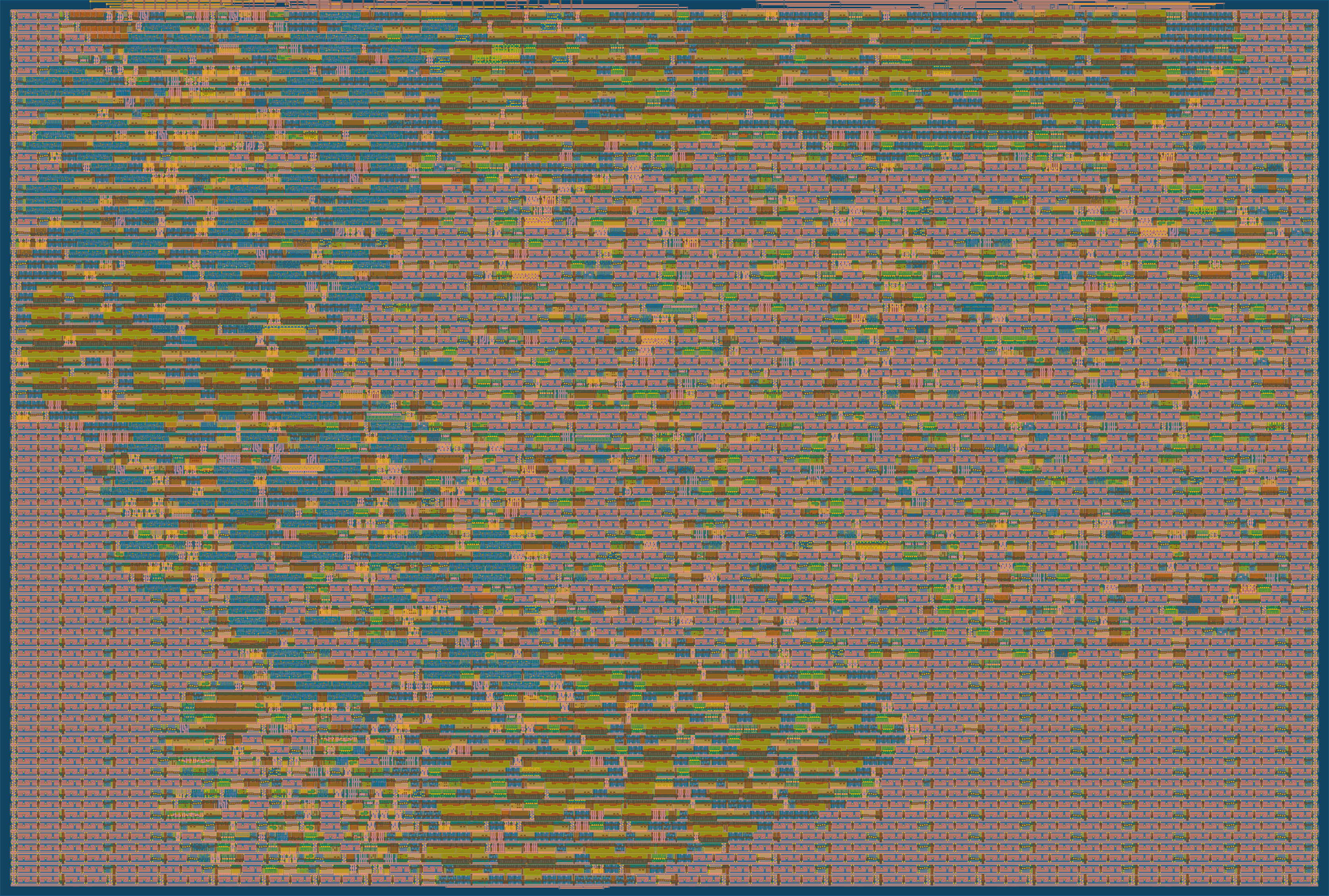
This project implements a complete neural network inference pipeline in Verilog, optimized for minimal gate count while maintaining good accuracy on handwritten digit recognition.
Architecture:
- Input: 8×8 pixels, 2-bit quantized (streamed 4 pixels/cycle)
- Layer 1: 64 → 48 neurons (ternary weights, sign activation)
- Layer 2: 48 → 10 neurons (ternary weights)
- Output: Digit prediction (0-9) via argmax
Performance:
- Accuracy: 80.96% on quantized MNIST test set
- Throughput: ~3,876 cycles per inference @ 10MHz = 388µs
- Gate count: ~180 gates
- Memory: 917 bytes ROM (weights + biases)
- Pixel Streaming (16 cycles) - Load 64 pixels via parallel interface (4 pixels/cycle)
- Layer 1 Computation (~3,216 cycles) - Sequential MAC operations for 48 neurons
- Layer 2 Computation (~520 cycles) - Sequential MAC operations for 10 output neurons
- Argmax (11 cycles) - Combinational logic finds maximum logit
- Result Ready - 4-bit prediction output
ternary_mac.v- Multiply-accumulate unit for {-1, 0, +1} weightslayer1_neuron.v- Single neuron compute (64 MACs + bias)sign_activation.v- Sign function: ±1 based on input signlayer2_neuron.v- Output layer neuron (48 MACs + bias)argmax.v- Parallel comparator tree for maximum logitmnist_top.v- FSM coordinator and memory managementproject.v- Tiny Tapeout wrapper (pin mapping)
- Ternary weights ({-1, 0, +1}) - No multipliers needed
- Sequential MAC - Single compute unit reused for all neurons
- K-means quantization - Input pixels quantized to 2-bit with optimal thresholds [33, 99, 169]
- ROM-based weights - All parameters stored in synthesizable memory
- Parallel streaming - 4 pixels/cycle reduces input latency
ui[1:0]- Pixel 0 (2-bit)ui[3:2]- Pixel 1 (2-bit)ui[5:4]- Pixel 2 (2-bit)ui[7:6]- Pixel 3 (2-bit)
uo[3:0]- Predicted digit (0-9)uo[4]- Done flaguo[5]- Busy flaguo[7:6]- Unused
uio[0]- Start signal (input)uio[7:1]- Unused
Run the Cocotb test suite:
nix develop -c uv run make -BExpected output: 10/10 tests passed (100.0%)
View waveforms:
gtkwave tb.vcdSee test/README.md for detailed testing information.
src/
├── project.v          # Tiny Tapeout wrapper
├── mnist_top.v        # Top-level FSM and memory
├── layer1_full.v      # Layer 1 controller + ROM
├── layer1_neuron.v    # Single neuron compute
├── layer2_full.v      # Layer 2 controller + ROM
├── layer2_neuron.v    # Output neuron compute
├── ternary_mac.v      # Core MAC unit
├── sign_activation.v  # Sign activation function
├── argmax.v           # Maximum finder
└── *.hex              # Weight/bias ROM data

test/
├── test.py            # Cocotb tests
├── tb.v               # Verilog testbench
└── test_vectors/      # Golden reference data

experiments/
└── winner_48h_kmeans/ # Training code and model
The model was trained using:
- Framework: Custom PyTorch implementation
- Dataset: MNIST downsampled to 8×8 with K-means quantization
- Optimization: Grid search over seeds, learning rates, layer sizes
- Validation: Python sequential forward pass matches Verilog exactly
Training code: experiments/winner_48h_kmeans/
- Tiny Tapeout - Get your designs manufactured
- Project Documentation - Detailed design information
- FAQ - Common questions
- Discord Community - Get help and share
Licensed under Apache 2.0. See project files for details.