Code of "Fourier Series Expansion Based Filter Parametrization for Equivariant Convolutions"
Paper link
Arxiv link
Supplementary Material
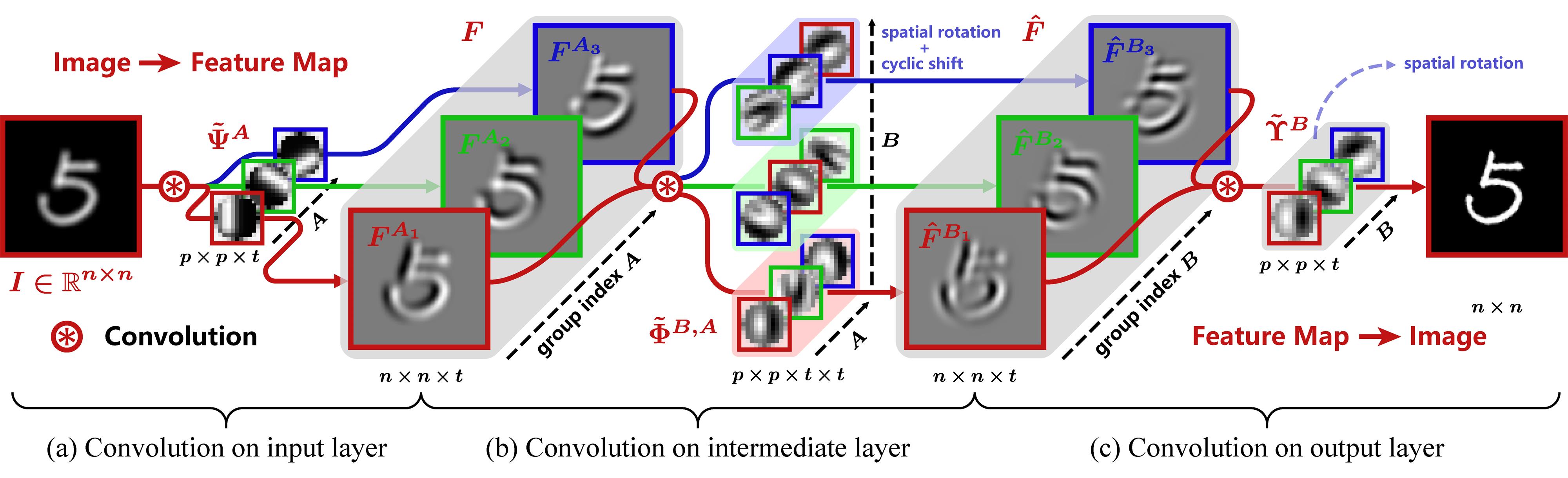
MinistExp\    : Code for the experiments on minist dataset
SRExp\        : Code for the experiments of image super resolution
F_Conv        : Code of the F-Conv proposed in our TPAMI paper
B_Conv        : Code of the B-Conv, new version of F-Conv
Supplementary Material.pdf: Supplementary Material
F-Convs are rotation equivariant convolutions with high representation accuracy, which can perform better on low-level computer vision tasks as comparsion with pervious rotation equivariant convolution methods.
Rotation symmetry on local features is an important structure characteristics of image, which can be hardly captured by commonly used CNN, as shown in the folliwing figure:
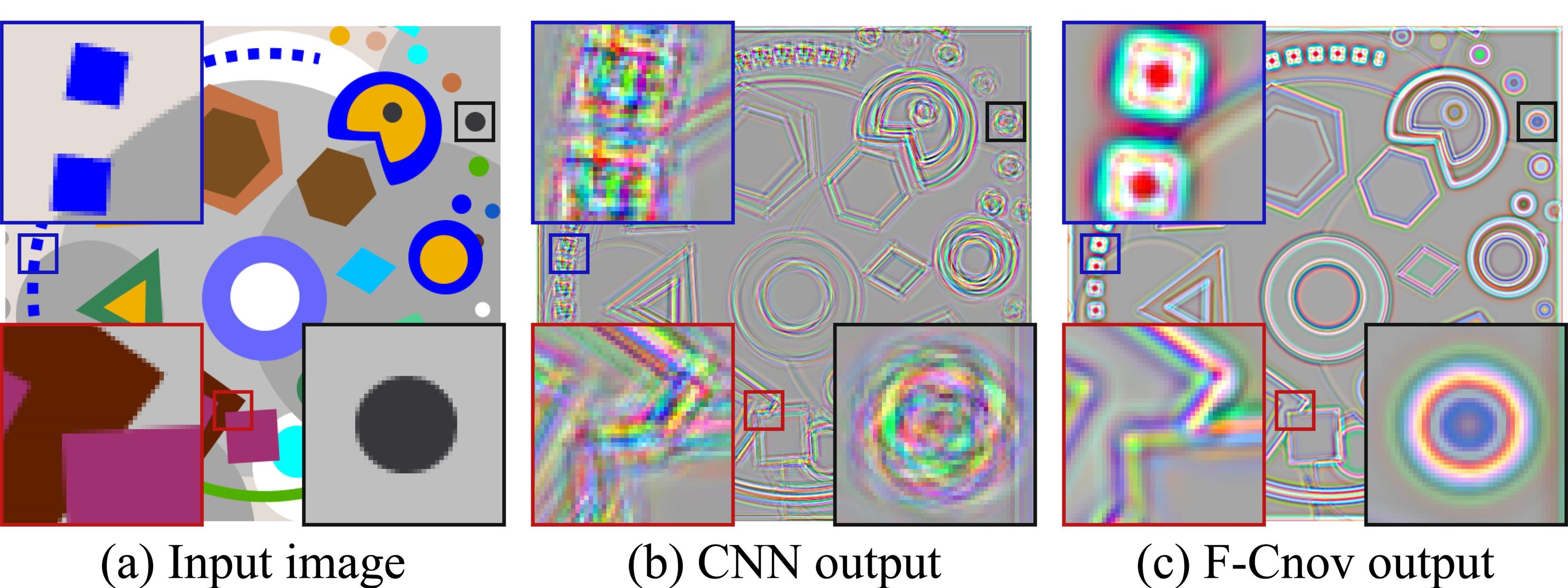
From the figure, we can also observe that the proposed F-Conv is expected to better maintain the symmetry of local features underlying the image, which should be help for the computer vision tasks.
Besides the output of F-Conv can be more stable than output of CNN when the input is rotated, as shown in the following two figures.
CNN results:

F-Conv results:

Usage:
For your CNN network, replace all the convolution layers with the proposed F-Conv layers.
Specifically, for the first layer of network, use Fconv_PCA with ifIni=1. For example:
#first layer of CNN

import torch.nn as nn
Conv_1 = nn.Conv_2d(c_in, c_out, kernel_size)

#first layer of F-Conv

import F_Conv as fn
tranNum = 4 #2*pi/tranNum degree rotation equviariant
Conv_1 = fn.Fconv_PCA(kernel_size, c_in, c_out//tranNum, tranNum, ifIni=1)
# ifIni=1 is important
For the intermediate layer of network, use Fconv_PCA with ifIni=0. For example:
#intermediate layer of CNN

Conv_2 = nn.Conv_2d(c_in, c_out, kernel_size)

#intermediate layer of F-Conv

Conv_2 = fn.Fconv_PCA(kernel_size, c_in//tranNum, c_out//tranNum, tranNum, ifIni=0)
# ifIni=0 is important
For the output layer of network, use Fconv_PCA_out. For example:
#output layer of CNN

Conv_3 = nn.Conv_2d(c_in, c_out, kernel_size)

#output layer of F-Conv

Conv_3 = fn.Fconv_PCA_out(kernel_size, c_in//tranNum, c_out, tranNum)
More detail usage can be found in the subfolders
Citation:
Qi Xie, Qian Zhao, Zongben Xu and Deyu Meng*.
Fourier Series Expansion Based Filter Parametrization for Equivariant Convolutions[J].
IEEE transactions on pattern analysis and machine intelligence, 2022.
BibTeX:
@article{xie2022FConv,
title={Fourier Series Expansion Based Filter Parametrization for Equivariant Convolutions},
author={Xie, Qi and Zhao, Qian and Xu, Zongben and Meng, Deyu},
journal={IEEE Transactions on Pattern Analysis and Machine Intelligence},
year={2022},
publisher={IEEE}
}