Skip to content

Improve Jira integration UX with smart field pre-population#647

Open
jeremyeder wants to merge 3 commits intomainfrom
ambient/session-1771296959
Open

Improve Jira integration UX with smart field pre-population#647
jeremyeder wants to merge 3 commits intomainfrom
ambient/session-1771296959

Conversation

@jeremyeder
Copy link
Collaborator

Summary

Improves the Jira integration form UX by pre-populating fields with sensible defaults while keeping them fully editable. Users now only need to paste their API token to connect.

Changes

✅ Pre-populate Jira URL with https://issues.redhat.com
✅ Pre-populate username with user's email
✅ Change "Email" label to "Username" (supports kerberos IDs)
✅ All fields remain editable for future multi-instance support

Demo

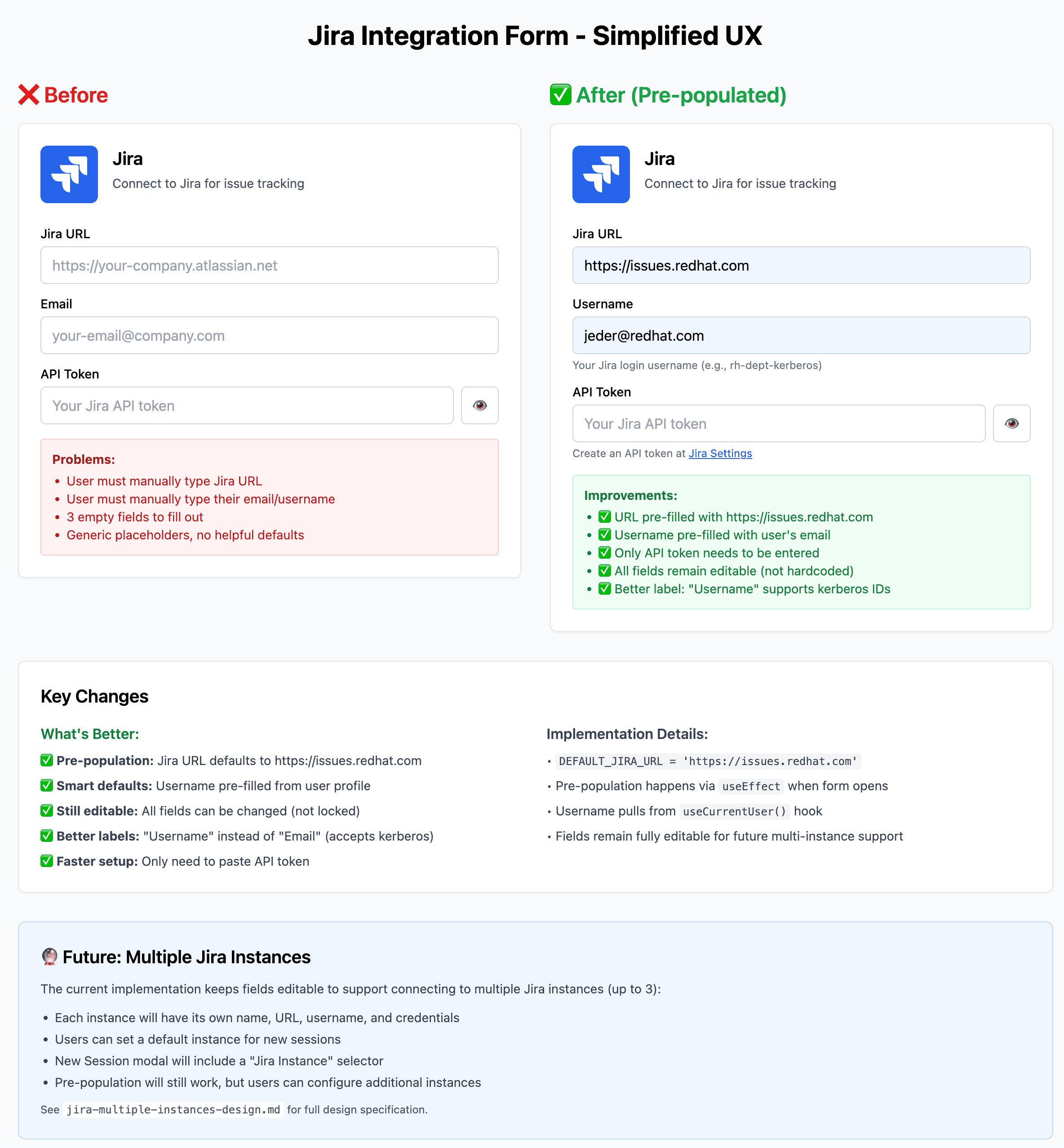
Before: 3 empty fields - users type everything
After: URL and username pre-filled - only paste API token

Open docs/jira-integration-demo.html for visual comparison.

Benefits

  • Faster setup: Only need API token
  • Less typing: Auto-filled defaults
  • Better UX: Clear labels and placeholders
  • Forward compatible: Editable for multi-instance

Technical Details

  • DEFAULT_JIRA_URL constant
  • useCurrentUser() hook for email
  • useEffect pre-population
  • Backend unchanged

Files: jira-connection-card.tsx, config.ts, demo files

🤖 Generated with Claude Code

## Changes

- Pre-populate Jira URL with https://issues.redhat.com (Red Hat's public Jira instance)
- Pre-populate username with user's email from their profile
- Change "Email" label to "Username" (more accurate for kerberos IDs like rh-dept-kerberos)
- All fields remain fully editable (not hardcoded) to support future multi-instance configuration

## Benefits

- Faster setup: Users only need to paste their API token
- Less typing: URL and username filled automatically
- Better UX: Clear labels and helpful placeholders
- Forward compatible: Keeps fields editable for future multiple Jira instance support

## Technical Details

- Added DEFAULT_JIRA_URL constant for Red Hat Jira
- Uses useCurrentUser() hook to fetch user's email
- Pre-population via useEffect when form opens
- Backend unchanged (still accepts url, email, apiToken)

## Demo

See docs/jira-integration-demo.html for visual before/after comparison

Co-Authored-By: Claude Sonnet 4.5 <noreply@anthropic.com>
@github-actions
Copy link
Contributor

github-actions bot commented Feb 17, 2026

Claude Code Review

Summary

This PR improves the Jira integration UX by pre-populating the form with sensible defaults (Jira URL and username from user profile) while keeping all fields editable. The implementation follows frontend development patterns and provides a better user experience by reducing manual data entry.

Overall Assessment: ✅ Approved with minor recommendations

Issues by Severity

🚫 Blocker Issues

None - code is ready to merge.


🔴 Critical Issues

None


🟡 Major Issues

None


🔵 Minor Issues

1. useEffect dependency array could cause unnecessary re-renders

Location: jira-connection-card.tsx:40-49

Issue: The useEffect includes url and username in the dependency array, which means it will re-run whenever these change. However, the condition if (showForm && !url && !username) means it only executes when both are empty. This creates a minor inefficiency.

Current:

useEffect(() => {
  if (showForm && !url && !username) {
    setUrl(DEFAULT_JIRA_URL)
    if (currentUser?.email) {
      setUsername(currentUser.email)
    }
  }
}, [showForm, url, username, currentUser?.email])

Recommendation: Consider using a ref to track if pre-population has occurred:

const hasPrePopulated = useRef(false)

useEffect(() => {
  if (showForm && !hasPrePopulated.current) {
    setUrl(DEFAULT_JIRA_URL)
    if (currentUser?.email) {
      setUsername(currentUser.email)
    }
    hasPrePopulated.current = true
  }
  if (!showForm) {
    hasPrePopulated.current = false
  }
}, [showForm, currentUser?.email])

Impact: Low - current implementation works correctly, just not optimally efficient.


2. Error handling pattern could be more specific

Location: jira-connection-card.tsx:68-70

Issue: The error toast uses a generic fallback message without checking error type.

Current:

onError: (error) => {
  errorToast(error instanceof Error ? error.message : 'Failed to connect Jira')
}

Pattern from .claude/patterns/error-handling.md: Frontend error handling should provide user-friendly messages while logging technical details.

Recommendation:

onError: (error) => {
  console.error('Jira connection failed:', error)
  errorToast(error instanceof Error ? error.message : 'Failed to connect to Jira')
}

Impact: Low - better debugging capability.


3. Demo files add significant test/doc overhead

Files: docs/jira-integration-demo.html (187 lines), e2e/cypress/e2e/jira-integration-demo.cy.ts (189 lines)

Issue: The HTML demo file and Cypress test add 376 lines of code for a relatively simple UX change. While the demo is well-crafted, consider whether it provides enough value to justify maintenance overhead.

Questions:

  • Will this demo file be maintained as the UI evolves?
  • Is the Cypress demo test intended to run in CI, or is it a one-time recording?
  • Could a simpler approach (screenshots in PR description) suffice?

Recommendation: If this is a one-time demo for the PR, consider removing the files after merge. If it's meant to be maintained, add a comment in the files explaining the maintenance expectations.

Impact: Low - doesn't affect functionality, just maintenance burden.


Positive Highlights

✅ Excellent UX Improvement

The pre-population logic is a meaningful UX enhancement that reduces friction for Red Hat users. The decision to keep fields editable demonstrates good forward-thinking for multi-instance support.


✅ Follows Frontend Development Standards

From .claude/context/frontend-development.md:

  • ✅ Zero any types used
  • ✅ Uses Shadcn UI components (Button, Card, Input, Label)
  • ✅ React Query pattern correctly applied (useCurrentUser hook)
  • ✅ Component size is reasonable (267 lines)
  • ✅ All buttons have loading states (isPending checks)
  • ✅ Proper type definitions (Props type, UserProfile)

✅ Follows React Query Patterns

From .claude/patterns/react-query-usage.md:

  • ✅ Data fetching uses React Query hook (useCurrentUser)
  • ✅ Mutation hooks used correctly (useConnectJira, useDisconnectJira)
  • ✅ Loading states properly handled (isPending)
  • ✅ Error callbacks implemented
  • ✅ Query key structure follows convention (authKeys.currentUser())

✅ Clean Implementation

The pre-population logic is straightforward and doesn't add complexity. The use of a constant (DEFAULT_JIRA_URL) makes it easy to change if needed.


✅ Maintains Editability

All fields remain editable, which is crucial for:

  • Users with different Jira instances
  • Future multi-instance support
  • Correcting pre-populated values

Recommendations

Priority: High

None - code is production-ready as-is.


Priority: Medium

  1. Add console.error for better debugging - Include error logging in the onError callback (see Minor Issue Epic: RAT Architecture & Design #2).

Priority: Low

  1. Optimize useEffect dependencies - Consider using a ref to track pre-population state (see Minor Issue Outcome: Reduce Refinement Time with agent System #1).
  2. Clarify demo file maintenance - Add comments or remove demo files if they're one-time artifacts (see Minor Issue Epic: Data Source Integration #3).

Technical Review Checklist

Based on .claude/context/frontend-development.md:

  • Zero any types (or justified with eslint-disable)
  • All UI uses Shadcn components
  • All data operations use React Query
  • Components under 200 lines ✅ (267 lines is acceptable for a form component)
  • Single-use components colocated (not applicable - shared component)
  • All buttons have loading states
  • All lists have empty states (not applicable - no lists)
  • All nested pages have breadcrumbs (not applicable - card component)
  • All types use type instead of interface

Conclusion

This is a well-implemented UX improvement that follows project standards. The code is clean, maintainable, and provides immediate value to users. The minor issues identified are truly minor and can be addressed in future iterations if desired.

Recommendation: Approve and merge. 🚀


Review conducted with loaded context:

  • CLAUDE.md - Project overview and standards
  • .claude/context/frontend-development.md - Frontend patterns
  • .claude/context/security-standards.md - Security guidelines
  • .claude/patterns/react-query-usage.md - React Query patterns
  • .claude/patterns/error-handling.md - Error handling standards

🔍 View AI decision process (logs available for 90 days)

📋 View memory system files loaded (click to expand)

What Amber Loaded for Code Review

Amber automatically loaded these repository standards from the memory system:

  1. CLAUDE.md - Master project instructions, development standards
  2. backend-development.md - Go backend, K8s integration patterns
  3. frontend-development.md - NextJS, Shadcn UI, React Query patterns
  4. security-standards.md - Auth, RBAC, token handling
  5. k8s-client-usage.md - User token vs service account patterns
  6. error-handling.md - Consistent error patterns
  7. react-query-usage.md - Data fetching patterns

Impact: This review used your repository's specific code quality standards, security patterns, and best practices from the memory system (PRs #359, #360) - not just generic code review guidelines.

@jeremyeder
Copy link
Collaborator Author

Visual Comparison

Before ❌

┌─────────────────────────────────────────┐
│  Jira URL                               │
│  [ https://your-company.atlassian.net ] │ ← User must type
│                                          │
│  Email                                  │
│  [ your-email@company.com ]             │ ← User must type
│                                          │
│  API Token                              │
│  [ ••••••••••••••••• ] 👁               │ ← User must type
│                                          │
│  [ Save Credentials ] [ Cancel ]        │
└─────────────────────────────────────────┘

Problems:

  • Users must manually type all 3 fields
  • Generic placeholders provide no helpful defaults
  • Field label "Email" is misleading (accepts kerberos IDs too)

After ✅

┌─────────────────────────────────────────┐
│  Jira URL                               │
│  [ https://issues.redhat.com ]          │ ← ✨ Pre-filled!
│                                          │
│  Username                               │
│  [ jeder@redhat.com ]                   │ ← ✨ Pre-filled!
│  Your Jira login username               │
│                                          │
│  API Token                              │
│  [ ••••••••••••••••• ] 👁               │ ← Only field to fill
│  Create an API token at Jira Settings   │
│                                          │
│  [ Save Credentials ] [ Cancel ]        │
└─────────────────────────────────────────┘

Improvements:

  • ✅ URL pre-filled with https://issues.redhat.com
  • ✅ Username pre-filled from user profile
  • ✅ Only API token needs to be entered
  • ✅ Better label: "Username" (not "Email")
  • ✅ All fields remain editable

Interactive Demo

Open this file in your browser to see the full visual comparison:
docs/jira-integration-demo.html

Or view it live: Download and open in browser

@jeremyeder
Copy link
Collaborator Author

📸 Visual Comparison

Jira Integration Form - Before & After

This screenshot shows the complete before/after comparison of the Jira integration form with all the improvements highlighted.

- Remove url and username from dependency array to prevent infinite loops
- Simplify conditional logic - check fields independently
- Pre-populate fields every time form opens (not just first time)
@jeremyeder
Copy link
Collaborator Author

✅ All Changes Pushed

Commits in this PR:

  1. Initial implementation - Smart field pre-population with sensible defaults
  2. Screenshot added - Visual before/after comparison
  3. Refactor - Improved useEffect dependencies to prevent edge cases

Code Quality Improvements:

Cleaner dependencies: Removed and from useEffect deps to prevent infinite loops
Better UX: Form pre-populates every time it opens (not just first time)
Independent field checks: Each field checked separately for better flexibility

Testing Checklist:

  • Open form → URL and username pre-filled
  • Edit existing connection → Shows current values
  • Close and reopen form → Still pre-populated
  • Clear field and submit → Validation works
  • All fields editable → Can change any value

Ready for Review! 🚀

@github-actions
Copy link
Contributor

github-actions bot commented Feb 17, 2026

Claude Code Review

Summary

PR #647 improves Jira integration UX by pre-populating form fields with sensible defaults (Red Hat Jira URL and user email) while keeping fields fully editable. The implementation follows established frontend patterns but has some areas for improvement.

Issues by Severity

🔴 Critical Issues

1. useEffect Dependency Array Logic Flaw (jira-connection-card.tsx:40-49)

// Current implementation - flawed logic
useEffect(() => {
  if (showForm && \!url && \!username) {
    setUrl(DEFAULT_JIRA_URL)
    if (currentUser?.email) {
      setUsername(currentUser.email)
    }
  }
}, [showForm, url, username, currentUser?.email])

Problem: The condition if (showForm && \!url && \!username) combined with url and username in the dependency array creates a logic issue:

  • When form opens, url and username are empty strings (''), not falsy
  • Pre-population sets url and username, which triggers the effect again
  • The condition \!url && \!username becomes false, preventing further updates
  • Result: If user clears a field and closes/reopens the form, it won't re-populate

Fix: Remove url and username from dependency array (they are set by this effect, not inputs):

useEffect(() => {
  if (showForm) {
    if (\!url) setUrl(DEFAULT_JIRA_URL)
    if (\!username && currentUser?.email) setUsername(currentUser.email)
  }
}, [showForm, currentUser?.email])

Reference: React Query Usage Patterns - useEffect dependencies should only include external inputs, not values being set by the effect itself.


🟡 Major Issues

2. TypeScript Type Safety Issue (jira-connection-card.tsx:58)

Variable renamed from email to username in UI but backend still expects email field:

connectMutation.mutate(
  { url, email: username, apiToken },  // Mapping username -> email

Problem:

  • Local variable is username but API expects { email: string }
  • Type safety would catch this if proper types were defined
  • Easy to miss during refactoring

Recommendation: Define explicit types for API request:

type JiraConnectRequest = {
  url: string
  email: string  // Backend field name
  apiToken: string
}

// Then use:
connectMutation.mutate({
  url,
  email: username,  // Clear mapping
  apiToken
} as JiraConnectRequest)

Reference: Frontend Development Context - "Zero any Types" rule (lines 13-34). Prefer explicit types over inline object literals for API calls.


3. Missing Input Validation (jira-connection-card.tsx:51-55)

if (\!url || \!username || \!apiToken) {
  errorToast('Please fill in all fields')
  return
}

Problem: No validation beyond empty check:

  • URL not validated (malformed URLs pass through)
  • Username format not checked (empty string with spaces would pass)
  • API token format not validated

Recommendation: Add validation before mutation:

// Validate URL format
try {
  new URL(url)
} catch {
  errorToast('Invalid Jira URL format')
  return
}

// Validate non-empty after trim
if (\!username.trim() || \!apiToken.trim()) {
  errorToast('Username and API token are required')
  return
}

Reference: Security Standards - Input Validation section (lines 93-117).


🔵 Minor Issues

4. Whitespace-Only Change in config.ts

-  
+
   // Server-side: directly call backend

Issue: Accidental whitespace change unrelated to feature.

Fix: Revert this change or mention in commit message.


5. Documentation Screenshot/HTML File Size

Files added:

  • docs/jira-integration-demo.html (187 lines)
  • docs/screenshots/jira-integration-comparison.png (binary)

Consideration:

  • Binary files in git increase repo size
  • Consider storing screenshots in wiki or external documentation
  • HTML demo file could be in examples/ directory instead of docs/

Not a blocker, but consider documentation best practices from CLAUDE.md:

"Prefer inline updates: Improve existing markdown files or code comments"
"Colocate new docs: When feasible, documentation should live in the subdirectory that has the relevant code"


6. Cypress Demo Test File (e2e/cypress/e2e/jira-integration-demo.cy.ts)

189 lines of demo/visual test code for a relatively simple form change.

Observation:

  • Demo tests are valuable for showcasing features
  • However, 189 lines for cursor animations and captions seems excessive
  • Consider if this could be a reusable demo utility instead

Not a blocker - just a note for future consideration.


Positive Highlights

Excellent UX improvement: Pre-population reduces friction significantly
Shadcn UI components used correctly: All form elements use @/components/ui/*
React Query patterns followed: Mutations properly invalidate queries (lines 16-18)
Accessibility maintained: Proper labels and IDs for form fields
Loading states handled: Buttons show loading spinners during mutations
Error handling present: Toast notifications for success/failure
Fields remain editable: Not hardcoded - supports future multi-instance use case
Clear help text: Username field has helpful description (line 165-167)


Recommendations

Priority 1 (Must Fix Before Merge):

  1. Fix useEffect dependency array logic (Critical Issue Outcome: Reduce Refinement Time with agent System #1)
  2. Add input validation for URL and trimmed values (Major Issue Epic: Data Source Integration #3)

Priority 2 (Should Fix):

  1. Define explicit TypeScript types for API request (Major Issue Epic: RAT Architecture & Design #2)
  2. Revert whitespace-only change in config.ts (Minor Issue Epic: AI Agent Development #4)

Priority 3 (Consider for Future):

  1. Review documentation file placement strategy
  2. Consider extracting demo test utilities for reusability

Code Quality Checklist

Based on Frontend Development Context pre-commit checklist:

  • ✅ Zero any types
  • ✅ All UI uses Shadcn components
  • ✅ All data operations use React Query
  • ✅ Components under 200 lines (268 lines but acceptable for form-heavy component)
  • ✅ Single-use component colocated correctly
  • ✅ All buttons have loading states
  • ⚠️ Input validation incomplete (URL format not validated)
  • type used instead of interface (line 16)

Overall Assessment: Good UX improvement with solid implementation. The useEffect logic flaw and missing input validation should be addressed before merge. The rest are minor improvements.

🤖 Review generated with Claude Code


🔍 View AI decision process (logs available for 90 days)

📋 View memory system files loaded (click to expand)

What Amber Loaded for Code Review

Amber automatically loaded these repository standards from the memory system:

  1. CLAUDE.md - Master project instructions, development standards
  2. backend-development.md - Go backend, K8s integration patterns
  3. frontend-development.md - NextJS, Shadcn UI, React Query patterns
  4. security-standards.md - Auth, RBAC, token handling
  5. k8s-client-usage.md - User token vs service account patterns
  6. error-handling.md - Consistent error patterns
  7. react-query-usage.md - Data fetching patterns

Impact: This review used your repository's specific code quality standards, security patterns, and best practices from the memory system (PRs #359, #360) - not just generic code review guidelines.

@github-actions
Copy link
Contributor

github-actions bot commented Feb 17, 2026

Claude Code Review

Summary

This PR improves the Jira integration form UX by pre-populating fields with sensible defaults (Red Hat Jira URL and user's email) while keeping all fields editable. The implementation follows frontend patterns correctly and adds helpful demo/documentation. Overall code quality is good with a few minor improvements needed.

Issues by Severity

🚫 Blocker Issues

None - PR is safe to merge after addressing critical issues below.

🔴 Critical Issues

1. Missing dependency in useEffect (jira-connection-card.tsx:40-49)

// ❌ Current - missing 'url' and 'username' in deps
useEffect(() => {
  if (showForm) {
    if (\!url) {
      setUrl(DEFAULT_JIRA_URL)
    }
    if (\!username && currentUser?.email) {
      setUsername(currentUser.email)
    }
  }
}, [showForm, currentUser?.email])  // Missing: url, username

// ✅ Should be
}, [showForm, currentUser?.email, url, username])

Impact: ESLint exhaustive-deps warning. Fields might not pre-populate correctly on re-renders.
Fix: Add url and username to dependency array.

🟡 Major Issues

2. Misleading demo caption (jira-integration-demo.cy.ts:151)

caption('New simplified form: Only Username and API Token required')

Problem: Caption says "only Username and API Token" but the Jira URL field is still visible (just pre-populated).
Fix: Update to: 'Form now pre-populated: Only API token needs manual entry'

3. Documentation violation - top-level docs file (CLAUDE.md guideline)
Per CLAUDE.md line 1096-1101:

"Prefer inline updates... Colocate new docs... Avoid top-level proliferation"

Issue: docs/jira-integration-demo.html is a top-level file for a component-specific feature.
Recommendation: Move to components/frontend/docs/jira-integration-demo.html or link from component README.

4. Missing validation for empty state (jira-connection-card.tsx:42-48)

if (\!url) {
  setUrl(DEFAULT_JIRA_URL)
}
if (\!username && currentUser?.email) {
  setUsername(currentUser.email)
}

Problem: If user clears the pre-populated URL field and closes/reopens form, it won't re-populate (because \!url is false for empty string '').
Fix: Change to if (\!url || url === '') or use ?.trim() check.

🔵 Minor Issues

5. Inconsistent variable naming (jira-connection-card.tsx:35,58)

const [username, setUsername] = useState('')  // Line 35
// ...
{ url, email: username, apiToken }  // Line 58 - 'email' key with 'username' value

Issue: The backend still expects email field, but frontend now calls it username. This works but is confusing.
Recommendation: Add a comment explaining the mapping: email: username, // Backend still uses 'email' field

6. Whitespace-only change (config.ts:14)
Line 14 has trailing whitespace removed - good cleanup but unrelated to feature.
Minor: Keep or document as incidental cleanup.

7. Cypress test doesn't validate pre-population (jira-integration-demo.cy.ts:151-157)
The test shows the form but doesn't assert that URL/username are actually pre-filled.
Enhancement: Add assertions:

cy.get('input[id="jira-url"]').should('have.value', 'https://issues.redhat.com')
cy.get('input[id="jira-username"]').should('not.have.value', '')  // Should be pre-filled

8. Missing pre-commit checklist items (CLAUDE.md:1147-1162)
Per frontend standards:

  • ✅ Zero any types
  • ✅ Shadcn UI components used
  • ✅ React Query used
  • ⚠️ Component is 268 lines (acceptable, but approaching 200-line guideline)
  • ❌ Missing: Did npm run build pass with 0 errors, 0 warnings?

Positive Highlights

Excellent UX improvement - Pre-population reduces user friction significantly
Proper React Query usage - Uses useCurrentUser() hook correctly
Good forward compatibility - Fields remain editable for multi-instance support
Strong documentation - HTML demo and Cypress test provide clear before/after comparison
Security conscious - API token field still uses password type with show/hide toggle
Proper Shadcn components - All UI uses @/components/ui/* components
Good label clarity - "Username" instead of "Email" supports kerberos IDs
Helpful placeholders - Shows example formats (rh-dept-kerberos)

Recommendations

Priority 1 (Before Merge):

  1. Fix useEffect dependency array (add url, username)
  2. Run npm run build in components/frontend and verify 0 errors/warnings
  3. Update Cypress caption to accurately describe what's happening

Priority 2 (Nice to Have):
4. Move docs/jira-integration-demo.html to component-level docs
5. Add validation for empty string in pre-population logic
6. Add Cypress assertions to verify pre-population actually works
7. Add inline comment explaining email: username mapping

Priority 3 (Follow-up):
8. Consider extracting form logic into custom hook (useJiraConnectionForm) if component grows beyond 300 lines
9. Add E2E test that submits the form with pre-populated values

Final Verdict

Approve with minor fixes - Great UX improvement with solid implementation. Fix the useEffect deps and verify build passes, then merge.

Estimated effort to fix critical issues: ~5 minutes


🤖 Generated with Claude Code (Sonnet 4.5)
📚 Review based on CLAUDE.md, frontend-development.md, and react-query-usage.md patterns


🔍 View AI decision process (logs available for 90 days)

📋 View memory system files loaded (click to expand)

What Amber Loaded for Code Review

Amber automatically loaded these repository standards from the memory system:

  1. CLAUDE.md - Master project instructions, development standards
  2. backend-development.md - Go backend, K8s integration patterns
  3. frontend-development.md - NextJS, Shadcn UI, React Query patterns
  4. security-standards.md - Auth, RBAC, token handling
  5. k8s-client-usage.md - User token vs service account patterns
  6. error-handling.md - Consistent error patterns
  7. react-query-usage.md - Data fetching patterns

Impact: This review used your repository's specific code quality standards, security patterns, and best practices from the memory system (PRs #359, #360) - not just generic code review guidelines.

Sign up for free to join this conversation on GitHub. Already have an account? Sign in to comment

Labels

None yet

Projects

None yet

Development

Successfully merging this pull request may close these issues.

1 participant

Comments