


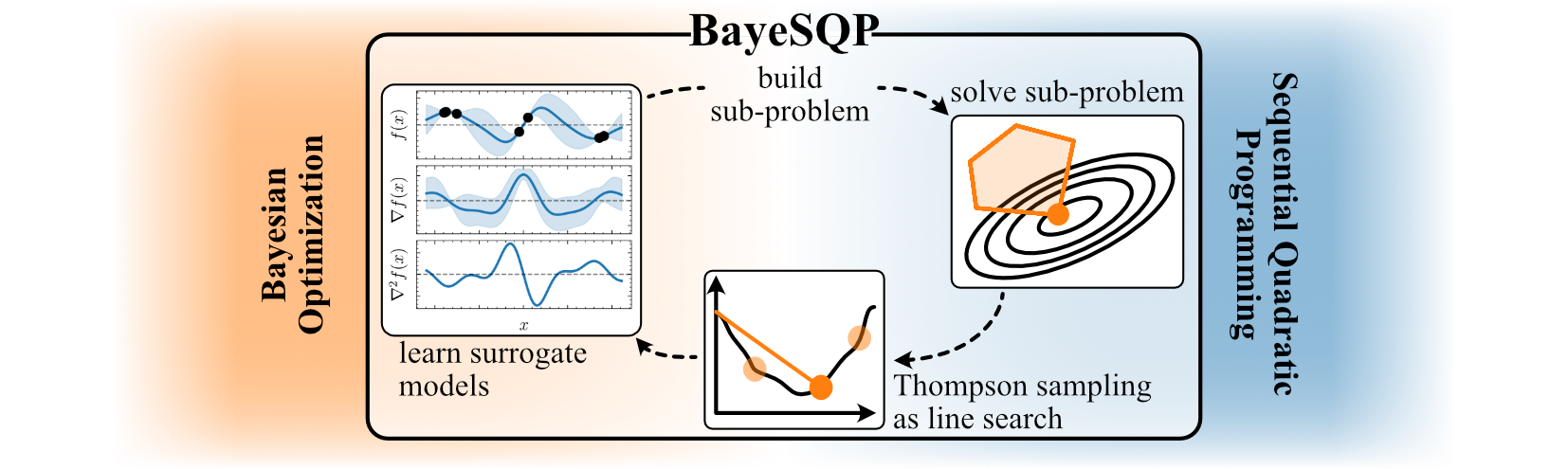
The repository contains a plug-and-play implementation of BayeSQP (NeurIPS 2025). BayeSQP as a framework aims to combine ideas from both Bayesian optimization (BO) and ideas from sequential quadratic optimization to effectively solve potentially constrained black-box optimization problems.
With this repository and package, we hope to provide practitioners with an easy-to-use tool that seemlessly integrates with the BoTorch API.
You can install BayeSQP in a few different ways depending on your needs.
Once the package is published to PyPI (in progess), simply run:
pip install bayesqpThis will install the core dependencies numpy, scipy, cvxopt, botorch, gpytorch.
If you want the latest version from the repository:
git clone https://github.com/brunzema/bayesqp.git
cd bayesqp
pip install .
Or, for editable (developer) installation:
pip install -e .To run the example notebooks, install the optional dependencies:
pip install ".[examples]"This will further install jupyter and matplotlib.
You can verify that BayeSQP is installed correctly with:
python -c "import bayesqp; print(bayesqp.__version__)"To build intuition about BayeSQP, both on behavior and configuration, take a look at the example notebooks in the examples/ folder.
To use BayeSQP in your own project, follow the installation steps mentioned above and then simply:
from bayesqp import BayeSQP

# Define your optimization problem following the BoTorch API
func = MyConstrainedOptimizationProblem()

# Initialize BayeSQP
bayesqp = BayeSQP(objective_function=func)

# Run optimization
result = bayesqp.minimize(x0, max_evals=50)

# Show result
print(result)
There are various ways to configure BayeSQP for your specific problem. We provide a set of default parameters that currently yield the best performance on our use cases and with this they hopefully will also provide a good starting point for your problem.
To make the integration as seamless as possible, we also provide a small wrapper to transfer your objective and constraints formulated in numpy directly into a ConstrainedBaseTestProblem.
from bayesqp import NumpyToConstrainedBoTorchProblem

# Define your Numpy functions
def my_objective(x):
    # Minimize: x[0]^2 + x[1]^2
    return np.sum(x**2)

def constraint_c1(x):
    # Constraint: x[0] + x[1] >= 1
    # -> x[0] + x[1] - 1 >= 0
    return x[0] + x[1] - 1.0

def constraint_c2(x):
    # Constraint: x[0] <= 0.5
    # -> 0.5 - x[0] >= 0
    return 0.5 - x[0]

# Define bounds (e.g., 2D problem between -2 and 2)
bounds = [(-2.0, 2.0), (-2.0, 2.0)]

# Instantiate the wrapper
problem = NumpyToConstrainedBoTorchProblem(
    objective_func=my_objective,
    constraint_funcs=[constraint_c1, constraint_c2],
    bounds=bounds,
    negate=False
)

test_X = torch.tensor([
    [0.0, 0.0],   # Infeasible
    [0.4, 0.8]    # Feasible
], dtype=torch.double)

# Evaluate Objective
obj_vals = problem(test_X)
print(f"Objective Values: {obj_vals}")
# Output: Objective Values: tensor([0.0000, 0.8000], dtype=torch.float64)

# Evaluate Constraints
constraints = problem.evaluate_slack(test_X)
print(f"Constraint Values: {constraints}")
# Output: Constraint Values: tensor([[-1.0000,  0.5000],
#                                    [ 0.2000,  0.1000]], dtype=torch.float64)

is_feasible = problem.is_feasible(test_X)
print(f"Feasible: {is_feasible}")
# Output: Feasible: tensor([False,  True])
Such a wrapper also exists for torch: TorchToConstrainedBoTorchProblem. Here it is however necessary to specify if the functions can handle batches and setting the vectorized-flag accordingly.
# cannot handle batches -> vectorized = False
def objective_simple(x):
    return torch.sin(x[0]) * x[1]

# can handle batches -> vectorized = True
def objective_vec(x):
return torch.sin(x[..., 0]) * x[..., 1]If you find our code or paper useful, please consider citing
@inproceedings{brunzema2025bayesqp,
  title={{BayeSQP}: {Bayesian} Optimization through Sequential Quadratic Programming},
  author={Brunzema, Paul and Trimpe, Sebastian},
  booktitle={Advances in Neural Information Processing Systems (NeurIPS)},
  year={2025}
}
Claude helped beautify the README.md; hence the emojies.