



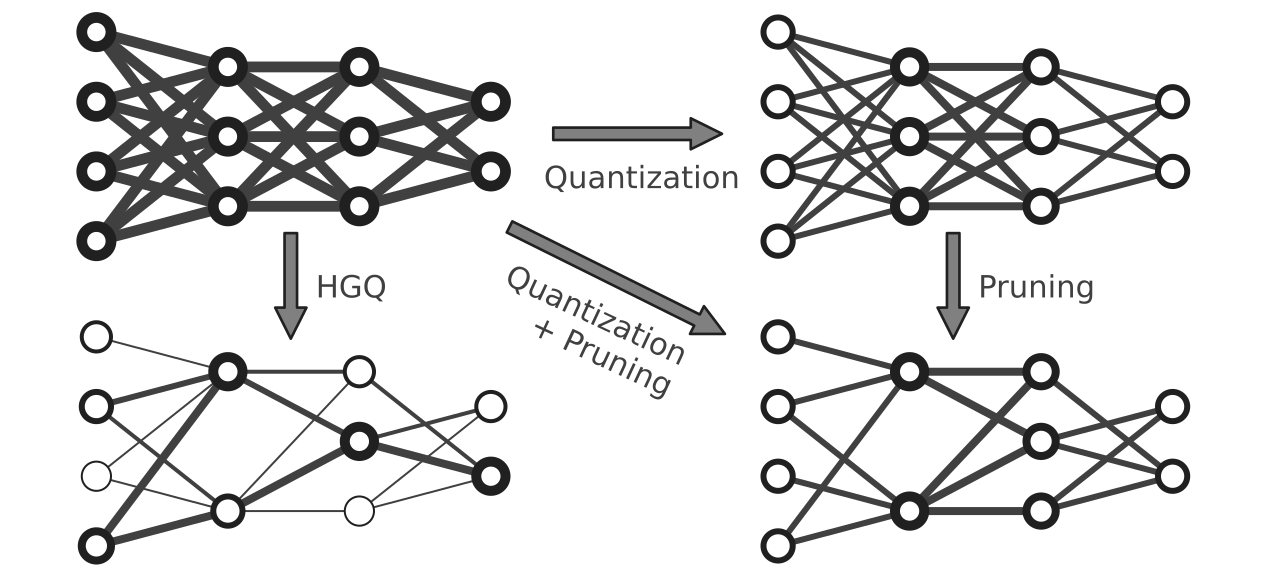
HGQ2 (High Granularity Quantization 2) is a quantization-aware training framework built on Keras v3, targeting real-time deep learning applications on edge devices like FPGAs. It provides a comprehensive set of tools for creating and training quantized neural networks with minimal effort.
HGQ2 implements an gradient-based automatic bitwidth optimization and quantization-aware training algorithm. By laveraging gradients, it allows for bitwidth optimization at arbitrary granularity, up to per-weight and per-activation level.
- High Granularity: HGQ supports per-weight and per-activation bitwidth optimization, or any other lower granularity.
- Automatic Quantization: Bit-widths are optimized via gradients, no need to manually tune them in general.
- What you see is what you get: One get exactly what you get from
Kerasmodels fromRTLmodels.- still subject to machine float precision limitation.
- Accurate Resource Estimation:
EBOPsestimated by HGQ gives a good indication of the actual resource usage on FPGA, either upper limit ofLUT(da4ml) orLUT + 55 * DSP(hls4ml).
In addition, this framework improves upon the old HGQ implementation in the following aspects:
- Scalability: HGQ2 supports
TensorFlow,JAX, andPyTorch. As XLA compilation inJAXandTensorFlowcan significantly speed up the training process. Training speed on HGQ2 can be 1.2-5 times faster than the previous implementation. - Quantizers:
- Fixed-point: While the last implementation only optimizes the number of floating bits with one way of parameterizing the fixed-point numbers, HGQ2 supports multiple ways of parametrizing them, and allows of optimizing any part of them via gradients.
- Minifloat: Training with minifloat quantization is supported, also with surrogate gradients support (alpha quality).
- More Layers: More layers are supported now, including the powerful
EinsumDense(BatchNorm)layer and theMultiHeadAttentionlayer with bit-accurate softmax and scaled dot-product attention.
pip install HGQ2If you are using da4ml, please make sure it is at least version 0.3:
pip install da4ml>=0.3If you are using hls4ml, please make sure it is at least version 1.2:
pip install hls4ml>=1.2.0Please refer to the documentation for more details on how to use the library.
A minimal example is shown below:
   import keras
   from hgq.layers import QDense, QConv2D
   from hgq.config import LayerConfigScope, QuantizerConfigScope

   # Setup quantization configuration
   # These values are the defaults, just for demonstration purposes here
   with (
      # Configuration scope for setting the default quantization type and overflow mode
      # The second configuration scope overrides the first one for the 'datalane' place
      QuantizerConfigScope(place='all', default_q_type='kbi', overflow_mode='SAT_SYM'),
      # Configuration scope for enabling EBOPs and setting the beta0 value
      QuantizerConfigScope(place='datalane', default_q_type='kif', overflow_mode='WRAP'),
      LayerConfigScope(enable_ebops=True, beta0=1e-5),
   ):
      model = keras.Sequential([
         QConv2D(32, (3, 3), activation='relu'),
         keras.layers.MaxPooling2D((2, 2)),
         keras.layers.Flatten(),
         QDense(10)
      ])

