Yuelin Xin1 · Yuheng Liu1 · Xiaohui Xie1 · Xinke Li2
1UC Irvine 2City University of Hong Kong
International Conference on Learning Representations 2026


- 2026-01-27: Initial code release.
Install dependencies:
pip install -r requirements.txtIn this codebase, all 3DGS is processed using the Gaussian class implemented in dataset/gaussiangen.py. You have to use this class to represent 3DGS data in order to run the rest of the codebase directly.
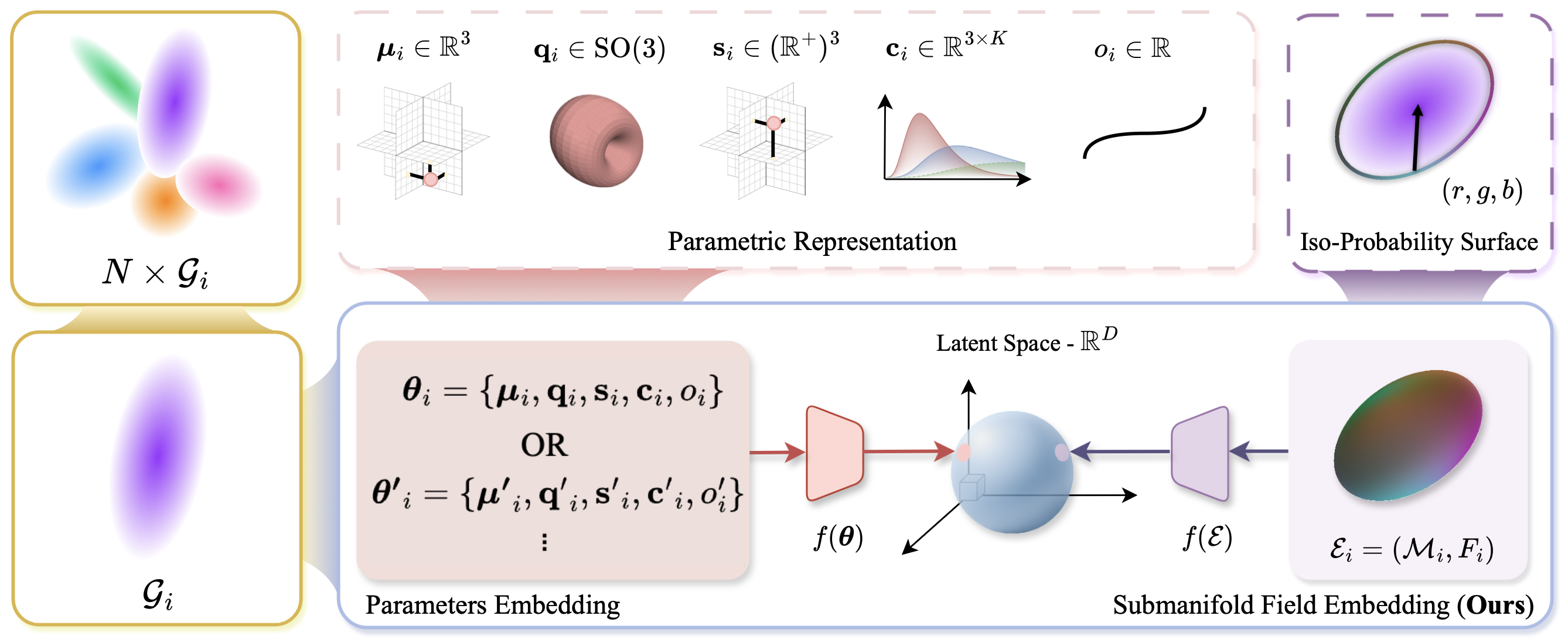
You can find some demo code for converting embeddings to 3D Gaussian Splatting format and save it to ply file in the converter.py file. You can implement this in your own code that takes in embeddings predicted by another model, and covert them to Gaussian representations. You can import the Converter class from converter.py to use it for converting embeddings to Gaussians. You will need to load the pre-trained embedding model checkpoint to initialize the Converter class. We have provided two 0th order checkpoints (compiled):
checkpoint_sfvae_sh0.pth: baseline checkpointcheckpoint_sfvae_sh0_144.pth: for 4x faster inference with very slightly lower reconstruction quality
You can also run the converter.py script directly to convert between embeddings and 3DGS.:
python converter.py \
    --gaussian2emb \ # or --emb2gaussian
    --src_path <INPUT_PATH> \
--dist_path <OUTPUT_PATH> We implemented several dataset classes in dataset/ply_data.py for loading 3DGS data from ply files. You may also find a dataset that loads embeddings data from npz files in the same script. You can use these dataset classes to load your own data in ply (3DGS) or npz (embeddings) format.
In addition, you can also find a 3DGS rendering function called visualize_gaussian in the utils/visualization.py file, implemented with gsplat, which can be used to render a given list of Gaussians. You may also use your own rasterization pipeline such as the original diff-gaussian-rasterization codebase.
Train your own embedding model to reproduce our results:
python train_embedding.py \
    --model sfvae \
    --dataset gaussiangen \
    --num_points 144 \
    --num_samples 500000 \
    --epoch 1000 \
    --bs 1000 \
    --embedding_dim 32 \
    --norm_weight 0.001 \
    --grid_dim 12 \
    --cuda 0 \
    --weight_path <CHECKPOINT_PATH>
Optional: resume from a checkpoint.
python train_embedding.py --resume True --weight_path <CHECKPOINT_PATH>@inproceedings{gsembedding2026,
title={Learning Unified Representation of 3D Gaussian Splatting},
author={Yuelin Xin and Yuheng Liu and Xiaohui Xie and Xinke Li},
booktitle={International Conference on Learning Representations},
year={2026}
}
For questions or issues, please open a GitHub issue or contact yuelix1@uci.edu
This project is released under the Apache 2.0 License. See LICENSE for details.