


fsm_lidar_odometry is a ROS 2 package written in C++ that provides LIDAR odometry from measurements of a single panoramic 2D LIDAR sensor, that is: a sensor whose field of view is 360 degrees. fsm_lidar_odometry is the ROS wrapper of fsm.

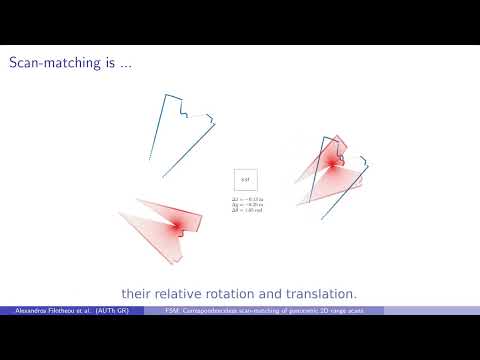
Lidar odometry is achieved via scan-matching but without establishing correspondences between elements of the input scans or their properties, but by leveraging the range signal's periodicity. Hence FSM may exploit properties of the Discrete Fourier Transform. These two pillars support the robustness of FSM's pose error against (a) sensor noise and (b) distance between consecutive poses, as exhibited in the figure which summarises key experiments below.

ROS 2 Lyrical and a compiler with C++23 support. Beyond ROS the package needs FFTW3, CGAL and Eigen3. All three are declared in the package manifest, so rosdep pulls them in without being asked.
This package is MIT, but the CGAL components it uses are GPL v3. A binary built from these sources therefore carries GPL v3 terms if you redistribute it.
Two ways, in increasing order of effort. The ROS 2 sources are on the lyrical-devel branch, which is the default; the older ROS 1 version is on kinetic-devel.
# `latest` points at the same image
docker pull li9i/fsm-lidar-odometry:lyrical
To build the image yourself instead of pulling it:
git clone https://github.com/fourier-scan-matcher/fsm-lidar-odometry.git
cd fsm-lidar-odometry
docker compose -f docker/docker-compose.yml buildmkdir -p ~/ros2_ws/src
cd ~/ros2_ws/src
git clone https://github.com/fourier-scan-matcher/fsm-lidar-odometry.git
cd ~/ros2_ws
sudo apt install libfftw3-dev
rosdep install --from-paths src --ignore-src -r -y --skip-keys libfftw3
colcon build --packages-select fsm_lidar_odometryNote
FFTW3 is installed by hand there because rosdep's rule for it names libfftw3-3, which Ubuntu has replaced with per-precision packages and which no longer exists on the release Lyrical targets.
The matcher is usable without the node. Name this package in your manifest and link the target you want.
For the matcher on its own, which pulls in no ROS:
fsm_lidar_odometry::fsm_lidar_odometry_core
Or, for the node's own class:
fsm_lidar_odometry::fsm_lidar_odometry_interface
--
find_package(fsm_lidar_odometry REQUIRED)
target_link_libraries(your_target fsm_lidar_odometry::fsm_lidar_odometry_core)
Each target carries this package's headers and its own dependencies, so Eigen, CGAL and FFTW3 do not have to be found again on your side.
Built from source:
source ~/ros2_ws/install/setup.bash
ros2 launch fsm_lidar_odometry fsm_lidar_odometry.launch.xml
With Docker. The container holds a built workspace, but its main process is a shell rather than the node, so it is started and then launched into:
docker compose -f docker/docker-compose.yml up -d
docker compose -f docker/docker-compose.yml exec --user fsm_lidar_odometry \
fsm_lidar_odometry bash -lc 'ros2 launch fsm_lidar_odometry fsm_lidar_odometry.launch.xml'Launching fsm_lidar_odometry puts it into stand-by; it processes nothing until told to. To start:
ros2 service call /fsm_lidar_odometry/start std_srvs/srv/TriggerThe executable is fsm_lidar_odometry_interface_node. It runs on a multi-threaded executor, so a service call cannot be held up behind a scan being matched.
| Topic | Type | Utility |
|---|---|---|
scan_topic |
sensor_msgs/msg/LaserScan |
2d panoramic scans are published here |
initial_pose_topic |
geometry_msgs/msg/PoseWithCovarianceStamped |
optional---for setting the very first pose estimate to something other than the origin |
| Topic | Type | Utility |
|---|---|---|
pose_estimate_topic |
geometry_msgs/msg/PoseStamped |
the current pose estimate relative to the global frame is published here |
path_estimate_topic |
nav_msgs/msg/Path |
the total estimated trajectory relative to the global frame is published here |
lo_topic |
nav_msgs/msg/Odometry |
the odometry is published here |
Note
Every message is stamped with the timestamp of the scan that produced it, not with the clock at the moment it was produced. Replaying a recording therefore gives the same output every time.
All four take std_srvs/srv/Trigger and return a success flag and a message.
| Service | Utility |
|---|---|
fsm_lidar_odometry/clear_estimated_trajectory |
clears the vector of estimated poses and returns the accumulated pose to the origin |
fsm_lidar_odometry/set_initial_pose |
node waits for one message on initial_pose_topic, sets fsm's initial pose from it, and returns. Waits for as long as it takes |
fsm_lidar_odometry/start |
commences node functionality |
fsm_lidar_odometry/stop |
halts node functionality (node remains alive) |
Found in config/params.yaml:
| IO Topics | Description |
|---|---|
scan_topic |
2d panoramic scans are published here |
initial_pose_topic |
(optional) the topic where an initial pose estimate may be provided |
pose_estimate_topic |
fsm_lidar_odometry's pose estimates are published here |
path_estimate_topic |
fsm_lidar_odometry's total trajectory estimate is published here |
lo_topic |
fsm_lidar_odometry's odometry estimate is published here |
| Frame ids | Description |
|---|---|
global_frame_id |
the global frame id (e.g. map) |
base_frame_id |
the lidar sensor's reference frame id (e.g. base_laser_link) |
lo_frame_id |
the (lidar) odometry's frame id |
| FSM-specific parameters | Description | Default value |
|---|---|---|
size_scan |
how many rays a scan is matched at; 0 matches every ray the scan carries, see below |
0 |
min_magnification_size |
base angular oversampling | 0 |
max_magnification_size |
maximum angular oversampling | 3 |
num_iterations |
Greater sensor velocity requires higher values | 2 |
xy_bound |
Axis-wise radius for randomly generating a new initial position estimate in case of recovery | 0.2 |
t_bound |
Angular-wise radius for randomly generating a new initial orientation estimate in case of recovery | π/4 |
max_counter |
Lower values decrease execution time | 200 |
max_recoveries |
Lower values decrease execution time | 10 |
rng_seed |
0 draws the recovery search from hardware entropy, as always. Any other value pins it so a run can be reproduced | 0 |
ray_search |
angular or windowed. How each ray is matched to the wall it meets; see below |
angular |
-
size_scandecides how many rays a scan is matched at.-
0, the default, matches every ray the scan carries: the sensor's own resolution, with nothing discarded. The first scan to arrive settles the size for the session, since two scans can only be matched against each other at one size, and a later scan of a different length is resampled to it rather than dropped.Any other value reduces every scan to that many rays before matching, and refuses a scan that carries fewer. This is the setting to reach for when matching cannot keep up with the sensor. Execution time rises faster than the ray count does, so halving the rays buys back more than half the time.
On a 1.70 GHz laptop core, a match takes 21 ms at 360 rays, 48 ms at 720, and 76 ms at 1081. Anything bought in the last few years is two to four times faster than that. If a match ever takes longer than the gap between scans the node says so, periodically, and names this setting.
-
-
ray_searchpicks between two ways of finding the wall each ray of a scan meets.-
angularoffers each wall only to the rays that can reach it. It returns the nearest wall in front of every ray whatever shape the room is, and its execution time rises in step withsize_scan. -
windowednarrows the search for each ray to the neighbourhood of the wall the previous ray met. It is what this algorithm shipped with, and it is kept so that a run can be compared against results published beforeangularexisted. Its execution time rises with the square ofsize_scan, and where a room turns back on itself it can return a wall standing behind the nearest one.
-
| Node parameters | Description | Default value |
|---|---|---|
scan_qos_reliability |
reliable or best_effort. Sensor drivers commonly publish best_effort, and a mismatched subscription receives nothing |
reliable |
scan_qos_depth |
subscription queue depth | 1 |
A parameter outside its permitted range is refused at start-up with an explanation, rather than tripping an assertion that release builds compile away.
lo_frame_id <- base_frame_id
in other words fsm_lidar_odometry publishes the transform from base_laser_link (or equivalent) to the equivalent of /odom (in this case lo_frame_id).
Note
The matching core reports in plain strings and does not write to a terminal itself. It hands each line to whatever destination the host installed, through fsm_lidar_odometry::setDiagnosticSink, and drops the line where nothing was installed. The node installs a destination that forwards to RCLCPP_INFO, so anything the core says arrives in the ordinary ROS log.
In an ordinary build there is almost nothing to say. The stage timings, which are the bulk of it, are compiled out unless the core is built with FSM_LIDAR_ODOMETRY_TRACE:
colcon build --cmake-args "-DCMAKE_CXX_FLAGS=-DFSM_LIDAR_ODOMETRY_TRACE"That build is for finding out where the time goes and is not the one to run a robot with: it reads the clock around every stage of every iteration.
The matcher itself is unchanged, and this is measured rather than asserted: driven over identical synthetic scans, the two versions agree on every published quantity to better than 4e-15, six orders of magnitude inside the 1e-9 bar the comparison demands. Both sides are checked against themselves first, three runs each, so that the comparison rests on something reproducible.
It is also faster. Driven over the same synthetic scans on the same machine, compiled with the same optimisation settings and with the ROS layer taken out of the picture on both sides, a match takes a little under half the time it did: 18.3 ms against 45.6 ms, median over 3444 matches across six scenarios. Roughly half of that comes from a compiler fifteen years newer and from returning results rather than writing them through output pointers, and the rest from the new angular ray search.
What did change:
- The package is called
fsm_lidar_odometry. It wasfsm_lo. Everything named after it followed: the node, the launch file, the default node name, and the four service names, which are nowfsm_lidar_odometry/startand so on. The topic and parameter names are untouched. - The four services return
std_srvs/srv/Triggerinstead of taking and returning nothing, so callers now get a success flag and a message. - Output is stamped from the incoming scan rather than from the clock at the moment of processing. The reported twist follows from the interval between scan stamps, so it no longer varies with machine load.
std_msgs/Headerhas no sequence number in ROS 2, so the published messages no longer carry one.- The scan subscription's reliability and depth are parameters. The default mirrors ROS 1, but a
best_effortsensor driver now needsscan_qos_reliabilityset to match, or no scans arrive at all. - Frame id defaults lost their leading slash.
- A scan carrying fewer ranges than
size_scanis refused with a warning instead of being read past its end.
Eight defects were corrected before the port, and the numbers above are measured against a ROS 1 build carrying those corrections rather than against the published one. Output from this version therefore differs from the published ROS 1 version by more than the figures above. The corrections:
- The rotation matrix that accumulates the trajectory mixed single and double precision, so it was not a rotation. Its determinant was 1.7e-8 away from unity, and since it is composed once per scan the error grew along the whole path.
- The initial pose supplied through
set_initial_posewas built in single precision, degrading it to about seven significant figures. - The convergence criterion of the translation stage took a single precision square root of a double.
- Gap filling read one element before the start of an empty list whenever a scan contained no invalid returns at all, which crashed the node. Real sensors nearly always return at least one bad ray, which is why this survived so long.
- With
pose_estimate_topicunset, the fallback was written to the wrong field: the pose publisher was given an empty topic name and the node threw during construction, so it could not start at all without that parameter. - Frame id fallbacks carried a leading slash, which tf2 rejects.
- Two assertions checked that an unsigned value was at least zero.
- Output was stamped from the wall clock rather than from the scan.
@INPROCEEDINGS{9981228,
  author={Filotheou, Alexandros and Sergiadis, Georgios D. and Dimitriou, Antonis G.},
  booktitle={2022 IEEE/RSJ International Conference on Intelligent Robots and Systems (IROS)},
  title={FSM: Correspondenceless scan-matching of panoramic 2D range scans},
  year={2022},
  pages={6968-6975},
  doi={10.1109/IROS47612.2022.9981228}}