








The trouble is that thought and culture are not the sort of thing that can have distinct units. They do not have a granular structure for the same reason that ocean currents do not have one — namely, because they are not stuffs, but patterns.
— Mary Midgley, Myths We Live By
     ∧_∧
  ry´・ω・`ヽっ
  `!     i
   ゝc_c_,.ノ
    (
    )
 .∧_∧.(
(´・ω・ ∩
o   ,ノ
O_ .ノ
 .(ノ
💽🌿 I love building stuff with and for data. It's popular these day's to discuss expanding 'data literacy', but data is not a language, it's an extension our senses. Data lets us comprehend the shape and movement of events beyond our direct physical perceptions — across space and time — which I think is pretty exciting (but also I'm a huge nerd). Unlike a language, because it's tied to our senses, this power is available to everyone. It's not an inherent expression of one culture, it instead lets us communicate useful patterns and form narratives across them. I won't pretend that using it effectively doesn't require learning, there's a deep well of knowledge, of course — but when people are convinced data analysis is totally alien, it limits them unnecessarily. They throw their everyday instincts from years of navigating the world out the window, when they're actually the perfect foundation for learning how to traverse this more expansive plane. The rules aren't different, it's just a lot more input, and that drives the learning curve. It's less counterintuitive than extra-intuitive.
🌌🐴 Given the vastness of my fascination with data, I've never been able to stay cramped in the box of analyst or engineer (or software developer, developer experience advocate, teacher, consultant, manager...), so often I prefer to just say I’m a Data Cowgirl. You know: ride around my trusty stallion Bracket and make sure all the data is1 thriving. Nurture it, help it grow strong, and when the leaves turn, go shear it and spend the long winter weaving it into tapestries. That kind of thing?
To be less...poetic2 about it — the way this manifests changes all the time, making labels a bit difficult. I've spent professional stretches:
- building handcrafted dev tools
- building enterprise SaaS dev tools
- constructing bomb-proof streaming data platforms for industrial manufacturing
- building tiny data warehouses for education non-profit groups, carefully designed to never tick over BigQuery's generous free tier
- designing and teaching effective patterns
- extracting data from a bunch of places and weaving it into a cohesive world
- building communities in-person and online
- shipping lovingly crafted CLI data tools
- writing newsletters and blogs
- writing documentation and guides
- giving conference talks
- designing web apps to build knowledge graphs
- managing teams building those knowledge graphs
- working with sales teams on Hex apps to smash their Q4 goals
- making dashboards and running financial analyses
- running social media campaigns
- analyzing social media camapigns
- modeling data from social campaigns in dbt then constructing Looker Explores on top of them
🎷🐄 You get it! So: Data Cowgirl.
The particular project is not as important as the mission:
- 🌱🍄🟫 Nurture a data ecosystem
- ✨🕸️ Get people excited about their ability to do amazing things within it
- 🗺️🌊 Work together to understand this world a little better every day 🫶
Giddyup!

👩🏻🌾🐚 Terminals, shells, command lines, Neovim, and spending waaay too much time gardening my dotfiles. You can check them out here. I'm excited by the terminal renaissance we're seeing because of Claude Code, even though it's totally transforming the work. The speed you can move at, the toil you can avoid, it's incredible.
🍦🦕 To that end, writing cute and useful CLI tools in Go with the Charm libraries lately. It makes me very very happy.
- DuckDB
- Cool stuff with Arrow Flight like the Airport extension
- Daft
- DataFusion (and the convergence on A4 - All Apache Arrow Always)
- Marimo
If you like my recommendations and want more: my collecting/scrapbooking/journaling/organizing/labeling instinct is powerful, so I am a dedicated GitHub Stargazer — you're welcome to explore my lists!
-
Data visualization is overrated! Don't get me wrong, I love visuals, and there are many, many analyses where they help communicate in a way words can't (I'm a girl with the complete works of Tufte on my shelf) — but in BI, visualization is treated as the go-to, the standard, THE final destination of all this engineering and modeling effort. It's past time we remembered that this week's revenue numbers might work better in a short paragraph, and thankfully LLMs are getting us there.
-
You're looking at too much data. Your brain cannot track a dashboard of 50 metrics hour-by-hour, day-by-day in a way that is actually useful and effective. It's the sensory equivalent of operating without object permanence. When we know how something behaves, we don't need our eyes on it at all times — our goal should be to get to this place with our most important metrics, saving chart watching for chaotic crises. It is cool to pounce on your CEO's board meeting pop quiz with a ratatat of punchy metrics that would make Aaron Sorkin proud, there's no denying that, but unless your career is based primarily on corporate theater, there are better things to do with your time!
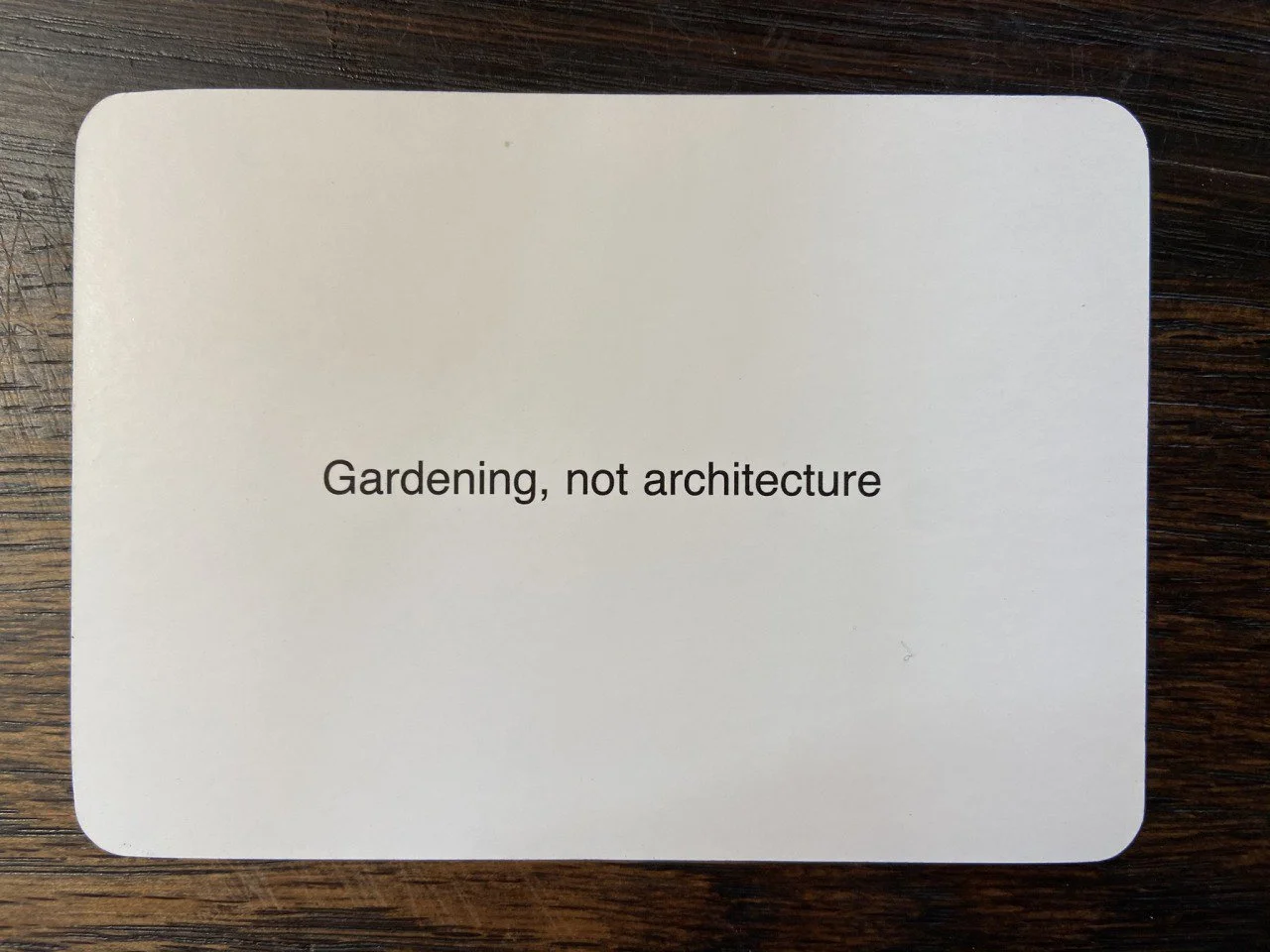
🃏🧚🏼 I'll leave you with something relevant to ponder — my favorite card from Brian Eno's famous Oblique Strategies deck...
𝒯𝒽𝒶𝓃𝓀𝓈 𝒻ℴ𝓇 𝓈𝓉ℴ𝓅𝓅𝒾𝓃ℊ 𝒷𝓎! ˚ʚ♡ɞ˚
⠀⠀⠀⠀⠀⠀⠀⠀⠀⠀⠀⠀⠀⠀⢀⡴⠒⠦⣄⣠⠶⠞⠳⣆⠀⠀⠀⠀
⠀⠀⠀⣴⠛⠛⠛⠲⢦⣤⡴⠶⠶⢶⠏⠀⢀⣄⣹⣇⡀⠀⠀⣻⡀⠀⠀⠀
⠀⠀⠀⡿⠀⠀⠀⠀⠀⠀⠀⠀⠀⢸⠂⠀⢿⣼⠋⠀⠉⣿⣍⠉⠉⡆⠀⠀
⠀⠀⠀⢿⡤⠀⠀⠀⠀⠀⠀⠀⠀⠈⠧⠤⠤⠿⢦⣀⣤⠿⠼⠀⣰⠃⠀⠀
⠀⠀⠀⡾⠁⠀⠀⠀⠀⠀⠀⠀⠀⠀⠀⠀⠀⠀⠀⠀⠈⠳⠤⠶⢿⡀⠀⠀
⠀⠀⢸⡇⠀⠀⠀⠀⠀⠀⠀⠀⠀⠀⠀⠀⠀⠀⠀⠀⠀⠀⠀⣠⣼⡧⠤⠆
⣠⣤⢼⡧⢤⠀⠀⠀⢠⣦⠀⠀⠀⠀⠀⠀⠀⠀⠀⣾⡇⠀⠀⠀⣤⣧⣄⡀
⠀⠀⢀⡿⠉⠹⡄⠀⠈⠋⠀⠀⠀⣴⠒⡆⠀⠀⠀⠀⠀⠀⠀⣀⣼⠁⠀⠀
⢠⡞⠉⠛⠀⠀⠹⠶⠶⣄⠀⠀⠀⠈⠉⠀⠀⠀⠀⠀⠀⠀⣀⠾⠉⠙⠒⠀
⠀⠳⢤⣀⠀⠀⢠⠖⠒⠈⢳⣀⠀⠀⢀⣀⣀⣀⣤⠤⠖⠛⠁⠀⠀⠀⠀⠀
⠀⠀⠀⢹⡀⠀⠘⠲⠖⠃⣼⠋⠉⠁⠉⠈⠀⠀⠀⠀⠀⠀⠀⠀⠀⠀⠀⠀
⠀⠀⠀⠀⠛⠦⣤⣤⠴⠞⠁⠀⠀⠀