



PowerFit is a Python package and simple command-line program to automatically fit high-resolution atomic structures in cryo-EM densities. To this end it performs a full-exhaustive 6-dimensional cross-correlation search between the atomic structure and the density. It takes as inputV an atomic structure in PDB-format and a cryo-EM density with its resolution; and outputs positions and rotations of the atomic structure corresponding to high correlation values. PowerFit uses the local cross-correlation function as its base score. The score is enhanced by a Laplace pre-filter and a core-weighted score to minimize overlapping densities from neighboring subunits. It can be hardware-accelerated by leveraging multi-core CPU machines out of the box or by GPU via the OpenCL framework. PowerFit is Free Software and has been succesfully installed and used on Linux and MacOSX machines.
Minimal requirements for the CPU version:
- Python3.10 or greater
To offload computations to a discrete or integrated* GPU the following is also required
- OpenCL1.1+
- GCC (or another C-compiler which is need to compile the pyvkfft package)
Recommended for installation
- git
- pip
* Integrated graphics on CPUs are able to signficantly outperform the native CPU implementation in some cases. This is mostly applicable to Intel devices, see the section tested platfoms.
If you want to run PowerFit on just the CPU, the installation should be as easy as opening up a shell and typing
# To run on CPU
pip install powerfit-em
If you want to offload the calculation to a GPU, please follow the instructions for your particular operating system described here, that should get you up and running in no time.
After installing PowerFit the command line tool powerfit should be at your disposal. The general pattern to invoke powerfit is
powerfit <map> <resolution> <pdb>where <map> is a density map in CCP4 or MRC-format, <resolution> is the
resolution of the map in ångstrom, and <pdb> is an atomic model in the
PDB-format. This performs a 10° rotational search using the local
cross-correlation score on a single CPU-core. During the search, powerfit
will update you about the progress of the search if you are using it
interactively in the shell.
Please refer to the PowerFit tutorial to learn how to use PowerFit in the command line.
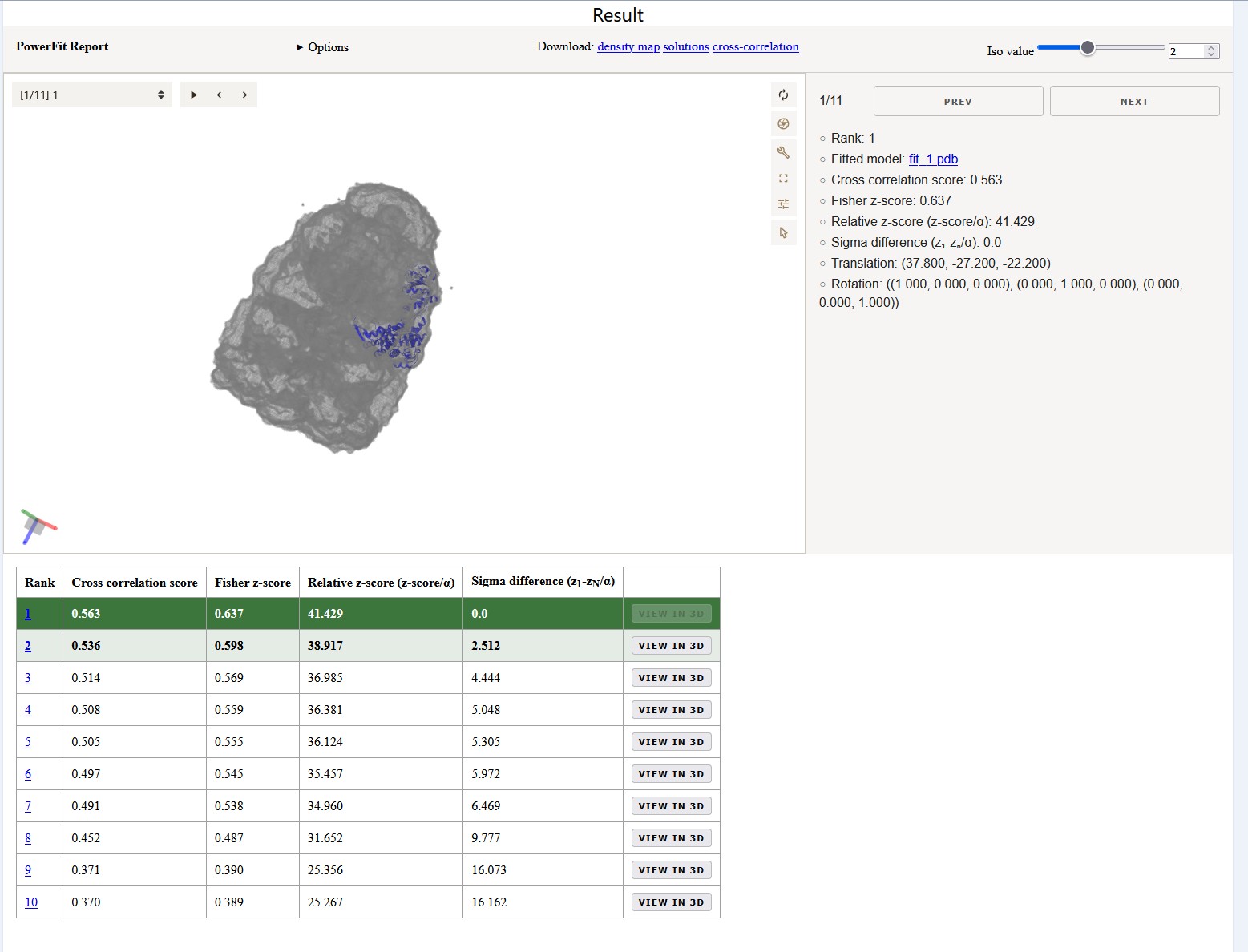
Please refer to the PowerFit webserver tutorial to learn how to use PowerFit on the webserver.
For more information and details please look at the general manual.
If this software was useful to your research, please cite us
G.C.P. van Zundert and A.M.J.J. Bonvin. Fast and sensitive rigid-body fitting into cryo-EM density maps with PowerFit. AIMS Biophysics 2, 73-87 (2015) https://doi.org/10.3934/biophy.2015.2.73.
For the use of image-pyramids and reliability measures for fitting, please cite
G.C.P van Zundert and A.M.J.J. Bonvin. Defining the limits and reliability of rigid-body fitting in cryo-EM maps using multi-scale image pyramids. J. Struct. Biol. 195, 252-258 (2016) https://doi.org/10.1016/j.jsb.2016.06.011.
If you used PowerFit v1, please cite software with https://doi.org/10.5281/zenodo.1037227. For version 2 or higher, please cite software with https://doi.org/10.5281/zenodo.14185749.
Apache License Version 2.0
The elements.py module is licensed under MIT License (see header). Copyright (c) 2005-2015, Christoph Gohlke
To contribute to PowerFit, see our Contribution guidelines.