




Vet is a standalone verification tool for code changes and coding agent behavior.
- Reviews intent and code: checks agent conversations for goal adherence and code changes for correctness.
- Runs anywhere: from the terminal, as an agent skill, or in CI.
- Bring-your-own-model: works with any provider using your own API keys.
- Works with existing subscriptions: supports Anthropic and OpenAI subscriptions using
--agentic. - Free and open source: no account, fees, or data collection. Requests go directly to your inference provider. Licensed under the AGPL-3.0.
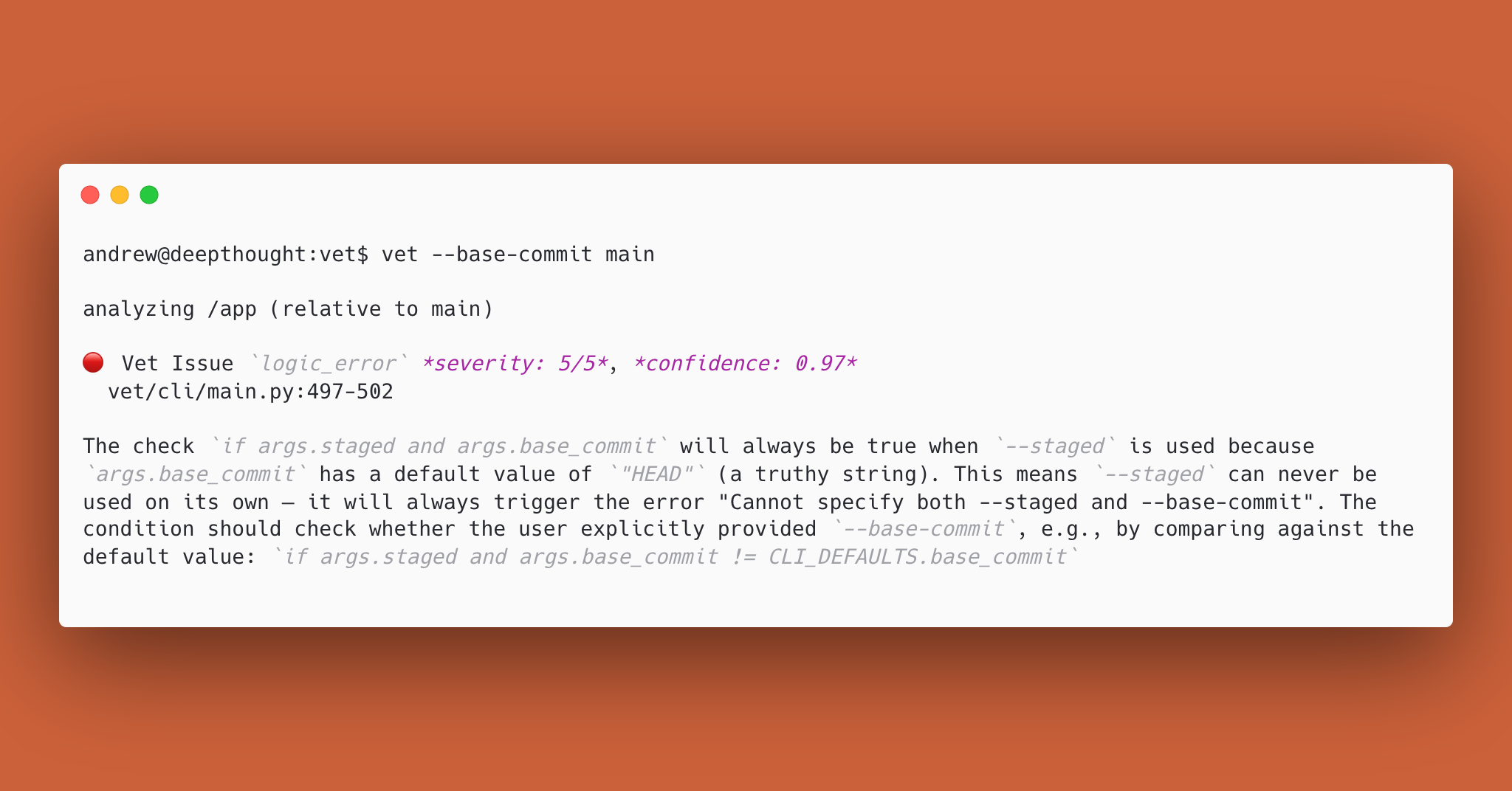
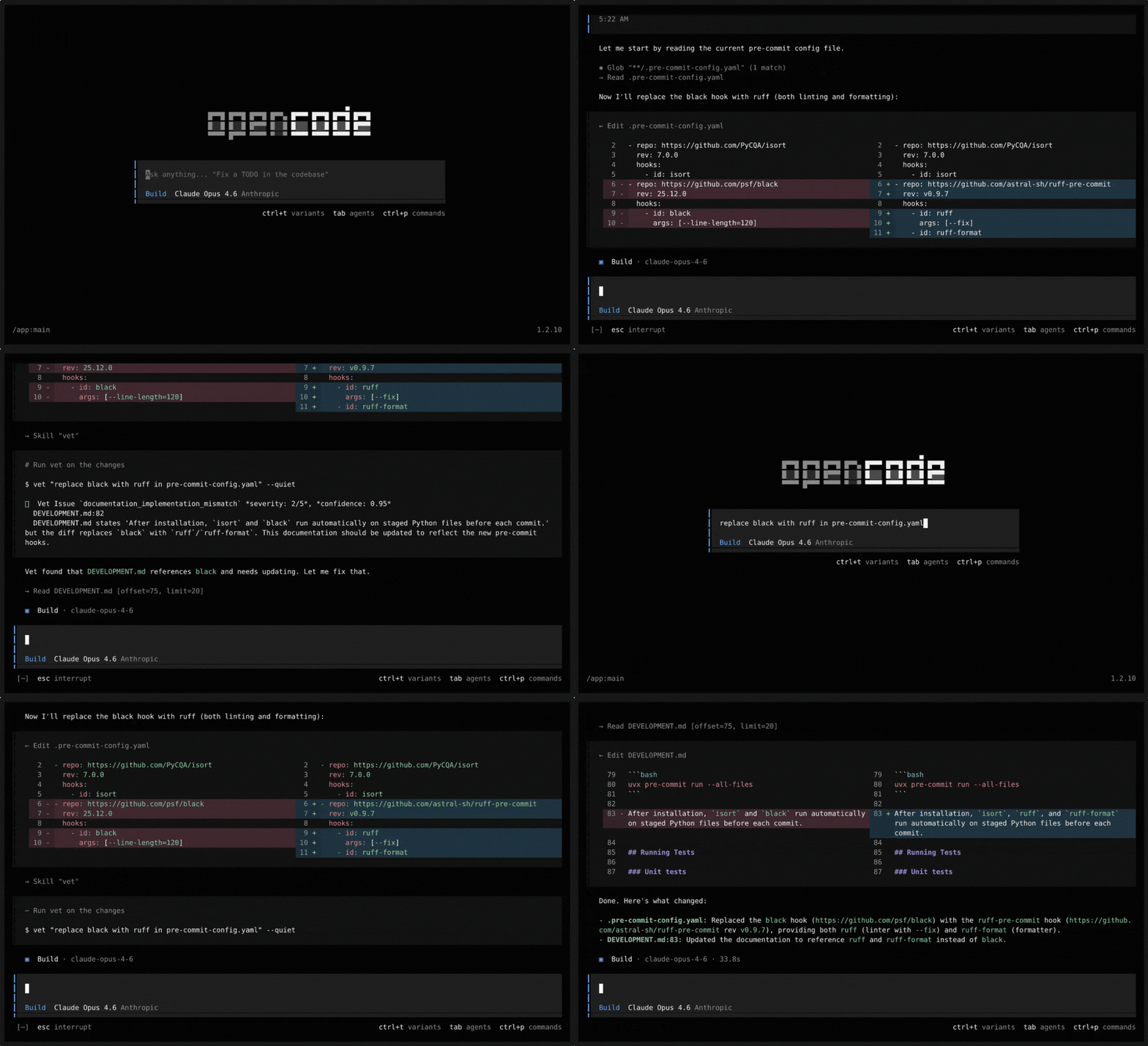
Vet includes an agent skill. When installed, agents will proactively run vet after code changes to find issues with the new code and mismatches between the user's request and the agent's actions.
curl -fsSL https://raw.githubusercontent.com/imbue-ai/vet/main/install-skill.sh | bashYou will be prompted to choose between:
- Project level: installs into
.agents/skills/vet/,.opencode/skills/vet/,.claude/skills/vet/, and.codex/skills/vet/at the repo root (run from your repo directory) - User level: installs into
~/.agents/,~/.opencode/,~/.claude/, and~/.codex/skill directories, discovered globally by all agents
Manual installation
From the root of your git repo:
for dir in .agents .opencode .claude .codex; do
  mkdir -p "$dir/skills/vet/scripts"
  for file in SKILL.md scripts/export_opencode_session.py scripts/export_codex_session.py scripts/export_claude_code_session.py; do
    curl -fsSL "https://raw.githubusercontent.com/imbue-ai/vet/main/skills/vet/$file" \
      -o "$dir/skills/vet/$file"
  done
donefor dir in ~/.agents ~/.opencode ~/.claude ~/.codex; do
mkdir -p "$dir/skills/vet/scripts"
for file in SKILL.md scripts/export_opencode_session.py scripts/export_codex_session.py scripts/export_claude_code_session.py; do
curl -fsSL "https://raw.githubusercontent.com/imbue-ai/vet/main/skills/vet/$file" \
-o "$dir/skills/vet/$file"
done
doneThe --history-loader option executes the specified shell command as the current user to load the conversation history. It is important to review history loader commands and shared config presets before use.
pip install verify-everythingOr with pipx:
pipx install verify-everythingOr with uv:
uv tool install verify-everythingRun Vet in the current repo:
vet "Implement X without breaking Y"Compare against a base ref/commit:
vet "Refactor storage layer" --base-commit mainUse Claude Code, Codex, or OpenCode instead of LLM APIs (--agent-harness: claude, codex, opencode):
vet "Implement X without breaking Y" --agentic --agent-harness claudeVet reviews pull requests using a reusable GitHub Action.
Create .github/workflows/vet.yml:
name: Vet

permissions:
  contents: read
  pull-requests: write

on:
  pull_request:
    types: [opened, edited, synchronize, reopened]

jobs:
  vet:
    if: github.event.pull_request.draft == false
    runs-on: ubuntu-latest
    env:
      ANTHROPIC_API_KEY: ${{ secrets.ANTHROPIC_API_KEY }}
    steps:
      - uses: actions/checkout@v4
        with:
          ref: ${{ github.event.pull_request.head.sha }}
          fetch-depth: 0
      - uses: imbue-ai/vet@main
        with:
          agentic: false
The action handles Python setup, vet installation, merge base computation, and posting the review to the PR. ANTHROPIC_API_KEY must be set as a repository secret when using Anthropic models (the default). See action.yml for all available inputs.
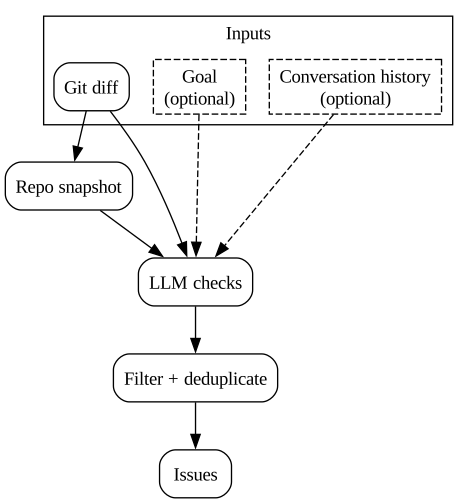
Vet snapshots the repo and diff, optionally adds a goal and agent conversation, runs LLM checks, then filters/deduplicates findings into a final list of issues.
- Exit code
0: no issues found - Exit code
1: unexpected runtime error - Exit code
2: invalid usage/configuration error - Exit code
10: issues found
Output formats:
textjsongithub
Vet supports custom model definitions using OpenAI-compatible endpoints via JSON config files searched in:
$XDG_CONFIG_HOME/vet/models.json(or~/.config/vet/models.json).vet/models.jsonat your repo root
{
  "providers": {
    "openrouter": {
      "name": "OpenRouter",
      "api_type": "openai_compatible",
      "base_url": "https://openrouter.ai/api/v1",
      "api_key_env": "OPENROUTER_API_KEY",
      "models": {
        "gpt-5.2": {
          "model_id": "openai/gpt-5.2",
          "context_window": 400000,
          "max_output_tokens": 128000,
          "supports_temperature": true
        },
        "kimi-k2": {
          "model_id": "moonshotai/kimi-k2",
          "context_window": 131072,
          "max_output_tokens": 32768,
          "supports_temperature": true
        }
      }
    }
  }
}
Then:
vet "Harden error handling" --model gpt-5.2Vet maintains a remote model registry with community-contributed model definitions. To fetch the latest definitions without upgrading vet:
vet --update-modelsThis downloads model definitions from the registry and caches them locally at ~/.cache/vet/remote_models.json. Once cached, registry models appear in vet --list-models and can be used with --model like any other model.
Model resolution priority (highest to lowest):
- User config (
.vet/models.jsonor~/.config/vet/models.json) - Builtin models (Anthropic, OpenAI, Gemini)
- Registry models (cached via
--update-models)
See registry/CONTRIBUTING.md for information about contributing model definitions to the registry.
Vet supports named profiles so teams can standardize CI usage without long CLI invocations.
Profiles set defaults like model choice, enabled issue codes, output format, and thresholds.
See the example in this project.
You can customize the guide text for the issue codes via guides.toml. Guide files are loaded from:
$XDG_CONFIG_HOME/vet/guides.toml(or~/.config/vet/guides.toml).vet/guides.tomlat your repo root
[logic_error]
suffix = """
- Check for integer overflow in arithmetic operations
"""

[insecure_code]
replace = """
- Check for SQL injection: flag any string concatenation or f-string formatting used to build SQL queries rather than parameterized queries
- Check for XSS: flag user-supplied data rendered into HTML templates without proper escaping or sanitization
- Check for path traversal: flag file operations where user input flows into file paths without validation against directory traversal (e.g. ../)
- Check for insecure cryptography: flag use of deprecated or weak algorithms (e.g. MD5, SHA1 for security purposes, DES, RC4)
- Check for hardcoded credentials: flag passwords, API keys, or tokens embedded directly in source code
"""
Section keys must be valid issue codes (vet --list-issue-codes). Each section supports three optional fields: prefix (prepends to built-in guide), suffix (appends to built-in guide), and replace (fully replaces the built-in guide). prefix and suffix can be used together, but replace is mutually exclusive with the other two. Guide text should be formatted as a list.
Join the Imbue Discord for discussion, questions, and support. For bug reports and feature requests, please use GitHub Issues.
This project is licensed under the GNU Affero General Public License v3.0 (AGPL-3.0-only).


