
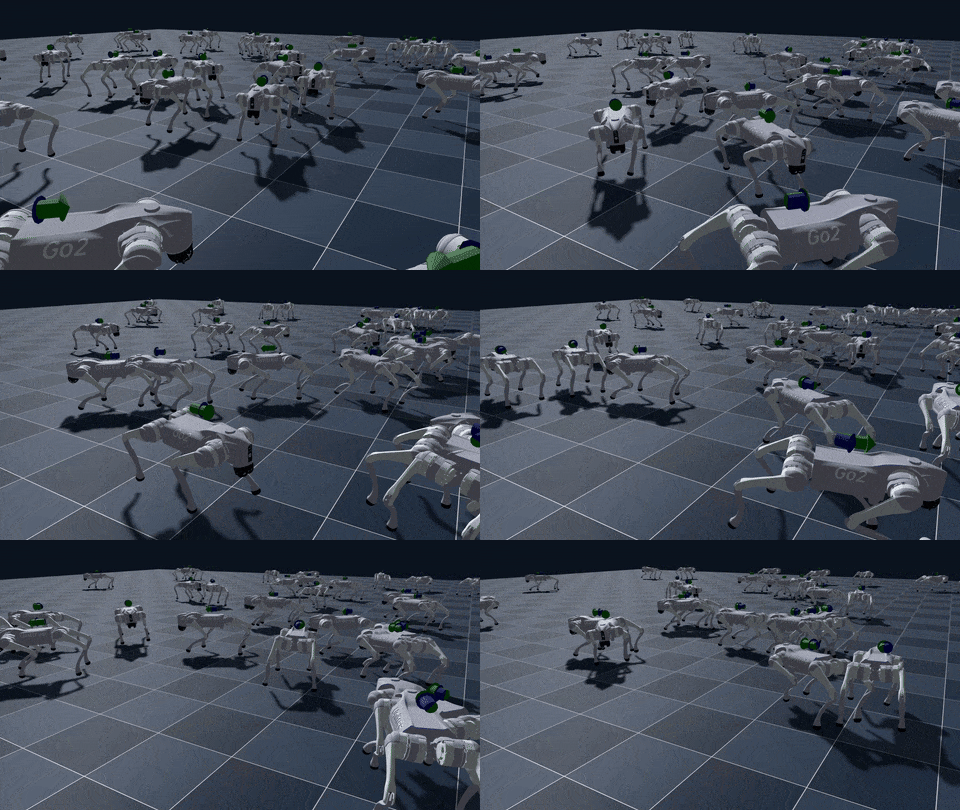
Genesis Forge is a powerful robotics reinforcement learning framework using the Genesis physics simulator. It provides a flexible and modular architecture to get your robot up and running quickly with less boilerplate work.
Today, modern robots learn to balance, walk, and manipulate objects using Reinforcement Learning algorithms. You simply create a program that defines a task and provides feedback on the robot's performance — much like training a dog with treats and commands. But with modern GPUs, you can parallelize this process across thousands of simulated robots at a time. Genesis Forge is a framework that makes this very easy to do, with documentation and examples to get you started.
- 🦿 Action manager - Control your joints and actuators, within limits and with domain randomization
- 🏆 Reward/Termination managers - Simple and extensible reward/termination handling with automatic logging
- ↪️ Command managers - Commands your robot with debug visualization
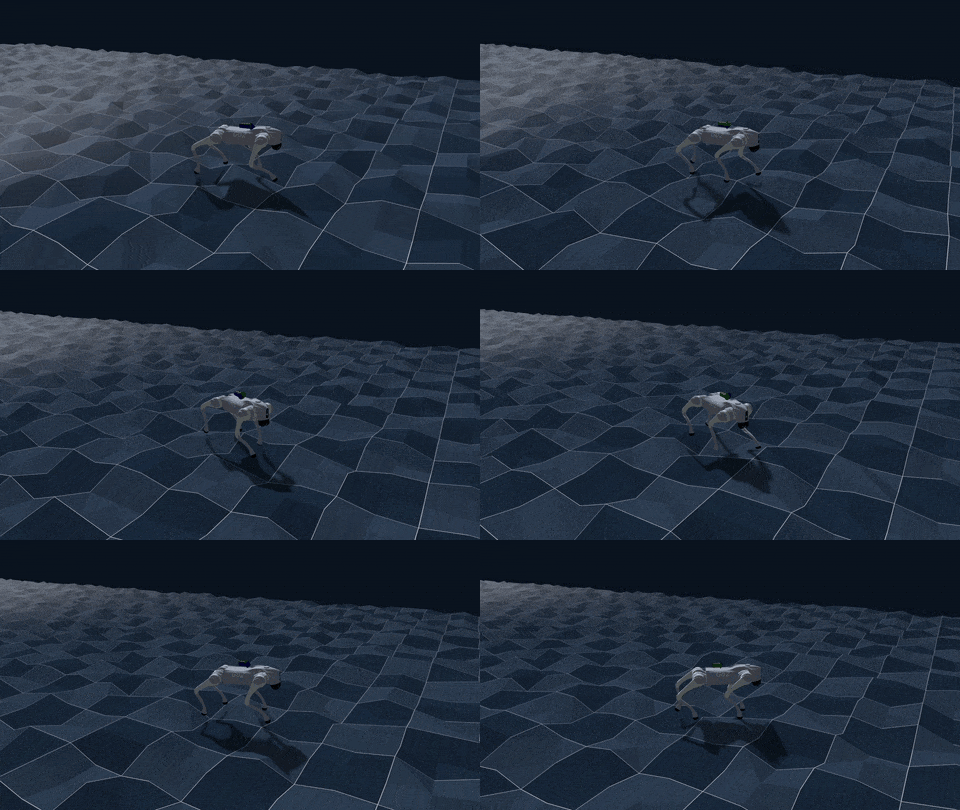
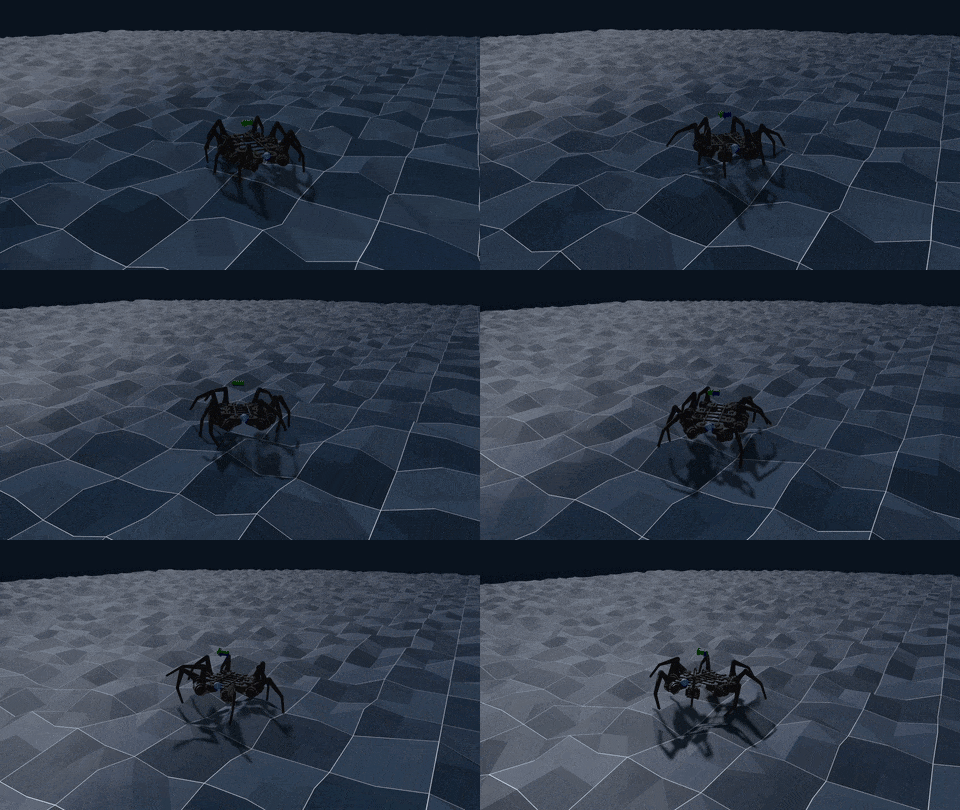
- 🏔️ Terrain manager - Helpful terrain utilities and curriculums
- 💥 Contact manager - Comprehensive contact/collision detection and reward/termination functions
- 🎬 Video Wrapper - Automatically records videos at regular intervals during training
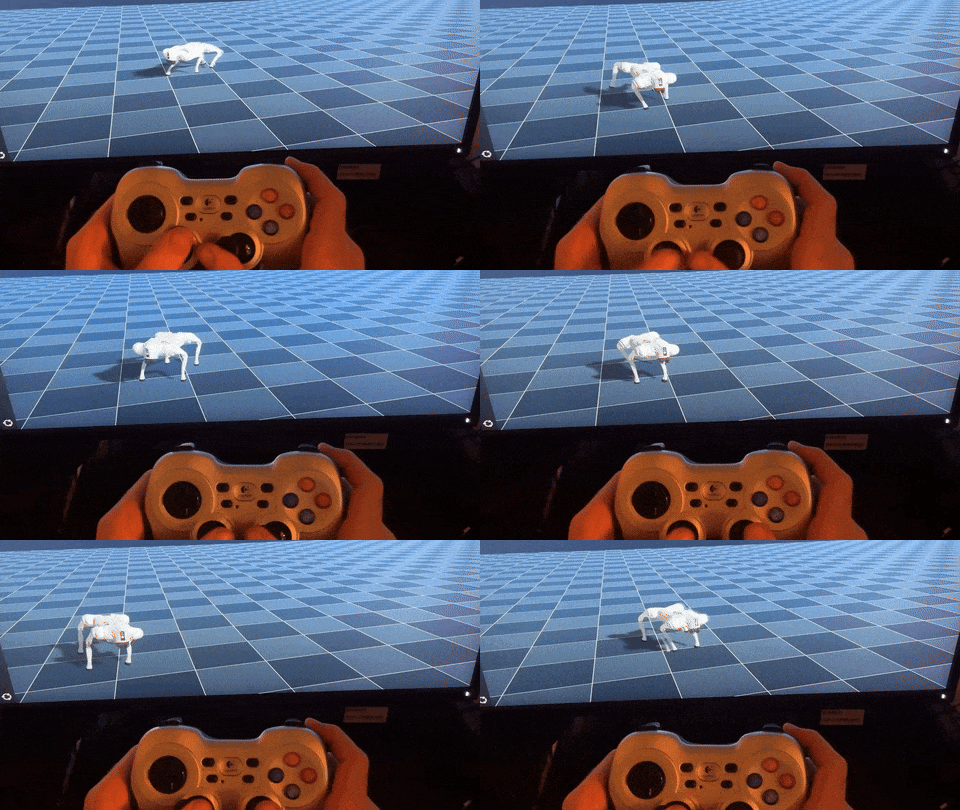
- 🕹️ Gamepad interface - Control trained policies directly with a physical gamepad controller.
- And more...
Learn more in the documentation
Before installing Genesis Forge, ensure you have:
- Python >=3.10,<3.14
- pip package manager
(Optional) CUDA-compatible GPU for faster training
pip install genesis-forgeHere's an example of a environment to teach the Go2 robot how to follow direction commands. See the full runnable example here.
class Go2CEnv(ManagedEnvironment):
    def __init__(self, num_envs: int = 1):
        super().__init__(num_envs=num_envs)

        # Construct the scene
        self.scene = gs.Scene(show_viewer=False)
        self.scene.add_entity(gs.morphs.Plane())
        self.robot = self.scene.add_entity(
            gs.morphs.URDF(
                file="urdf/go2/urdf/go2.urdf",
                pos=[0.0, 0.0, 0.35],
                quat=[1.0, 0.0, 0.0, 0.0],
            ),
        )

    def config(self):
        # Robot manager - Reset the robot's initial position on reset
        self.robot_manager = EntityManager(
            self,
            entity_attr="robot",
            on_reset={
                "position": {
                    "fn": reset.position,
                    "params": {
                        "position": [0.0, 0.0, 0.35],
                        "quat": [1.0, 0.0, 0.0, 0.0],
                    },
                },
            },
        )

        # Joint Actuators & Actions
        self.actuator_manager = ActuatorManager(
            self,
            joint_names=[".*"],
            default_pos={
                ".*_hip_joint": 0.0,
                ".*_thigh_joint": 0.8,
                ".*_calf_joint": -1.5,
            },
            kp=20,
            kv=0.5,
        )
        self.action_manager = PositionActionManager(
            self,
            scale=0.25,
            use_default_offset=True,
            actuator_manager=self.actuator_manager,
        )

        # Commanded direction
        self.velocity_command = VelocityCommandManager(
            self,
            range={
                "lin_vel_x": [-1.0, 1.0],
                "lin_vel_y": [-1.0, 1.0],
                "ang_vel_z": [-1.0, 1.0],
            },
        )

        # Rewards
        RewardManager(
            self,
            cfg={
                "base_height_target": {
                    "weight": -50.0,
                    "fn": rewards.base_height,
                    "params": {
                        "target_height": 0.3,
                    },
                },
                "tracking_lin_vel": {
                    "weight": 1.0,
                    "fn": rewards.command_tracking_lin_vel,
                    "params": {
                        "vel_cmd_manager": self.velocity_command,
                    },
                },
                "tracking_ang_vel": {
                    "weight": 1.0,
                    "fn": rewards.command_tracking_ang_vel,
                    "params": {
                        "vel_cmd_manager": self.velocity_command,
                    },
                },
                "lin_vel_z": {
                    "weight": -1.0,
                    "fn": rewards.lin_vel_z_l2,
                },
            },
        )

        # Termination conditions
        self.termination_manager = TerminationManager(
            self,
            logging_enabled=True,
            term_cfg={
                # The episode ended
                "timeout": {
                    "fn": terminations.timeout,
                    "time_out": True,
                },
                # Terminate if the robot's pitch and yaw angles are too large
                "fall_over": {
                    "fn": terminations.bad_orientation,
                    "params": {
                        "limit_angle": 10, # degrees
                    },
                },
            },
        )

        # Observations
        ObservationManager(
            self,
            cfg={
                "velocity_cmd": { "fn": self.velocity_command.observation },
                "angle_velocity": {
                    "fn": lambda env: self.robot_manager.get_angular_velocity(),
                },
                "linear_velocity": {
                    "fn": lambda env: self.robot_manager.get_linear_velocity(),
                },
                "projected_gravity": {
                    "fn": lambda env: self.robot_manager.get_projected_gravity(),
                },
                "dof_position": {
                    "fn": lambda env: self.action_manager.get_dofs_position(),
                },
                "dof_velocity": {
                    "fn": lambda env: self.action_manager.get_dofs_velocity(),
                    "scale": 0.05,
                },
                "actions": {
                    "fn": lambda env: self.action_manager.get_actions(),
                },
            },
)Check out the user guide and API reference
If you used Genesis Forge in your research, we would appreciate it if you could cite it.
@misc{Genesis-Forge,
  author = {Jeremy Gillick},
  title = {Genesis Forge: A modular framework for RL robot environments},
  month = {September},
  year = {2025},
  url = {https://github.com/jgillick/genesis-forge}
}