

- Binomial option model
- OCaml implementation notes and examples
- C++ implementation notes
- Performance benchmark and comparison
For an introduction to options see the attached writeup: Binomial Option Pricing: A practical introduction in OCaml
The binomial model represents the option's underlying asset as a random process with a Bernoulli distribution. A walk of all of the asset's states takes the shape of a lattice-like structure:

The lattice structure allows the binomial model to calculate the price of an option during any the discrete-time periods. This makes it more versatile than its continuous-time analog, the black-scholes equation, which can only price an option at a single point in time. The ability to determine an option's maximum value at any future point in time makes the binomial model the model of choice for pricing American and Bermudan options.
While computationally slower than the black-scholes model, the binomial model is more accurate. This is due to the black-scholes' reliance on the cumulative distribution function of a normal distribution, which can only be numerically approximated. An example of this can be seen in ocaml/bin/converge_example.ml. The latter executable prints a side-by-side comparison of the black-scholes price and the binomial price as the resolution on the binomial model is increased (the resolution represents the number of discrete time periods). As the resolution of the binomial model increases, the difference between the prices of the two models decreases. The latter relationship holds until between resolutions of 1,000 and 10,000, where the difference in prices increases due to the cdf approximation function used in the black-scholes model. The approximation is only accurate to about four decimal places.
The OCaml folder contains implementations of both the binomial model and the black-scholes model. The binomial model uses linked lists to enumerate each of the possible states of the underlying asset in a discrete time period. A modified mapping function is then used to take the expectation of each adjacent state, which in turn is then used to calculate the prior state.
Also included in the OCaml section is a command line app that prompts the user for each of the required details about the options contract. It then prints the price of the option to stdout
Inside ocaml/bin are a number of executables that demonstrate how the price of an option can be affected by changing the function's various inputs. Comments explaining the intuition behind the relationships are in their respective files. See the OCaml README for more details
Like the ocaml/ folder, cpp/ contains implementations of both the binomial model and the black-scholes model. It also contains a playground.cpp executable showing the convergence between the two models.
Both the C++ and OCaml implementation of the binomial models were benchmarked with varying resolutions (500, 1000, 5000, 7000, 10000, 15000, and 20000). Each model was run 100 times per each resolution, and the results were averaged:
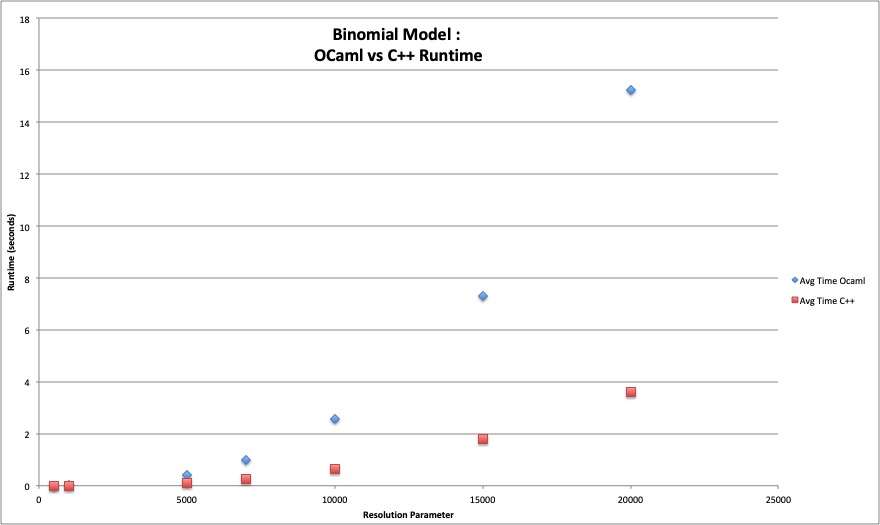
As the resolution increased, the difference between the time that it took for the C++ model to finish and the OCaml model to finish increased exponentially. Originally, this was not the case--the C++ model had only been a small percentage faster than the OCaml model, until a resolution of 30,000 revealed a bug in which the C++ model's stack overflowed on large resolutions. The bug occurred because the C++ model was recursive and each vector representing the future states was being passed in as an argument to the next recursive function call. This resulted in the compiler not being able to deallocate the memory until the recursion finished--it was not tail-recursive. The implementation was switched to heap based memory allocation (using manual memory management), and a speedup of about 4x was achieved. This is likely due to the fact that the allocator did not have to work so hard to find extra memory when more needed to be allocated.