2009, Li Shen @ Lab of Engineering, Department of Bio-medical Engineering, Tsinghua University

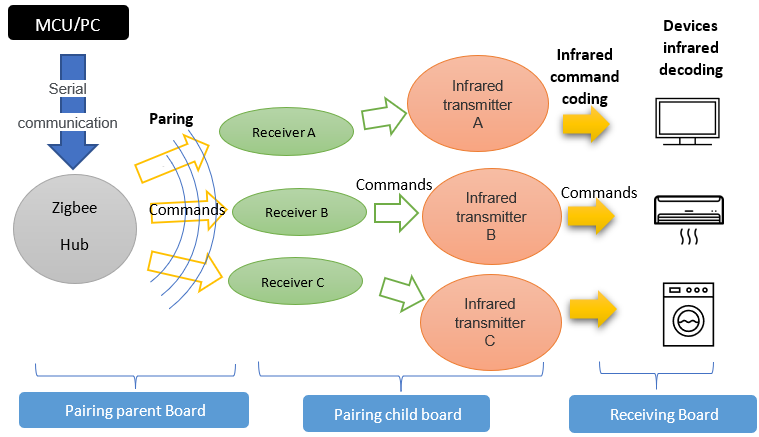
Brain-computer interface (BCI) is a technology that builds a communication pathway between brain and external devices. It enables paralyzed patients to control the external devices by decoding their brain signals. Combined with smart home system, BCI can further benefit the patients by wirelessly controlled the home appliances by “mind” and largely improve the life quality. Here I designed and implemented communication modular for smart home control for BCI application based on Zigbee protocol. In this project, the patterns of EEG which extracted from the BCI core system can be translated into various household appliances’ control instruction or parameters changes. Then the control instruction from the host computer (MCU or PC) is sent to the designated appliances via Zigbee wireless communication technology and is translated into infrared control signal to control the home appliance. Finally, these hardware are forming a one-to-many smart home system. Its normal work range exceeds 10 m and can decode and save all kinds of household appliances used the infrared codes. This work also developed a system of infrared codes learning supporting software, a household electrical appliances remote control user-interface program. The whole BCI system based on the steady state visual evoked potential (SSVEP) extracting the EEG patterns, translating into commands to control LCD TV, Music player etc.
Normally, the communication between the brain and the external environment requires peripheral nerve and muscles. However, this communication may be impaired or destroyed due to diseases or accidents, such as amyotrophic lateral sclerosis (ALS), spinal cord injury (SCI), cerebral palsy, muscular dystrophies, etc. The development of medical technology enables these patients to survive for longer, but they may lose their basic ability to communicate with the outside world and cannot express their thinking and needs normally. Therefore, how to improve their life quality has become an important question. Fortunately, BCI technology provides an alternative communication way, allowing the brain to directly interact with the external environment. It directly converts the brain signals into control commands for external devices, without requirement of peripheral nerves or muscles. Therefore, it will enable the patients suffering from motor loss disorders to independently operate device, such as computers, speech synthesizers and so on. In current BCI research, various methods for monitoring brain activity are used, such as electroencephalogram (EEG), electrocorticogram (ECoG), magnetoencephalogram (MEG), positron emission tomography (PET) and functional magnetic resonance imaging (fMRI), Near-infrared spectroscopy (NIRS), and electrophysiology, etc. In this project, I used EEG signal.
Smart home system is an efficient, safe, convenient, and environmentally friendly living environment that integrates appliances, services, and management. And it is equipped with technology to remotely control and automate household systems. In this project, I established the smart home environment control is a typical output interface of the brain-computer interface (BCI) system. Its function is to translate the EEG status code recognized by the BCI core system into the control commands and parameters of different household appliances.
Among wireless communication technologies, the advantages of Bluetooth are simplicity, convenience, broad application, no driver software installation, low power, low cost, built-in security, stability, ease of use, and immediacy. However, Bluetooth also has corresponding shortcomings. For example, the sending and receiving ends need to perform a one-to-one pairing process, which takes a certain amount of time and makes the communication time longer. In contrast, the Zigbee communication protocol can be used to establish a star-shaped wireless network, eliminating the need for a pairing process. In addition, it also has the advantages of low power consumption, low data volume, and low cost. In the Zigbee protocol, we can use the free frequency 2.4G for high anti-interference, high confidentiality, and automatic dynamic networking. "ZigBee" is a highly reliable wireless data transmission network protocol based on the IEEE 802.15.4 standard. It is similar to CDMA and GSM networks. The ZigBee data transmission module is similar to a mobile network base station. The communication distance ranges from the standard 75 meters to hundreds of meters. Kilometers, and supports wireless expansion. The research and development purpose of Zigbee system is to be suitable for low power consumption, wireless connection monitoring and control system. The system adopts direct sequence spread spectrum communication (DSSS) with high anti-interference performance, 64-bit factory number and supports AES-128 encryption. The data transmission rate of the RF front end of each network module of ZigBee is about 250K. The advantages of the ZigBee standard include: low cost, safety, reliability and self-healing, flexible and scalable, low power consumption, use of global unrestricted radio frequency bands, intelligent network establishment and information routing, etc. The Zigbee network can also be connected to the Internet, GPRS network, CDMA1x network and other communication system lines through various methods such as interface cards to realize remote control. We can also connect two or more local Zigbee networks together through other networks. The redundancy, self-configuration, and self-healing capabilities of ZigBee wireless mesh networks are ideal for many applications.