A Wagtail library that extends wagtail-localize to allow translators to mark translation segments as "do not translate". These segments count as translated (contributing to progress) but fall back to the source page's value when rendered.
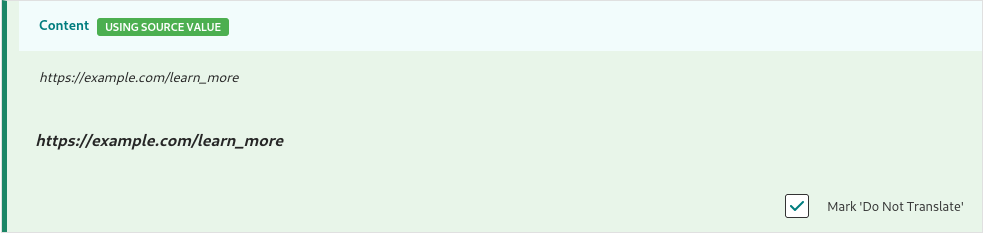
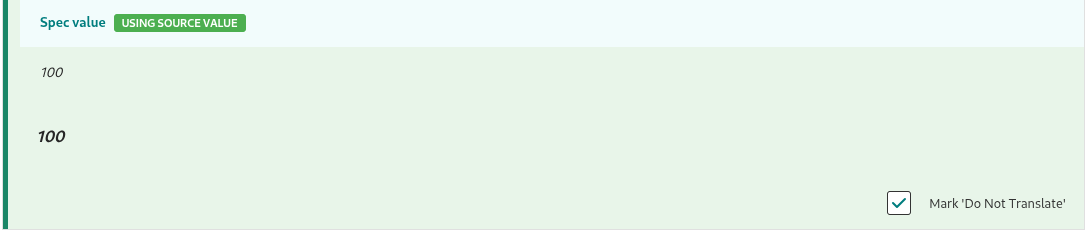
- ✅ Translator Control: Translators decide which fields to not translate
- ✅ Per-Locale Flexibility: One language can translate a value while another language can use the source value
- ✅ Progress Tracking: "Do not translate" segments count as translated by
wagtail-localize - ✅ No Template Changes: Works transparently with existing templates
- ✅ Drop-in Integration: Minimal code changes required
- ✅ UI Included: Adds "Do Not Translate" buttons to translation editor
pip install wagtail-localize-intentional-blanksImportant: wagtail_localize_intentional_blanks must come before wagtail_localize in INSTALLED_APPS for template overrides to work.
# settings.py

INSTALLED_APPS = [
    # ... other apps
    'wagtail_localize_intentional_blanks',  # Must be BEFORE wagtail_localize
    'wagtail_localize',
    'wagtail_localize.locales',
    # ... other apps
]# urls.py
from django.urls import path, include
urlpatterns = [
# ... other patterns
path(
'intentional-blanks/', include('wagtail_localize_intentional_blanks.urls')
),
]That's it! The "Do Not Translate" button will now appear in the translation editor for all translatable fields. No code changes to your blocks or models required.
This library works by:
- Adding UI controls - JavaScript adds "Do Not Translate" checkboxes to the translation editor
- Storing markers - When checked, a marker string (
__DO_NOT_TRANSLATE__) is stored in the translation - Automatic replacement - When rendering pages, a patch intercepts segment retrieval and replaces markers with source values
- Progress tracking - Marked segments count as "translated" for progress calculation
Key benefit: No code changes to your blocks or models. The library handles everything automatically through patching wagtail-localize's internal methods.
- Open a page translation in wagtail-localize's editor
- For each segment, you'll see a "Mark 'Do Not Translate'" checkbox
- Check it to mark that segment as do not translate
- The segment counts as translated (shows green)
- When the page renders, it automatically shows the source value for that field
- If the value in the original page changes, and the translated pages are synced, the segment still counts as translated (shows green) and when the page renders, it shows the updated source value for that field
- Brand names and trademarks - Keep consistent across locales
- Product codes and SKUs - No translation needed
- URLs - Pages may contain the translations for different languages, but a URL is the same for all languages
- IDs - Not language-specific identifiers
You can customize behavior in your Django settings:
# settings.py

# Enable/disable the feature globally
WAGTAIL_LOCALIZE_INTENTIONAL_BLANKS_ENABLED = True

# Custom marker (advanced)
WAGTAIL_LOCALIZE_INTENTIONAL_BLANKS_MARKER = "__DO_NOT_TRANSLATE__"

# Require specific permission (default: None = any translator)
WAGTAIL_LOCALIZE_INTENTIONAL_BLANKS_REQUIRED_PERMISSION = 'cms.can_mark_do_not_translate'You can programmatically mark segments as "do not translate" using the provided utilities:
from wagtail_localize_intentional_blanks.utils import (
    mark_segment_do_not_translate,
    unmark_segment_do_not_translate,
    get_source_fallback_stats,
)
from wagtail_localize.models import Translation, StringSegment

# Mark a segment
translation = Translation.objects.get(id=123)
segment = StringSegment.objects.get(id=456)
mark_segment_do_not_translate(translation, segment, user=request.user)

# Unmark a segment
unmark_segment_do_not_translate(translation, segment)

# Get statistics
stats = get_source_fallback_stats(translation)
print(f"{stats['do_not_translate']} segments marked as do not translate")
print(f"{stats['manually_translated']} segments manually translated")- Python 3.10+
- Django 4.2+
- Wagtail 5.2+
- wagtail-localize 1.8+
In order to make a release, we add a git tag and push it to GitHub. We have a GitHub Action that releases the code to PyPI when we add a new tag.
MIT License - see LICENSE file for details.
Contributions are welcome!
- Clone the repository:
git clone https://github.com/lincolnloop/wagtail-localize-intentional-blanks.git
cd wagtail-localize-intentional-blanks- Install the package with development dependencies:
pip install -e ".[dev]"This installs the package in editable mode along with testing tools (pytest, black, flake8, etc.).
Run the test suite with pytest:
pytestRun tests with coverage:
pytest --cov=wagtail_localize_intentional_blanksRun specific test files:
pytest tests/test_utils.py
pytest tests/test_views.pyCheck code with ruff:
ruff check .Format with ruff:
ruff format .Created by Lincoln Loop, LLC for the Wagtail community.