

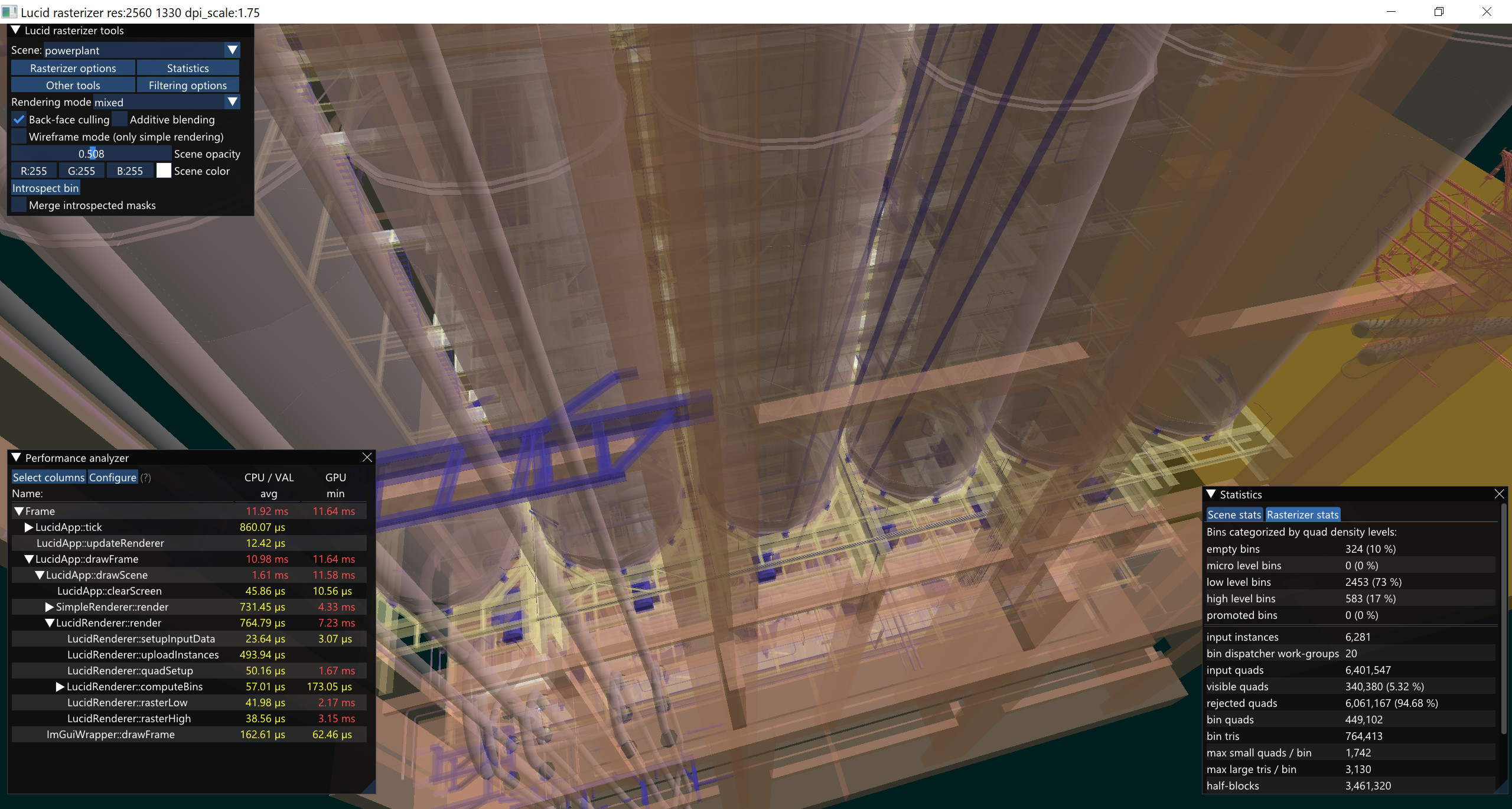
LucidRaster is a software rasterizer running on a GPU which allows for efficient exact rendering of complex transparent scenes. It uses a new two-stage sorting technique and sample accumulation method. On average it's faster than high-quality OIT approximations and only about 3x slower than hardware alpha blending. It can be very efficient especially when rendering scenes with high triangle density or high depth complexity.
Most of LucidRaster's logic is implemented in Vulkan compute shaders, the rest of the code is mainly C++.
Paper
Windows build + scene files
Project page (more details)
Author's Linkedin profile
This work is licensed under a GNU GPL v3 license.
LucidRaster is based on CMake and libfwk framework. Please take a look at libfwk's readme to learn what tools / compilers are required. LucidRaster can be easily built under Windows and Linux by running the following commands:
cd lucid/
git submodule update --init --recursive
libfwk/tools/configure.py download-deps
libfwk/tools/configure.py
cmake --build build --parallel
There are also github workflows available, which build LucidRaster for both platforms (but artifacts are only created for Windows).