
HMO.py is an interactive application that allows users to draw the sigma skeleton of conjugated systems, build the corresponding Hückel matrix, calculate π molecular orbitals, and visualize the numerical results as tables and graphics.
- ✏️ Interactive drawing of the sigma skeleton molecules (adding atoms, bonds and global charges),
- ⚙️ Automatic calculation of π molecular orbitals using the Hückel method,
- ⚛️ Display of molecular orbital coefficients, energies and reactivity descriptors,
- 🔬 Calculation of various descriptors:
- Total π-electron energy,
- HOMO-LUMO gap,
- Electronic potential (μ),
- Chemical hardness (η),
- Chemical softness (S),
- Electrophilicity index (ω),
- 💾 Save/load molecules in
.hmoformat, - 🖨️ Export results to PDF,
- 📈 Export of data to Excel (.xlsx) files,
- 🖼️ Graphical display of the molecule in the results window.
The required dependencies are listed in the pyproject.toml file. If you install the project via pip install hmo, all dependencies will be handled automatically.
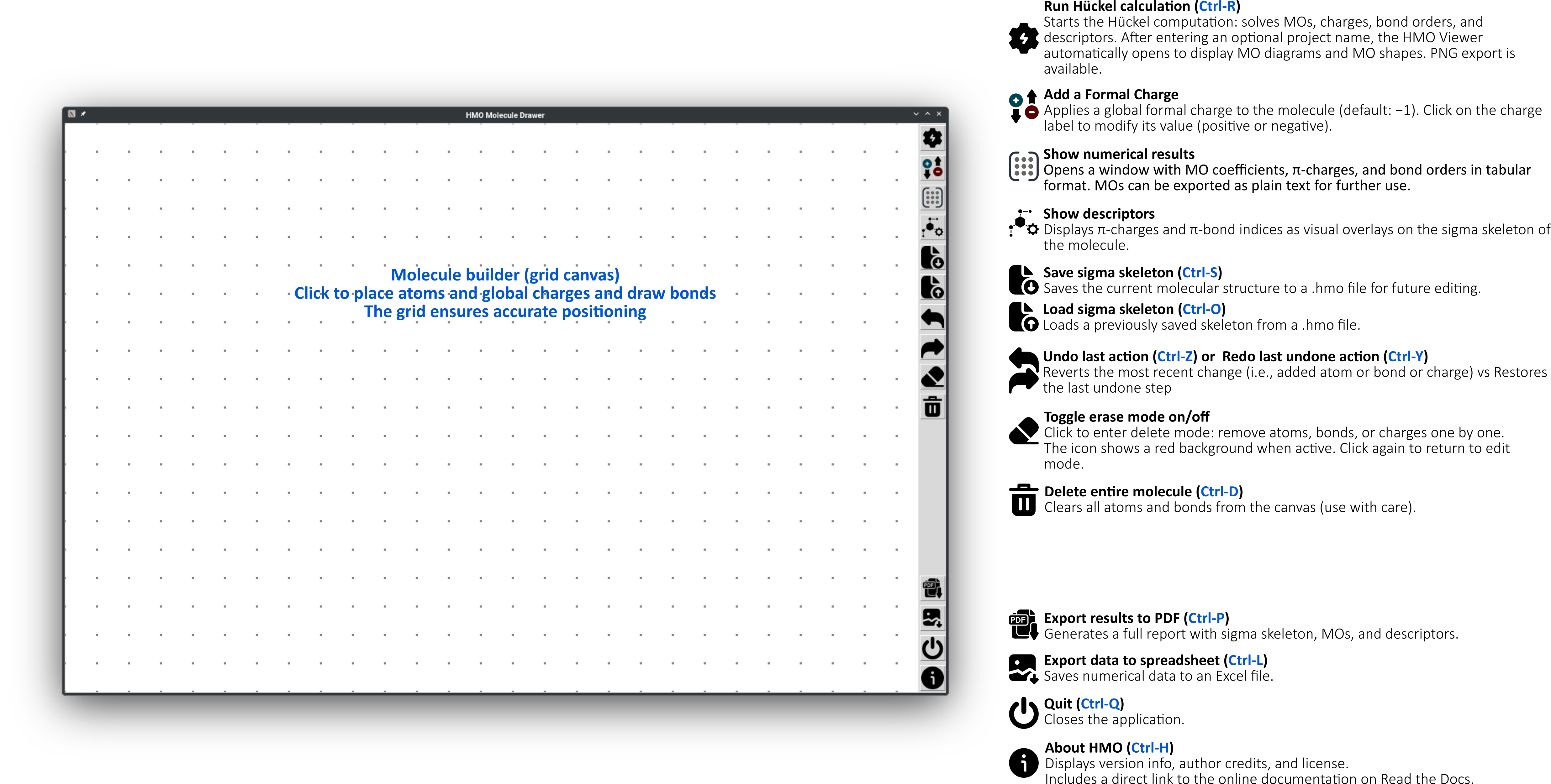
python HMO.py1️⃣ Drawing:
- Click to add atoms on the canvas,
- Click and drag between two atoms to create a bond,
- Delete or modify atoms/bonds as needed.
2️⃣ Run Hückel:
- Once the molecule is built, click the Run Hückel button to perform the calculations.
3️⃣ Results:
- Click Show Numerical Results to open the detailed window:
- Molecule displayed with atom numbering,
- Full table of molecular orbitals and descriptors,
- Scrollbars are available for larger molecules.
4️⃣ Saving:
- Save the molecule using the menu or the dedicated button (in
.hmoformat), - Export Excel results after running the calculation.
- Generate a PDF full report with sigma skeleton, MOs, and descriptors.
A simple text file structured as follows:
Nodes:
C· 330.0 180.0
C· 480.0 210.0
...
Bonds:
0 1
1 2
...
- Each atom:
Type x y - Each bond:
index_atom1 index_atom2
- The method is limited to planar π-conjugated systems,
- Atom names must be recognized by the library (e.g., C·, O:, etc.),
- No graphical export into the Excel file yet (planned for a future version).
- Improved color and style management,
- Support for user-defined Hückel parameters,
- Optional integration of molecule snapshots in the Excel file.
This project was developed by Romuald Poteau (LPCNO, University of Toulouse, CNRS & INSA), with strong contributions of ChatGPT for documentation, the graphical interface, and calculation features.
Thanks to users and testers for their feedback and improvement suggestions.
-
Erich Hückel, Quantentheoretische Beiträge zum Benzolproblem. I. Die Elektronenkonfiguration des Benzols und verwandter Verbindungen (1931), Z. Phys. 70: 204–286. DOI: 10.1007/BF01339530
-
Andrew Streitwieser, Molecular Orbital Theory for Organic Chemists (1961), Wiley International Edition, 4th Edition, Wiley.
-
Robert Burns Woodward & Roald Hoffmann, The Conservation of Orbital Symmetry (1969) Angew. Chem., Int. ed. Eng. 8: 781-853. DOI: 10.1002/anie.196907811
-
Frederic A. Van-Catledge, A Pariser-Parr-Pople-based set of Hückel molecular orbital parameters (1980), J. Org. Chem. 45: 4801–4802. DOI: 10.1021/jo01311a060