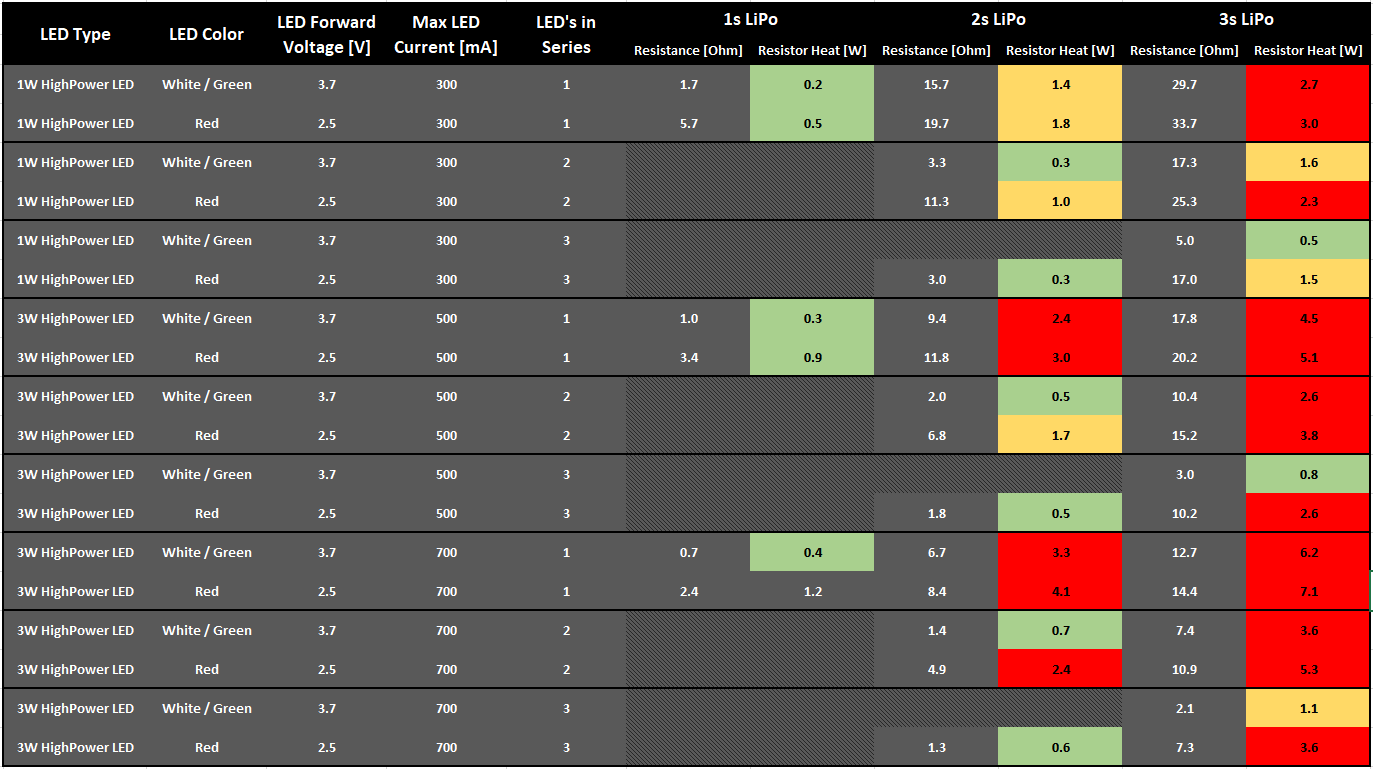
Inline resistor calculation
The inline resistor needs to be connected based on the forward voltage of your LED's, the maximum allowed current, and the battery you connect to the controller. Inline resistors will produce heat, and there are bigger and smaller resistors available accepting more or less heatload. If you are programming your LED outputs to just flash (maybe for beacon lights), you can come away with smaller resistance than theoretically required. You also can use the Channel Dimming setting on your channel, to reduce the maximum voltage the controller will put on your resistor and LED, to reduce the heat generated.
If you connect a fully charged 3s LiPo to the controller, which has 12.4 Volts, and you program your channel dim to 60%, the controller will not put more than 12.4V*60/100 = 7.4V to the output, which further reduces required resistance and generated heat. However, if you connect a 3W high brightness LED and use it as a landing light which is on for long periods of time, make sure your get the resistor right, and make sure you can deal with the heat the resistor generates.
- Attach smaller batteries to the led controller. The closer the battery voltage is to the LED forward voltage of your lights, the smaller the resistance the heat generated. In most cases for high brightness LED's, a 2S LiPo is much better than a 3S LiPo, as the LED will require around 3 Volts only.
- Use the channel dim setting: You can program the maximum voltage individually on each output channel. Even if you program an LED object at the highest brightness setting, the controller will make sure it is not putting out more voltage, than you programmed in the channel dim. Make sure you program this setting BEFORE you connect the battery to the controller.
- Use several LED's in series: If you connect two high brightness LED's having 3V forward voltage each, the "total" LED will have 6V forward voltage, and therefore reduce the required resistor connected to it and generate less heat.
- Uled is the forward voltage in Volt for the LED, normally given in the datasheet or the shop your purchase from
- Iled it the current in Ampere flowing through our LED, it must not exceed what you LED can take, or it will be destroyed
- Uout is the maximum voltage in Volt the controller is putting to the output. If the channel dim is at 100%, this is equal to the voltage of your fully charged battery connected to the controller.
- R is the resistance on Ohm of the inline resistor
- P is the heat in Watt your resistor will generate
R = ( Uout - Uled ) / Iled
P = ( Uout - Uled ) * Iled = R * Iled * Iled
Iled = ( Uout - Uled ) / R