In statistics, the k-nearest neighbors algorithm (k-NN) is a non-parametric classification method developed by Evelyn Fix and Joseph Hodges in 1951 and later expanded by Thomas Cover. Used for classification and regression. In both cases, the input includes training models close to the data set. Output depends on whether k-NN is used for classification or regression:
- In the k-NN classification, the output of the class membership. An item is divided by a majority vote of its neighbors, the item is assigned the most common category among its closest neighbors and k. If
k = 1, then the object is given to the class of that one nearest neighbor. - In k-NN regression, the output is the property value for the object. This value is the average value of
kfor nearby neighbors.
Dataset used for the model is “Fish.csv”. Dataset consists of 159 rows and 7 columns.
The attributes used in dataset are given bellow:
- Species
- Weight
- Length1
- Length2
- Length3
- Height
- Width
Independent attributes in dataset are:
- Length1
- Length2
- Length3
- Height
- Width
Dependent attribute in dataset is:
- Weight
Target attribute in dataset is:
- Weight
We will predict the weight of fish by using other attributes to train the model.
Here is the head of dataset used in the model.
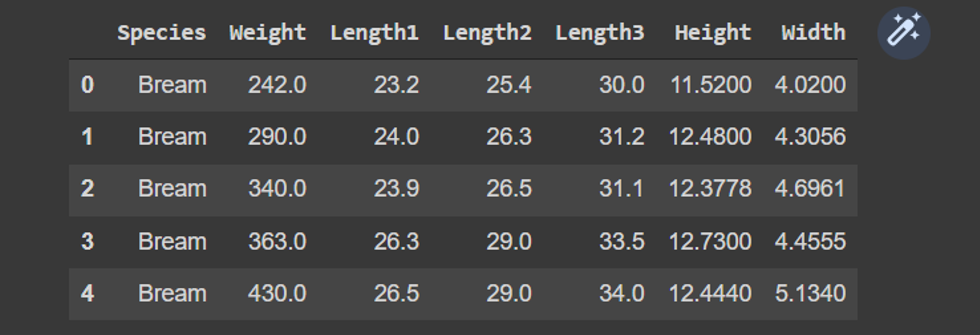
As we don't need Species attribute to predict the weight of fish. So, we will drop Species attribute. The final dataset is given below:

After preprocessing the dataset, we used preprocessed data for model training. For this purpose, we split up the data and select 30% of data for test purposes and 70% of data for model training. We test our model for k up to 20 to get minimum Root Mean Square Error (RMSE). The RMSE for different values of k are given below:
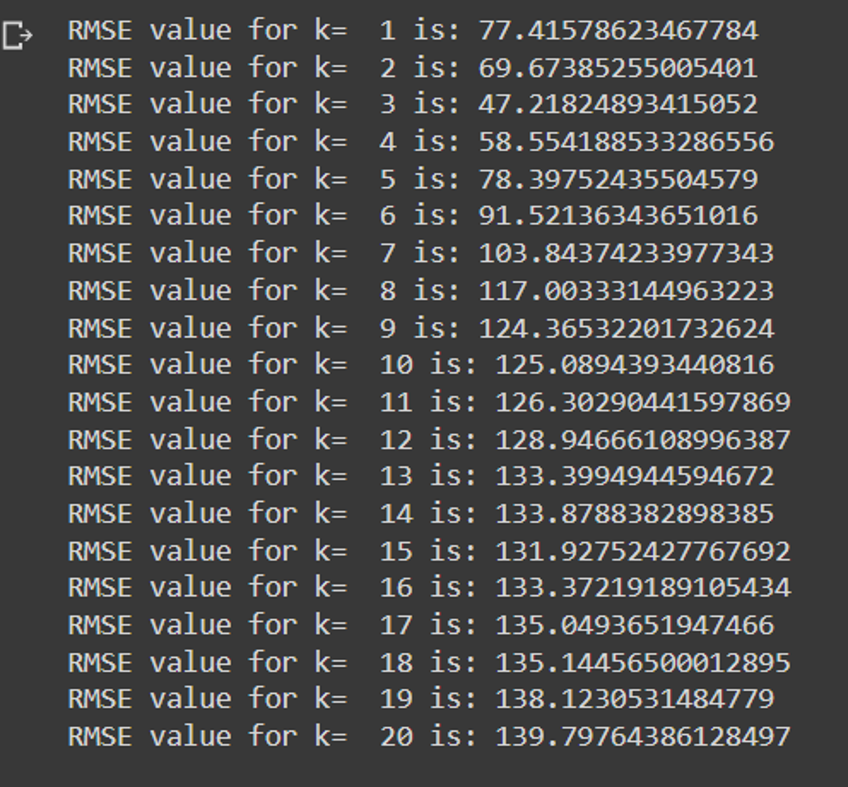
As it is clear from the above figure that RMSE is minimum for k = 3.
RMSE value for k = 3 is: 47.21824893415052
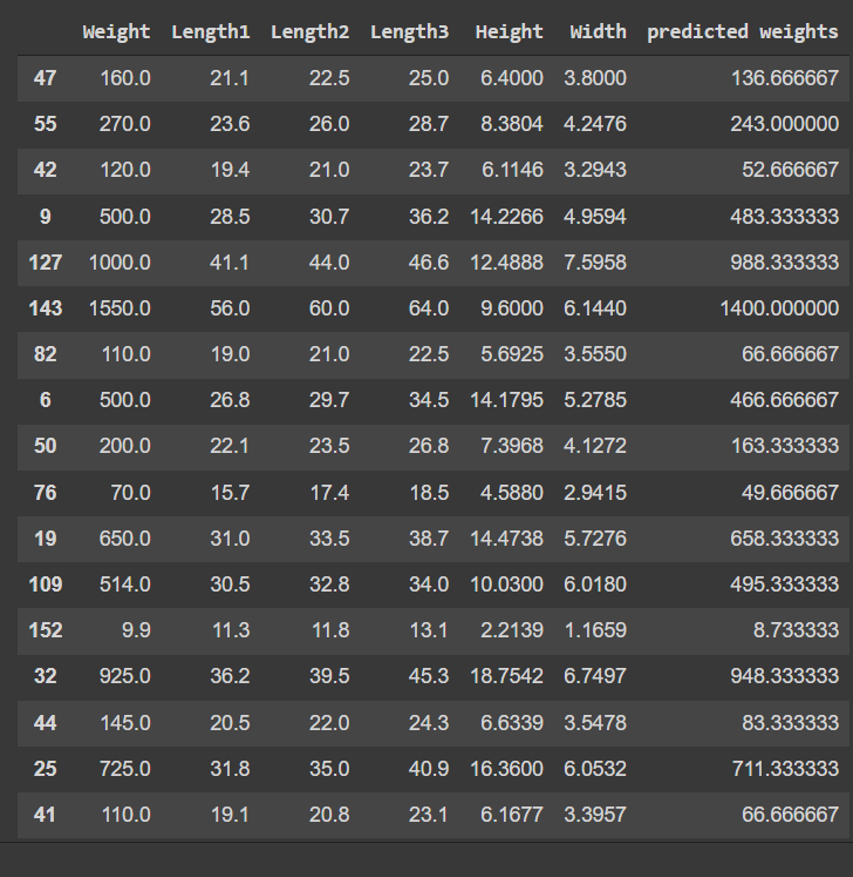
So, we used k = 3 for the prediction of the weight of fishes. As we get minimum RMSE on 3 which is approximately 47. The prediction results are given below:
- Dataset Link: View Fish Dataset
- Download Link: Download Fish Dataset
