etyb.ai · Changelog · Stacks · Install Guide · Architecture




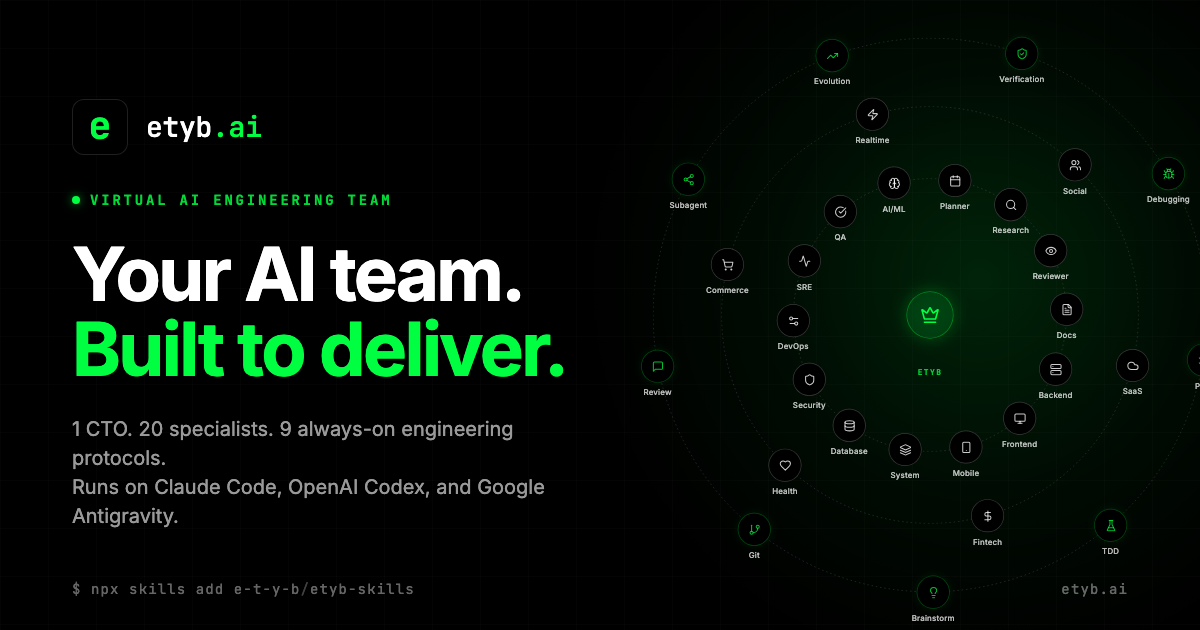
Install a virtual engineering company. One slash command — /etyb — gives your AI agent a CTO, 20 specialists, 9 always-on engineering disciplines, and platform-specific Stack Packs.
v4 collapses what used to be 30 separate skills into one coordinated skill with currency-stamped vendor knowledge living inside the repo at stacks/<vendor>/. The user only ever invokes /etyb. ETYB silently routes the work to the right internal specialist, applies the right protocols, reads the relevant Stack page directly when the work involves a vendor, and signs every response. New: the public changelog is linked under every response — one channel, no slash-command pollution.
# Any agent — Claude Code, Codex, Cursor, Kiro, Trae, Antigravity
npx skills add e-t-y-b/etyb-skills
Or, on Claude Code, install as a native plugin instead:
/plugin marketplace add e-t-y-b/etyb-skills
/plugin install etyb@etyb-skills
Once installed, every request goes through /etyb. Specialist expertise is loaded internally as you need it.
| Platform | Enforcement | What You Get |
|---|---|---|
| Claude Code | Model-trusted today; deterministic hooks + agents ship in v5 M2 | Full /etyb skill via skills CLI or native plugin |
| OpenAI Codex | Model-trusted today; adapter-generated runtime ships in v5 M2 | Full /etyb skill discovered from .agents/skills/ |
| Google Antigravity | Model-trusted | Markdown-first protocols; ADK integration deferred. All gates and disciplines apply via instruction |
- Teams shipping real software — your AI agent works like a disciplined team member, not a solo cowboy
- Engineers tired of AI "yes-and" behavior — agents that skip tests, rubber-stamp reviews, or chase symptoms
- Regulated or high-stakes codebases (fintech, healthcare, e-commerce) — traceable decisions, gated releases, evidence-backed claims
- Solo developers —
/etybis one slash command and works the same regardless of project size
An AI coding agent that works like a 100-person engineering org — through a single trigger:
- Refuses to ship untested code — TDD-first discipline, backed by advisory hooks on the Claude Code plugin path (warn, never block)
- Stops you from building the wrong thing — structured brainstorming before architecture
- Pushes back on bad review feedback — evaluates findings on merit, no performative agreement
- Coordinates parallel work — subagent dispatch with two-stage review and worktree isolation; heavy work runs in sub-agent contexts, model-tiered (cheap models for cheap work, never above your own selected model), so your session stays fast and your context stays clean
- Covers the full SDLC — from research through production operations
- Knows your domain — fintech ledgers, HIPAA compliance, e-commerce patterns, real-time systems
- Speaks your platform — Stack Packs load across all roles when work involves a specific stack. 13 Stacks are live under
stacks/: AWS, GCP, Azure, Salesforce, Anthropic Claude, OpenAI, Cloudflare, Vercel, Supabase, Firebase, Expo, Stripe, Observability - Identifies itself — every Tier 1-4 response ends with
ETYB · <role-engaged>and aWhat's new — etyb.ai/changelogline. One brand, transparent expertise.
USER REQUEST
     │
   /etyb (the only trigger surface — single skill, single brand)
     │
ETYB CTO core ── reads internal references on demand:
     │
     ├── references/specialists/  (14 core engineering team READMEs)
     ├── references/protocols/    (9 always-on engineering disciplines)
     ├── references/verticals/    (6 business-domain architects)
     │
     │  ALWAYS-ON PROTOCOL LAYER (loaded into every response)
     │  ├── TDD — no code without failing test
     │  ├── Verification — evidence before claims
     │  ├── Review — no performative agreement
     │  ├── Plan execution — one task at a time
     │  ├── Brainstorm-first — explore before solving
     │  ├── Branch safety — never merge without green tests
     │  ├── Subagent coordination — parallel dispatch + review
     │  ├── Self-improvement — failing eval before skill changes
     │  └── Debugging — root-cause-first after repeated failures
     │
     │  STACK PACK OVERLAYS (load when platform signals match)
     │  └── 13 vendors — AWS, GCP, Azure, Salesforce, Anthropic, OpenAI,
     │      Cloudflare, Vercel, Supabase, Firebase, Expo, Stripe, o11y
     │
RESPONSE — signed: ETYB · <role-engaged> + changelog link
Three orthogonal axes: specialists (the roles), protocols (the disciplines), Stack Packs (the platforms). All live as internal references under skills/etyb/references/. Adding a new stack adds a folder, not a roster slot — and never a new slash command.
| Reference | Phase | What It Owns |
|---|---|---|
research-analyst |
Discovery | Tech evaluation, competitive analysis, feasibility, requirements |
project-planner |
Planning | Sprint planning, timelines, agile coaching |
system-architect |
Design | System design, domain modeling, API design, data architecture |
frontend-architect |
Design + Dev | React, Angular, Vue, Svelte, SEO, performance, accessibility |
backend-architect |
Design + Dev | Java, TypeScript, Go, Python, Rust, microservices, auth |
database-architect |
Design + Dev | SQL, NoSQL, caching, search, data pipelines, migrations |
mobile-architect |
Design + Dev | React Native, Flutter, iOS, Android, mobile performance |
ai-ml-engineer |
Design + Dev | ML, MLOps, LLMs, data science, AI product integration |
qa-engineer |
Testing | Unit, integration, E2E, performance, API testing, test strategy |
devops-engineer |
Deploy | CI/CD, containers, Kubernetes, AWS/GCP/Azure, IaC, releases |
sre-engineer |
Operations | Monitoring, logging, tracing, incident response, chaos engineering |
security-engineer |
Cross-cutting | AppSec, infra security, IAM, compliance, threat modeling |
technical-writer |
Cross-cutting | API docs, architecture docs, runbooks, user guides |
code-reviewer |
Cross-cutting | Code quality, performance, security, architecture review |
| Reference | Domain |
|---|---|
social-platform-architect |
Feeds, social graphs, content ranking, fan-out, real-time delivery |
e-commerce-architect |
Catalogs, cart/checkout, payments, inventory, order management |
fintech-architect |
Ledgers, payment processing, AML/KYC, PCI/PSD2, fraud detection |
saas-architect |
Multi-tenancy, billing, subscriptions, onboarding, usage metering |
real-time-architect |
WebSockets, CRDTs, collaboration, gaming backends, live streaming |
healthcare-architect |
HIPAA, HL7/FHIR, EHR integration, patient data, audit trails |
| Reference | Always On | Runtime Support |
|---|---|---|
tdd-protocol |
Every code change | Model-trusted; hook script ships in-repo, wiring lands in v5 M2 |
review-protocol |
Every review cycle | Model-trusted; pre-commit check script ships, wiring in v5 M2 |
subagent-protocol |
Parallel work | Platform subagent runtimes (agent definitions ship in v5 M2) |
git-workflow-protocol |
Branch management | Model-trusted; pre-merge check script ships, wiring in v5 M2 |
plan-execution-protocol |
Active plans | Portable .etyb/plans/ artifacts on all platforms |
brainstorm-protocol |
Ambiguous requests | Platform-neutral |
skill-evolution-protocol |
Skill improvements | Platform-neutral |
verification-protocol |
Every completion claim | Model-trusted on all platforms today |
debugging-protocol |
Active troubleshooting | Platform-neutral |
Platform-specific knowledge overlays with knowledge-currency timestamps, authoritative-source URLs, per-product drift-risk ratings, and vendor-skill delegation — when a vendor MCP/skill is installed in your environment, ETYB defers to it rather than answering from baked knowledge. The team doesn't grow — it learns the platform.
| Stack | Last Verified | Coverage |
|---|---|---|
| Salesforce | 2026-05-12 (Spring '26) | Apex, LWC, Flow, Data 360, Agentforce, MCP-native dev, ECA migration, MFA mandate |
| AWS | 2026-05-14 | Lambda + SnapStart, EKS Auto Mode, Aurora DSQL, Bedrock + AgentCore + Strands Agents SDK, Karpenter v1 |
| GCP | 2026-05-14 | Cloud Run gen2, GKE Autopilot, AlloyDB AI, Vertex AI + Gemini, Agent Builder + Agentspace, TPU v7 |
| Azure | 2026-05-14 | AKS Auto/LTS, Container Apps, Cosmos DiskANN, Entra ID, AI Foundry + Foundry Agents, Microsoft Fabric |
| Anthropic Claude | 2026-05-14 | Claude 4.x API, prompt caching, tool use, Claude Agent SDK, MCP authoring, Claude Code patterns |
| OpenAI | 2026-05-14 | GPT-5 family, Responses API, Realtime API, Agents SDK, Structured Outputs, Computer Use |
| Cloudflare | 2026-05-14 | Workers + RPC, Durable Objects (SQLite), D1, R2, Hyperdrive, Vectorize, AI Gateway, AI Search, Workflows |
| Vercel | 2026-05-14 | Next.js + PPR + Cache Components, Fluid Compute, AI SDK, AI Gateway, Vercel Sandbox, Workflow |
| Supabase | 2026-05-14 | Postgres + RLS, Supabase Auth, Edge Functions, Realtime, Storage, pgvector, Supavisor, branching |
| Firebase | 2026-05-14 | Firebase Auth, Firestore + multi-database, App Hosting, Cloud Functions gen 2, Firebase AI Logic, Genkit, Data Connect |
| Expo | 2026-05-14 | Expo SDK + Router, EAS Build/Update/Submit/Workflows/Hosting, New Architecture, CNG, dev clients |
| Stripe | 2026-05-14 | Payment Intents, Checkout, Billing, Connect, Treasury, Issuing, Meter API, Express Checkout, Tax, Radar |
| Observability | 2026-05-14 | multi-vendor: Datadog, New Relic, Grafana stack, Prometheus, Splunk, Honeycomb, Sentry, Dynatrace, OpenTelemetry |
13 Stacks live in this repo under stacks/ with a unified knowledge-currency framework. ETYB reads per-product and per-role pages directly when the install is on disk. Third-party agents without the install can fetch the same content as raw markdown from https://raw.githubusercontent.com/e-t-y-b/etyb-skills/main/stacks/<vendor>/<page>.md. See STACKS.md for the full registry, drift-risk model, and authoring conventions.
Roadmap: Snowflake, Databricks, dbt, Shopify, SAP, ServiceNow, Twilio, Auth0/Okta/Clerk/WorkOS as separate Stacks.
npx skills add e-t-y-b/etyb-skillsThe skills CLI installs the full /etyb skill — 14 specialists + 9 protocols + 6 verticals — into every detected agent's skills directory (Claude Code .claude/skills/, Codex/Antigravity/Trae .agents/skills/, Kiro .kiro/skills/, Cursor .cursor/skills/). Project installs record a skills-lock.json — commit it so your team restores the same skill set with npx skills experimental_install.
/plugin marketplace add e-t-y-b/etyb-skills
/plugin install etyb@etyb-skills
Native plugin install from this repo's .claude-plugin/ manifest. Use the skills CLI or the plugin, not both. See docs/installation.md for per-harness details, verification, and troubleshooting.
Enforcement note: on the Claude Code plugin path, five advisory hooks (
hooks/hooks.json) and five specialist agent definitions (agents/) ship with the install — the hooks surface warnings (no test file before an edit, no review evidence before a commit, merging without green tests) but never block. On skills-CLI installs for other harnesses, ETYB's disciplines are model-trusted — enforced by instruction only.
npx skills updateEvery ETYB response ends with What's new — etyb.ai/changelog so you always have a one-click path to release notes. On the plugin path, update the marketplace and reinstall from the /plugin menu.
Skills use progressive disclosure — a markdown-based RAG pattern:
Layer 0  Runtime guardrails (0 tokens — scripts outside the LLM)
Layer 1  ETYB SKILL.md always loaded (~800 tokens — the culture)
Layer 2  Relevant reference loads on demand (~2,500 tokens — the specialist)
Layer 3  Deep reference loads on demand (~4,000 tokens — single helper file)

Per-activation: ~6,000-10,000 tokens (not the whole library)
Tier 0-1 requests: ~3,500 tokens (ETYB handles directly)
The v4 collapse cuts metadata cost — instead of 30 always-loaded descriptions competing at trigger time, there's one. Internal references are loaded only when ETYB consults them.
| Scenario | Without ETYB | With ETYB |
|---|---|---|
| "Skip tests, demo tomorrow" | Wrote production code immediately | Refused. Named the rationalization. Laid out 4 TDD cycles. |
| "Build restaurant app with React+Firebase" (6 features) | Built entire architecture, 6-week plan, all code | Stopped. Identified 3 red flags. Asked 10 questions. Challenged build-vs-buy. |
| "Handle these 5 review findings" | Agreed with all 5 | Pushed back on 2 with evidence. Caught a mis-severity. Demanded a test before accepting a code change. |
Average token overhead: +53%. What you get: an engineer who says "no" when it matters.
- Website: etyb.ai
- Changelog: etyb.ai/changelog
- Repo: github.com/e-t-y-b/etyb-skills
- Install guide: docs/installation.md
- Architecture: docs/architecture.md
- Issues & contributions: github.com/e-t-y-b/etyb-skills/issues
MIT — see LICENSE.