Exploration
- Estimate the time lag
- Calculate the generalized dimension
- Estimate the acceptable minimum embedding dimension
- Visualization
- Utils
Generate a time series using the embedding dimension D and the time lag L.
Embedding uses the delayed coordinate system shown below.
from hundun import embedding
# ok -> from hundun.exploration import embedding- u_seq
- T
- D
- e_seq
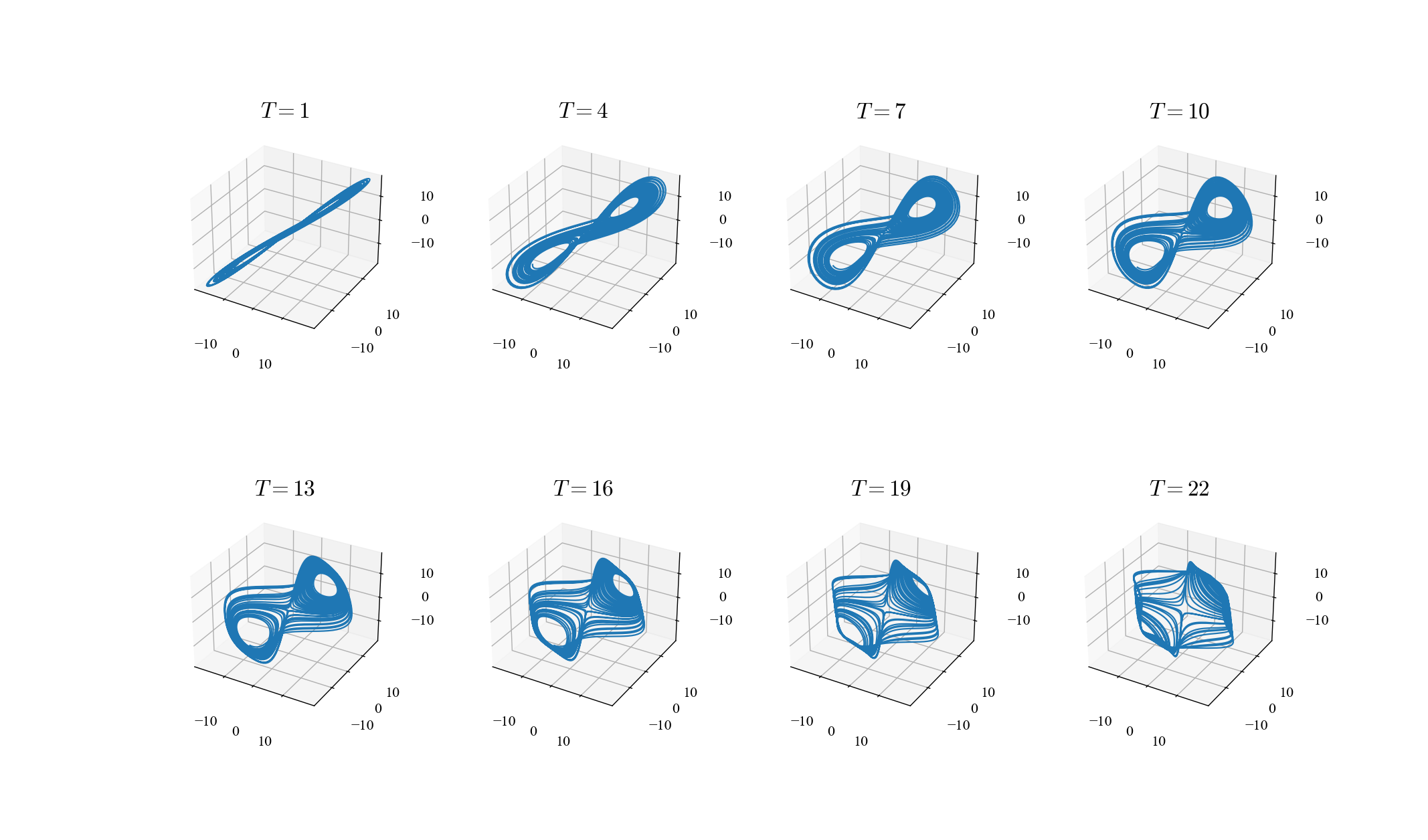
An example is shown using x in the three-dimensional time series (x, y, z) obtained from the Lorenz equation.
Fix it at D=3 and draw while shifting T by 3.
from hundun import Drawing
from hundun.equations import Lorenz
from hundun.exploration import embedding

x_seq = Lorenz.get_u_seq(5000)[:, 0]

d = Drawing(2, v:=4, three=True)
for i in range(8):
    s, T = divmod(i, v), i*3+1
    e_seq = embedding(x_seq, T, 3)  # <- here
    d[s].set_title(f'$T={T}$')
    d[s].plot(e_seq[:, 0], e_seq[:, 1], e_seq[:, 2])
d.show()
Calculate the autocorrelation function from the time series data.
The autocovariance function is calculated from the following formula.
The autocorrelation function is estimated as follows.
from hundun.exploration import acf- u_seq
- tau
- rho_seq_list:
List[numpy.ndarray]

Calculate the time series with Barrett's formula.
Calculate using the standard deviation quantile
in
.
from hundun.exploration import bartlett- seq
- alpha=0.95
- B:
numpy.ndarray
Calculate mutual information by creating a histogram.
Calculate from the following formula using information entropy.
from hundun.exploration import bartlett- u_seq
- tau
- mi_seq:
numpy.ndarray