Features Spatial Spatial Trees 3d Guide
This approachable guide shows when to use OctTree3D, KdTree3D, and RTree3D, with quick code you can copy.
- Answer “What’s near X?” or “What’s inside this volume?” in 3D without scanning everything.
- Organize your data so queries touch only relevant spatial buckets.
- Big speedups for range, bounds, and nearest‑neighbor queries.
Quick picks
- General 3D queries (broad‑phase, good locality): OctTree3D
- Nearest neighbors on static points: KdTree3D (Balanced)
- Fast builds with good‑enough point queries: KdTree3D (Unbalanced)
- Objects with size (3D bounds), intersect/contain queries: RTree3D
Points (OctTree3D / KdTree3D)
using WallstopStudios.UnityHelpers.Core.DataStructure;
using UnityEngine;
using System.Collections.Generic;

struct VfxPoint { public Vector3 pos; public int id; }

var points = new List<VfxPoint>(/* fill with positions */);

// Build trees from points
var oct = new OctTree3D<VfxPoint>(points, p => p.pos);
var kd  = new KdTree3D<VfxPoint>(points, p => p.pos); // balanced by default

// Range query (sphere)
var inRange = new List<VfxPoint>();
oct.GetElementsInRange(playerPos, 12f, inRange);

// Bounds (box) query
var inBox = new List<VfxPoint>();
kd.GetElementsInBounds(new Bounds(center, size), inBox);

// Approximate nearest neighbors
var neighbors = new List<VfxPoint>();
kd.GetApproximateNearestNeighbors(playerPos, count: 12, neighbors);
Sized objects (RTree3D)
using WallstopStudios.UnityHelpers.Core.DataStructure;
using UnityEngine;
using System.Collections.Generic;

struct Volume { public Bounds bounds; public int kind; }

var volumes = new List<Volume>(/* fill with bounds */);

// Build from 3D bounds (AABBs)
var rtree = new RTree3D<Volume>(volumes, v => v.bounds);

// Bounds query (fast for large volumes)
var hits = new List<Volume>();
rtree.GetElementsInBounds(worldBounds, hits);

// Range query (treats items by their bounds)
var near = new List<Volume>();
rtree.GetElementsInRange(center, radius, near);
Notes
- These trees are immutable: rebuild when positions/bounds change significantly.
- For lots of moving points, consider
SpatialHash3Dfor broad‑phase neighborhood queries. - See Spatial Tree Semantics for boundary behavior and edge cases.
All 3D spatial trees support the same zero-allocation query pattern as their 2D counterparts. Pass a reusable buffer to avoid GC allocations:
// Reusable buffer (declare once)
private List<VfxPoint> nearbyBuffer = new(128);

void Update()
{
    nearbyBuffer.Clear();

    // 🟢 GOOD: Reuses same List = zero allocations
    tree.GetElementsInRange(playerPos, 15f, nearbyBuffer);

    foreach (VfxPoint p in nearbyBuffer)
    {
        p.UpdateEffect();
    }
}
All 3D spatial trees support buffered queries:
OctTree3D.GetElementsInRange(pos, radius, buffer)KdTree3D.GetElementsInBounds(bounds, buffer)RTree3D.GetElementsInRange(pos, radius, buffer)
📖 For the complete buffering guide including pooled buffers and GC impact analysis, see:
- Zero-Allocation Queries (2D Guide) — detailed examples
- Buffering Pattern — project-wide pooling utilities
- Partition: Recursively splits space into eight octants.
- Use for: General 3D partitioning, broad‑phase, visibility culling, spatial audio.
- Pros: Good spatial locality; intuitive partitioning; balanced performance.
- Cons: Nearest neighbors slower than KDTree on pure point data.

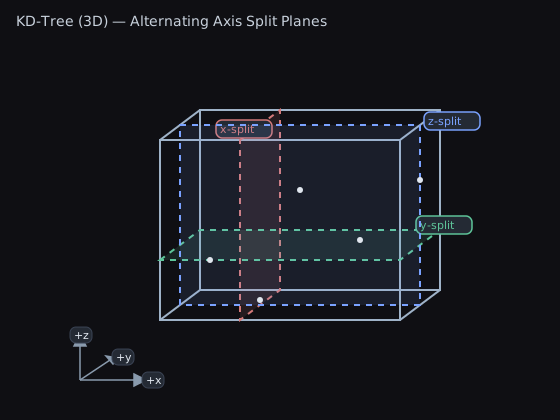
- Partition: Alternating axis‑aligned splits (x/y/z), often median‑balanced.
- Use for: Nearest neighbor, k‑NN, range queries on points.
- Pros: Strong NN performance; balanced variant gives consistent query time.
- Cons: Costly to maintain under heavy churn; unbalanced variant can degrade.
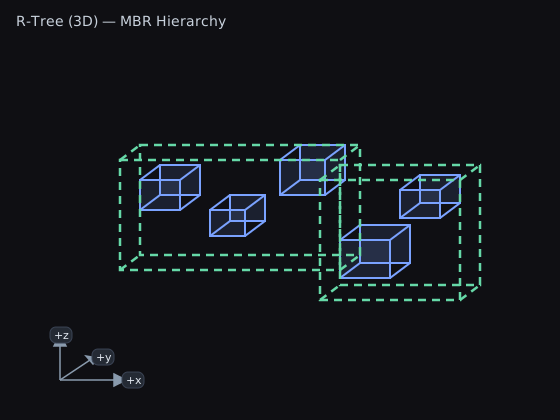
- Partition: Groups items by minimum bounding boxes with hierarchical bounding.
- Use for: Items with size (3D AABBs): volumes, colliders; bounds intersection.
- Pros: Great for large bounds queries; matches volumetric semantics.
- Cons: Overlapping boxes can increase node visits; not optimal for point NN.
- Many moving points, frequent rebuilds: OctTree3D or SpatialHash3D
- Nearest neighbors on static points: KDTree3D (Balanced)
- Fast builds with good‑enough point queries: KDTree3D (Unbalanced)
- Objects with volume; bounds queries primary: RTree3D
- Points vs. Bounds: KDTree3D/OctTree3D are point‑based; RTree3D is bounds‑based.
- Boundary inclusion: 3D variants can differ at exact boundaries. Normalize to half‑open or add small epsilons.
- For details and performance data, see: